
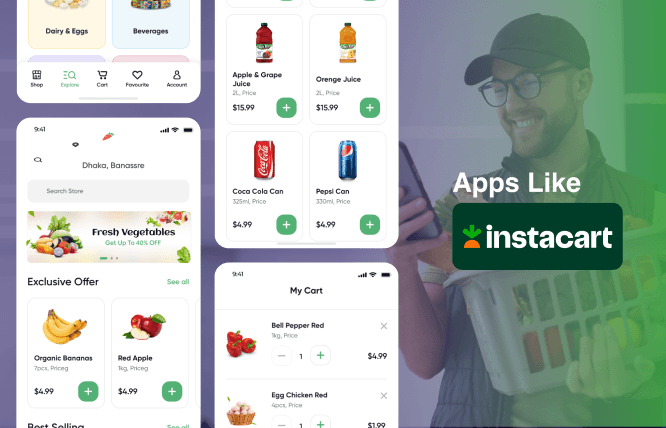
Consumers are leaning towards online grocery shopping because of the convenience it offers. One of the most popular choices for this is Instacart, but there are several alternatives, offering convenient grocery shopping. out there. This blog will talk about all the apps like Instacart and their pros and cons.
Online purchasing is growing in popularity and consumers prefer the convenience of ordering their groceries online. Just to give you an idea of the sheer size of the market, the online grocery shopping market is set to reach $2,158.53 billion by 2030. This is a huge opportunity for businesses as surveys have shown that 87% of customers use their mobile phones for grocery shopping.
One of the most popular apps for grocery shopping is Instacart, but there are various other apps like Instacart that you might not have come across yet. In this article, we will be discussing apps like Instacart that you can use to order your groceries.
Top 6 Apps Like Instacart
The online grocery market has seen significant growth, driven by the convenience and efficiency that digital solutions provide. Let’s explore various applications in the online grocery space and compare them to Instacart, a leading service in this sector.
1. goPuff
goPuff delivers everyday essentials, including groceries, snacks, and household items, directly to customers’ doors. Operating a network of micro-fulfilment centres, goPuff ensures quick delivery times and product availability around the clock, making it a convenient choice for many.
| Pros | Cons |
|
Quick delivery times |
Limited product range compared to traditional grocery stores |
|
24/7 availability in many locations |
Service areas are limited to major cities |
|
Own fulfilment centres ensure product availability |
Delivery fees apply |
2. Shipt
Shipt partners with local grocery stores to offer a wide range of products delivered straight to customers’ homes. By supporting local businesses, Shipt provides a diverse selection of groceries while maintaining competitive pricing and fostering community engagement.
| Pros | Cons |
|
Wide range of products from local stores |
Delivery times depend on partner store availability |
|
Supports local businesses |
Limited to areas where partner stores are available |
|
Competitive pricing |
Delivery fees and service charges may apply |
3. Rappi
Rappi, a versatile multi-service app, includes grocery delivery among its offerings, catering primarily to Latin American markets. With its fast delivery times and extensive service range beyond just groceries, Rappi is a popular choice for those big on convenience when it comes to grocery shopping.
| Pros | Cons |
|
Wide range of services beyond groceries |
Service quality varies by region |
|
Available in multiple countries in Latin America |
Delivery fees can be high |
|
Fast delivery times |
Limited availability in rural areas |
4. FreshDirect
FreshDirect specialises in delivering fresh groceries, including organic produce, meats, and prepared meals, from its own facilities. Known for its high-quality products and customisable delivery slots, FreshDirect serves customers looking for premium groceries and convenience in the Northeastern US.
| Pros | Cons |
|
High-quality, fresh produce and meats |
Service limited to specific regions (primarily Northeastern US) |
|
Option for meal kits and prepared foods |
Higher prices for premium products |
|
Customisable delivery slots |
Delivery fees and minimum order requirements |
5. Burpy
Burpy collaborates with major grocery chains to provide same-day delivery services, offering a broad selection of grocery items. By leveraging partnerships with established retailers, Burpy ensures access to a wide range of products while delivering them swiftly to customers.
| Pros | Cons |
|
Partners with major grocery chains |
Delivery depends on stores’ operating hours |
|
Same-day delivery options |
Service areas limited to certain cities |
|
Broad product selection |
Delivery fees and potential service charges |
6. OurHarvest
OurHarvest connects customers with local farmers and producers, offering fresh, locally sourced groceries. With a focus on sustainability and supporting local agriculture, OurHarvest provides high-quality produce and meats, appealing to consumers who prioritise ethical sourcing.
| Pros | Cons |
|
Supports local farmers and producers |
Limited to areas with participating farmers |
|
Fresh, high-quality produce and meats |
Smaller product range compared to larger grocery stores |
|
Sustainable and ethical sourcing |
Delivery fees and minimum order requirements |
Off-the-Shelf Application vs Custom Applications
When choosing an online platform for a grocery store, businesses have two primary options: off-the-shelf applications and custom applications with the help of an app development company. Both have their unique advantages and drawbacks, and the best choice depends on the specific needs and goals of the business.
Off-the-Shelf Applications
Off-the-shelf applications are pre-built solutions that are readily available for purchase or subscription. These platforms are designed to cater to a wide range of businesses and come with a variety of features and functionalities.
Pros:
- Cost-Effective: Off-the-shelf applications typically have lower upfront costs compared to custom-built solutions. They are designed to be affordable and accessible for small to medium-sized businesses.
- Quick Deployment: Since these applications are pre-built, they can be deployed quickly, allowing businesses to start their online operations without significant delays.
- Established Reliability: These applications have been tested and used by many businesses, ensuring reliability and stability. Any bugs or issues are generally resolved by the provider.
- Ongoing Support & Updates: Off-the-shelf solutions often come with ongoing support and regular updates from the provider, ensuring the platform remains up to date with the latest features and security measures.
Cons:
- Limited Customisation: These applications offer limited customisation options, which may not meet the unique needs of all businesses. Customisation is often restricted to what the provider offers.
- Generic Features: Off-the-shelf solutions are designed to serve a broad market, so the features may be too generic and not tailored to specific business requirements.
- Scalability Issues: As the business grows, the scalability of off-the-shelf applications may become a concern. These platforms may not handle increased traffic and larger product catalogs efficiently.
Custom Applications
Custom applications, which include hybrid mobile app development, are bespoke solutions built specifically for a business’s unique requirements. These platforms are designed from the ground up to align with the business’s goals, processes, and branding.
Pros:
- Tailored to Business Needs: Custom applications are built to meet the needs of the business, ensuring that all features and functionalities align with business processes and objectives.
- High Flexibility and Scalability: These solutions offer high flexibility and scalability, allowing businesses to adapt and expand their platform as they grow.
- Unique User Experience: Custom applications provide a unique and branded user experience, which can enhance customer satisfaction and loyalty.
- Competitive Advantage: A bespoke platform can offer unique features that set the business apart from competitors, providing a significant competitive advantage.
Cons:
- Higher Initial Costs: Developing a custom application requires a significant investment upfront, which may not be feasible for all businesses, especially startups.
- Longer Development Time: Building a custom solution takes time, from planning and development to testing and deployment, leading to longer project timelines.
- Maintenance and Updates: The business is responsible for maintaining the custom application and implementing updates, which can be resource-intensive and require ongoing technical support.
Comparison Table:
| Aspect | Off-the-Shelf Applications | Custom Applications |
| Cost |
Lower upfront costs |
Higher initial investment |
| Deployment Time |
Quick deployment |
Longer development time |
| Customisation |
Limited customisation options |
High flexibility and tailored features |
| Features |
Generic features |
Features tailored to business needs |
| Scalability |
May face scalability issues |
Easily scalable as the business grows |
| User Experience |
Standard user experience |
Unique and branded user experience |
| Support & Updates |
Ongoing support and updates from the provider |
Business responsible for maintenance and updates |
| Competitive Advantage |
Limited |
Provides unique features and advantages |
Choosing between off-the-shelf and custom applications for an online grocery store depends on the business’s specific needs, budget, and long-term goals. While off-the-shelf solutions offer quick and cost-effective deployment, custom applications provide flexibility, scalability, and a tailored experience that can significantly benefit the business in the long run.
Conclusion
As more customers look for convenience and ease, online grocery stores are set to grow at an exponential pace. As a consumer, you have several apps like Instacart that can be used to cater to your grocery needs. As a business trying to expand its avenues into the digital field, a great alternative is getting a custom application developed.
If you aren’t sure about how to start the application developed, Codeeo has got you covered. Contact us today and get a free consultation.