 Digital TransformationReplatforming From Drupal, AEM or .NET Without DowntimeWebsite replatforming from Drupal, AEM or .NET without downtime: choose the target platform, run delta content syncs, plan the cutover and test your rollback.
CodeeoInsightsDigital Transformation
Digital Transformation in Finance: Technologies, Benefits, Risks
How digital transformation in finance works: the technologies reshaping banking and payments, the benefits they bring, the risks to manage, and how to start.
Digital transformation in finance is the move from paper, branches and manual back office work to software, data and automation across banking, lending, payments, insurance and corporate finance. It is reshaping the industry by making services faster and available on mobile, cutting the cost of routine processing, and improving how institutions detect fraud and manage risk. The firms that benefit most treat it as a change to processes and products, not just a new app.
Below are the technologies driving that change, the benefits they deliver, the risks to manage, and a practical way for a financial business to plan its next steps.
The technologies reshaping financial services
1. Artificial intelligence and machine learning
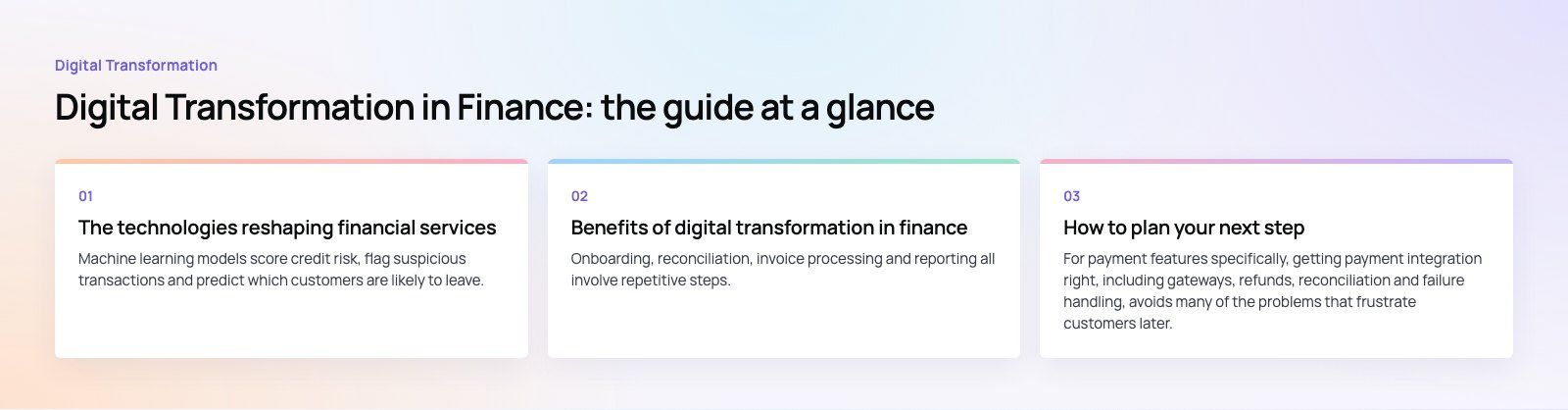
Machine learning models score credit risk, flag suspicious transactions and predict which customers are likely to leave. Language models now summarize documents, draft responses for support teams and help analysts search policy and research. In finance, these tools work best with a person reviewing consequential decisions, because regulators expect lending and fraud decisions to be explainable.
2. Cloud computing
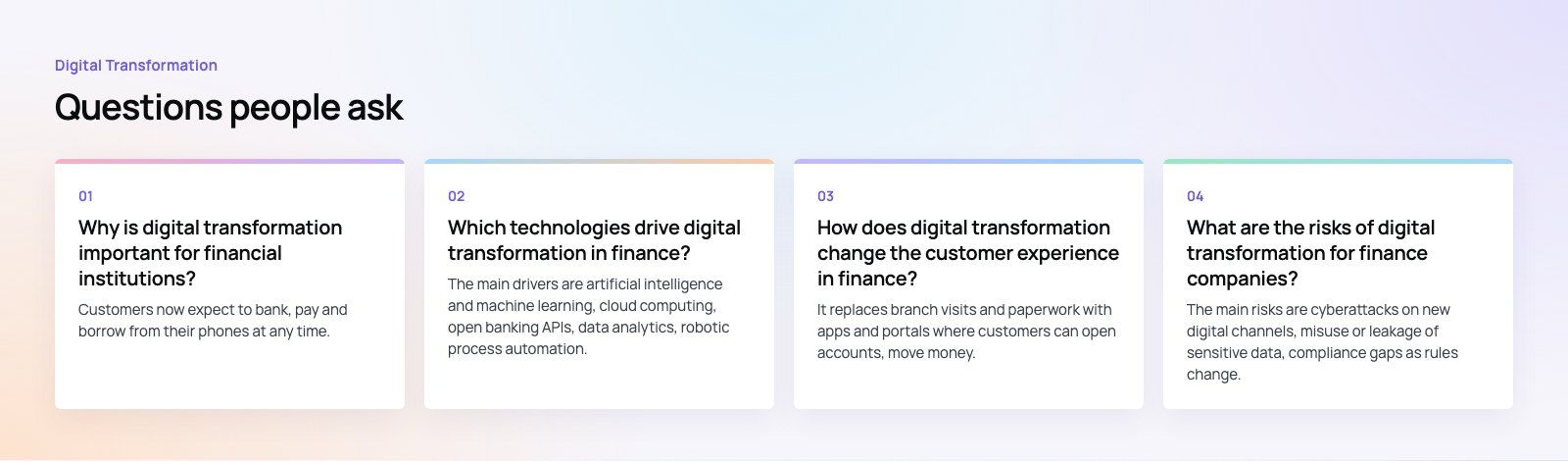
Banks and fintechs are moving core workloads, data platforms and customer channels to the cloud for flexibility and faster releases. Cloud also simplifies disaster recovery and makes analytics and AI services easier to use. The main constraints are data residency rules, outsourcing regulations and the need for strong access control.
3. Open banking and APIs
Open banking lets customers share their financial data securely with approved third parties through APIs. That makes products such as account aggregation, faster onboarding and pay by bank possible. The UK's Open Banking program is one of the best known models, and many countries now have their own frameworks. For any financial product, a clean API layer is becoming as important as the customer app.
4. Digital only banking and embedded finance
Digital only banks serve customers entirely through apps, with no branch network. Traditional banks have responded with digital first strategies of their own. At the same time, embedded finance puts payments, lending and insurance directly inside non financial products, such as buy now pay later at checkout or payments inside a marketplace app.
5. Robotic process automation
RPA bots handle repetitive, rules based tasks such as moving data between systems, reconciling statements and preparing standard reports. RPA is a useful bridge for legacy systems without APIs, although direct integrations are usually more reliable over time.
6. Data and analytics
Financial institutions hold large amounts of transaction and customer data. Analytics turns it into dashboards for finance teams, risk models for credit and personalized offers for customers. Reporting tools such as Power BI help finance teams see performance daily instead of waiting for month end packs.
7. Blockchain and tokenization
Distributed ledgers are being tested and used for cross border payments, trade finance and tokenized assets. Adoption is real but uneven. For most businesses, the practical question is whether a ledger solves a specific trust or settlement problem better than a conventional database.
8. Cybersecurity and identity
As more money moves through apps and APIs, security becomes a product feature. Biometric login, device binding, encryption, tokenized card data and AI based threat detection are now standard expectations in serious financial products.
9. Regulatory technology
RegTech automates compliance work: identity verification, Know Your Customer checks, sanctions screening, transaction monitoring and regulatory reporting. Anti money laundering programs follow standards set by bodies such as the Financial Action Task Force, and software makes it possible to apply them consistently at scale.
Comparing the main technologies
| Technology | Main benefit | Main risk or constraint |
|---|---|---|
| AI and machine learning | Faster, more accurate risk and fraud decisions | Bias, explainability and model drift |
| Cloud | Speed, scalability, easier analytics | Data residency, outsourcing rules, configuration errors |
| Open banking APIs | New products and partnerships | Consent management and API security |
| RPA | Quick automation of legacy processes | Fragile when screens or formats change |
| Analytics | Better visibility and personalization | Data quality and privacy |
| RegTech | Consistent, auditable compliance | Integration effort and false positives |
Benefits of digital transformation in finance
Efficiency through automation
Onboarding, reconciliation, invoice processing and reporting all involve repetitive steps. Automating them reduces errors, shortens processing times and frees staff for advice, analysis and exceptions.
Better customer experience
Customers expect to open an account, move money, apply for credit and get support from their phone, at any hour. Well designed apps and self service portals meet that expectation and reduce load on call centers.
Stronger security and risk management
Real time monitoring catches fraud as it happens rather than after the fact. Combining behavioral data, device signals and transaction patterns gives a fuller picture of risk than rules alone.
Faster innovation
Modern architectures with APIs and cloud services let teams launch features and partner integrations in weeks instead of quarters. That matters in a market where fintechs compete on speed.
Lower operating cost
Fewer manual steps, less paper, smaller physical footprints and retired legacy systems all reduce running costs over time. The savings depend on actually switching old processes off, not running them alongside the new ones indefinitely.
Better compliance
Automated checks and audit trails make it easier to show regulators what happened and why. Consistent rules applied by software are easier to defend than manual processes that vary by person.
Data driven decisions
Finance leaders can track liquidity, margins and risk on live dashboards and test scenarios quickly, rather than relying on spreadsheets assembled by hand.
Financial inclusion
Mobile banking, digital wallets and simpler onboarding bring people without easy branch access into the financial system, especially where smartphones are more common than bank branches.
Risks to manage
- Cybersecurity. More channels mean more attack surface. Security reviews, penetration testing and monitoring must be part of every release.
- Privacy. Financial data is highly sensitive and tightly regulated. Collect only what you need and control who can access it.
- Legacy integration. Core banking and ERP systems are often decades old. Poorly planned integrations cause outages and data mismatches.
- Regulatory change. Rules on AI, data, outsourcing and crypto assets keep evolving. Build for change rather than one fixed rulebook.
- Operational disruption. Migrations should run in phases, with rollback plans and parallel testing before cutover.
How to plan your next step
- Start from a customer or operational pain point, such as slow onboarding, manual reconciliation or high fraud losses.
- Map the systems and data involved and identify where integrations are missing.
- Check regulatory requirements early, including licensing, data residency and outsourcing rules.
- Deliver in phases, starting with a contained product or process, and measure the result.
- Build an API layer so future products, partners and channels can reuse the same services.
For payment features specifically, getting payment integration right, including gateways, refunds, reconciliation and failure handling, avoids many of the problems that frustrate customers later.
Codeeo has delivered 200+ projects across the UAE and the US, with a team of 80+ across Dubai, Riyadh and Karachi. Our Purpose Payment case study shows a payments app where every purchase sends a share to the customer's chosen charity and earns reward points, with an app, portals and API. Explore our work for fintech companies, or talk to our custom software development team about your own product.
Frequently asked questions
Customers now expect to bank, pay and borrow from their phones at any time, and fintechs compete on speed and convenience.
Digital transformation lets institutions meet those expectations, cut the cost of manual processing, detect fraud faster and report to regulators more reliably. Institutions that delay tend to carry higher costs and slower product cycles than competitors built on modern systems.
Digital TransformationReplatforming From Drupal, AEM or .NET Without DowntimeWebsite replatforming from Drupal, AEM or .NET without downtime: choose the target platform, run delta content syncs, plan the cutover and test your rollback. Digital TransformationWhat a Good Enterprise Website SLA ContainsWhat a website maintenance SLA should contain, clause by clause: scope, severity tiers, response and resolution times, uptime, reporting, remedies and exit.
 Digital TransformationTreating Your Website as a Production System: The Case for an SLAWhy a business critical website needs an SLA: hypothetical incident costs, what changes with agreed response times, and how to make the case for support.
Tell us what the business needs. We will tell you what to build first.
Schedule a free consultation and get a written recommendation, with costs, before you commit to anything.
Get in touchPROVEN RESULTS
4.7 / 5verified reviews on Google