 E-CommerceGenerative AI in Online Retail: Uses That Pay BackGenerative AI ecommerce uses ranked by payback and risk: product descriptions, AI search and support assistants, plus Arabic quality checks for UAE stores.
Ecwid vs WooCommerce: Which Ecommerce Platform Fits Your Store?
Ecwid vs WooCommerce compared on cost structure, features, ease of use, support, SEO and scalability, with a simple checklist to pick the right one.
Ecwid is a hosted store you can drop into almost any existing website or social page, with hosting, security and updates handled for you. WooCommerce is a free, open source plugin that turns a WordPress site into a fully controllable store, but you manage hosting, extensions and maintenance yourself. Pick Ecwid for a quick, low maintenance store attached to a site you already have; pick WooCommerce when you need deep customization, content led SEO and room to grow.
Both platforms sell real products for real businesses, so the decision is less about which is better and more about which fits your team, catalog and plans. This comparison walks through cost structure, features, ease of use, support, integrations and scalability, then gives a simple way to decide.
Ecwid vs WooCommerce at a glance
| Factor | WooCommerce | Ecwid |
|---|---|---|
| Type | Open source plugin for WordPress, self hosted | Hosted ecommerce platform, now part of Lightspeed |
| Where it runs | On your WordPress site and your hosting | Embedded in an existing site, a social page or its own Instant Site |
| Cost model | Free plugin; you pay for hosting, extensions, themes and upkeep | Monthly or annual subscription by plan tier |
| Ease of setup | Needs WordPress knowledge or a developer | Quick setup with little technical skill |
| Customization | Near unlimited through code, themes and plugins | Good within the platform, limited beyond it |
| SEO and content | Full WordPress content and SEO tooling | Solid basics, less control over structure |
| Hosting and security | Your responsibility, through your host | Included and managed by Ecwid |
| Support | Documentation, forums, your developer or host | Knowledge base, plus chat or phone on higher plans |
| Best for | Growing stores that want control | Small stores adding commerce to an existing presence |
What is WooCommerce?
WooCommerce is the ecommerce plugin for WordPress. Install it on a WordPress site and you get products, variations, cart, checkout, orders, tax and shipping settings, and an ecosystem of extensions for payments, subscriptions, bookings, memberships and more. Because it is open source and self hosted, you own the code and the data, and any developer who knows WordPress can extend it.
The trade off is responsibility. You choose and pay for hosting, keep WordPress, WooCommerce and plugins updated, manage backups and security, and fix conflicts when two extensions disagree.
What is Ecwid?
Ecwid, now part of Lightspeed, is a hosted store builder designed to be embedded. You add your store to an existing WordPress, Wix or custom website with a plugin or a snippet, sell on social channels and marketplaces from the same catalog, or use Ecwid's own Instant Site if you have no website. Hosting, PCI compliant checkout, SSL and platform updates are handled by Ecwid.
The trade off is control. You work within the features and design options the platform offers, and moving away later means exporting data and rebuilding the storefront.
Detailed comparison
Cost structure
WooCommerce itself costs nothing to install, but a real store is never free. Hosting, a domain, a quality theme, paid extensions for things like subscriptions or advanced shipping, and developer time for setup and maintenance all add up. The total depends heavily on how much the store needs to do.
Ecwid charges a subscription by plan, and the plan sets limits such as the number of products and which features are included. As of October 2026, the Ecwid pricing page lists four plans, Starter, Venture, Business and Unlimited, and no longer shows a free plan. Older comparisons that recommend Ecwid's free tier are out of date. Hosting and security are included, which makes the running cost easier to predict.
In short: Ecwid is more predictable, WooCommerce is more variable. For a small catalog with simple needs, Ecwid often costs less effort overall. For a complex store, WooCommerce can be more economical because you only pay for the extensions and development you actually need.
Features
WooCommerce covers almost any requirement through its extension ecosystem and custom code: complex product options, B2B pricing, subscriptions, bookings, multi warehouse stock, custom checkout fields and integrations with ERP or CRM systems. If a feature does not exist, a developer can build it.
Ecwid covers the core of selling well: product variations, discounts, abandoned cart emails, tax calculation, multiple payment providers and multichannel selling across social and marketplace channels. Advanced or unusual requirements are harder, since you rely on the app market and the platform's API.
Ease of use
Ecwid wins here. A non technical owner can create an account, add products, connect payments and embed the store in an afternoon. The dashboard is focused and the same on every plan.
WooCommerce has a steeper learning curve because it sits inside WordPress. Store owners who already run WordPress adapt quickly; those who do not usually need help with setup, theme choice and the first round of configuration.
Support
WooCommerce support comes from extensive documentation, community forums, extension vendors for their own products, your hosting company and your developer. Quality varies with who you rely on.
Ecwid support is centralized. According to its pricing page, live chat is included from the Venture plan upward and phone callbacks on the Business and Unlimited plans, alongside a knowledge base. Check which channels your chosen plan includes before you commit.
Integrations
WooCommerce benefits from the whole WordPress ecosystem: thousands of plugins plus the ability to connect any system with an API. That makes it a strong fit for stores that need to talk to accounting, ERP, CRM or warehouse tools.
Ecwid integrates with popular website builders, social channels, marketplaces and a curated app market. It covers common needs well, but niche or custom integrations usually require custom work against its API.
SEO and content
If organic search is a main channel, WooCommerce has the edge. Products live on the same WordPress site as your blog and landing pages, you control URLs, templates and structured data, and SEO plugins give fine control. Ecwid provides the essentials, such as editable titles, descriptions and clean product pages, but you have less control over how store pages fit into the rest of the site.
Scalability and ownership
WooCommerce scales with good hosting, caching and careful plugin choice; large catalogs and high traffic stores run on it, but performance becomes your job. Ecwid scales by moving to a higher plan, with the infrastructure handled for you. On ownership, WooCommerce gives you the code and database. Ecwid lets you export data, but the storefront and logic stay on the platform.
How to choose
Answer these questions honestly and the choice usually becomes clear:
- Do you already have a website you are happy with? If it is not on WordPress and you only need to add a store, Ecwid is the faster path.
- Who will maintain the store? No technical help available points to Ecwid. A developer or agency on hand makes WooCommerce realistic.
- How unusual are your products or checkout? Complex options, B2B rules or bookings point to WooCommerce.
- Is organic search a main growth channel? Content heavy SEO strategies favor WooCommerce on WordPress.
- Do you need to connect business systems? ERP, CRM and warehouse integrations are generally easier to build on WooCommerce.
- How important is predictable running cost? Ecwid's subscription is easier to forecast.
If your needs sit between the two, a platform fit review compares your requirements against each option before you commit to a build.
Migrating between the two
Stores often start on Ecwid and move to WooCommerce as they grow, or leave a neglected WooCommerce site for something hosted. Either way, plan for product and customer data export, image transfer, URL redirects to protect search rankings, payment gateway setup and a full test of checkout and emails. Redirects are the step most often missed, and skipping them loses search traffic that took years to build.
Need help choosing or building?
Both platforms can run a profitable store. The right one is the one your team can operate well. Our WooCommerce developers build and maintain stores of every size, our site migration team moves catalogs and redirects safely, and you can see a large WooCommerce build in the Clocksprings Australia case study. Codeeo has delivered 200+ projects across the UAE and the US; get in touch to talk through your store.
Frequently asked questions
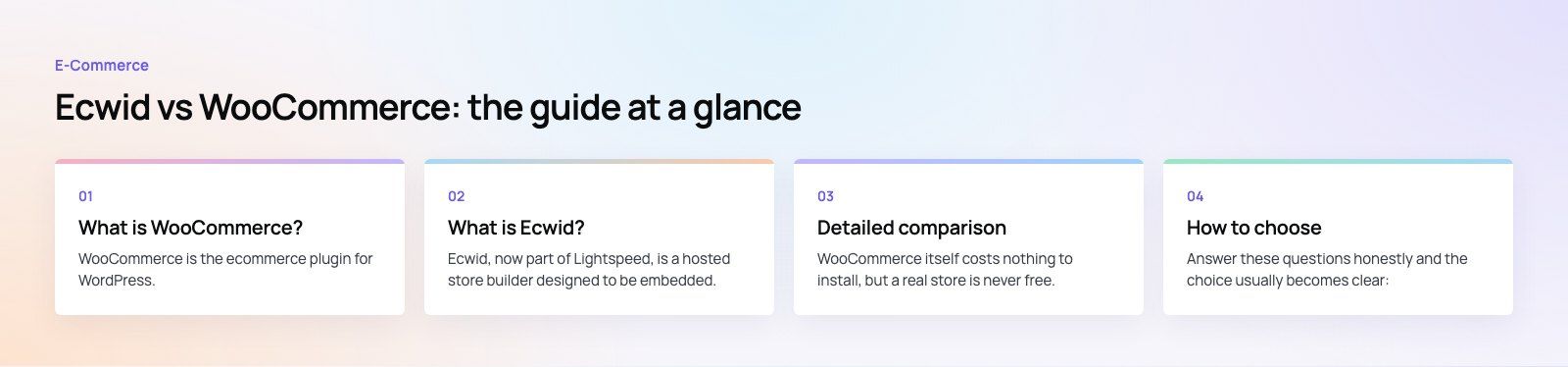
Yes, for most non technical owners.
Ecwid is hosted, so there is no server, plugin or update management, and you can embed a store in an existing site quickly. WooCommerce needs WordPress knowledge for setup and ongoing maintenance. If you already run WordPress comfortably, the gap is smaller, and WooCommerce offers more control once you are past the initial learning curve.
E-CommerceGenerative AI in Online Retail: Uses That Pay BackGenerative AI ecommerce uses ranked by payback and risk: product descriptions, AI search and support assistants, plus Arabic quality checks for UAE stores. E-CommerceConnecting WooCommerce to ERP, CRM and Shipping Without DuplicatesPlan a WooCommerce ERP integration that avoids duplicates: data ownership rules, idempotent order sync, CRM matching and UAE shipping, with Odoo and Dynamics.
 E-CommerceEnterprise Ecommerce Platform Selection: Requirements Before DemosChoose an enterprise ecommerce platform by setting integration, multi entity, data residency and order management requirements before any vendor demo starts.
Tell us what the business needs. We will tell you what to build first.
Schedule a free consultation and get a written recommendation, with costs, before you commit to anything.
Get in touchPROVEN RESULTS
4.7 / 5verified reviews on Google