

Nine platforms take food and grocery orders at meaningful scale in Saudi Arabia in 2026: HungerStation, Jahez, Keeta, Ninja, Mrsool, ToYou, Shgardi, Nana and The Chefz. Two names that appear near the top of almost every published list of food delivery apps in Saudi Arabia, Uber Eats and Talabat, do not operate there at all. If you are a UAE operator sizing up the Saudi market, that distinction matters more than the ranking, because it tells you who you would actually be bidding against.
The useful question is not which app has the nicest interface. It is what the market does to the companies inside it. One of the nine publishes audited accounts, and those accounts are unflattering.
The platforms that actually take orders in Saudi Arabia
Ownership matters here because it determines who funds the discounting. Four of the nine sit inside groups large enough to absorb years of losses.
| Platform | Owner or status | Main focus |
|---|---|---|
| HungerStation | Delivery Hero, being acquired by Uber | Food, grocery, pharmacy |
| Jahez | Listed on Tadawul, ticker 6017 | Food, plus owned and associated brands |
| Keeta | Meituan, China | Food, entered October 2024 |
| Ninja | Independent, valued at 1.5 billion dollars in July 2025 | Grocery and quick commerce |
| The Chefz | Owned by Jahez | Fine dining, desserts, gifts |
| Mrsool, ToYou, Shgardi | Independent Saudi platforms | Food and errand delivery |
| Nana | Independent Saudi platform | Groceries |
Rider counts, customer totals and city coverage for the smaller platforms circulate widely and trace back to company marketing pages rather than audited disclosure. Treat them as claims, not measurements. Only Jahez files numbers that an auditor has signed.
Three names on most lists that should not be there
Uber Eats stopped serving Saudi Arabia on 4 May 2020. Uber said at the time that it was exiting markets where it did not expect to reach first or second position. Six years later it still appears in published rankings of Saudi delivery apps, which is a reliable sign that a list was assembled from older lists rather than from the app stores.
Talabat does not operate in Saudi Arabia either. Delivery Hero owns both Talabat and HungerStation and runs HungerStation as its Saudi brand, so Saudi Arabia is the one Gulf market Talabat leaves alone. Listing Talabat as a Saudi option describes the corporate group correctly and the consumer market incorrectly.
The Chefz is real, and it is not an independent competitor. Jahez agreed to buy it for SAR 650 million, about 172.9 million dollars, in a cash and share deal announced in November 2022. Counting Jahez and The Chefz as rivals double counts one company.
What the one set of audited accounts shows
Jahez is the only Saudi delivery platform whose performance you can check rather than infer, and the trend across its recent filings is the single most useful fact in this market.
For the nine months to 30 September 2025, filed on 9 November 2025, Jahez reported revenue of SAR 1,626.3 million against SAR 1,623.2 million a year earlier, gross merchandise value up 6.5 percent to SAR 5.1 billion, and net profit of SAR 121.5 million. Order volume rose 3.7 percent and average order value 2.7 percent. The company raised its take rate from 14.6 percent to 15.5 percent and grew advertising revenue 31.9 percent.
Then the full year landed. In results reported on 31 March 2026, Jahez posted FY2025 revenue of SAR 2,323.6 million, up 4.7 percent, and GMV of SAR 7.2 billion, up 10.8 percent. Net profit fell 61.1 percent to SAR 73 million. Operating profit fell 70.7 percent to SAR 49.4 million. Because the company had earned SAR 121.5 million by September, the fourth quarter was a net loss of SAR 48.5 million.
The stated cause was a 26.1 percent rise in operating expenses to SAR 469.1 million, driven by marketing spend to defend market share, together with the consolidation of Snoonu costs from the fourth quarter. The losses continued: Jahez reported a net loss of SAR 9.2 million in Q1 2026 and SAR 26.6 million for the first half of 2026.
Read that sequence slowly, because it is the whole argument. Volume grew. Revenue grew. Take rate improved. The company still went from solidly profitable to loss making inside twelve months, because holding position cost more than the extra volume earned. Anyone modelling a Saudi delivery business on order growth alone is modelling the wrong variable.
How Keeta reset the price floor
Meituan launched Keeta in Saudi Arabia in October 2024, its first market outside China. By January 2025 it was the third largest food delivery platform in the country, holding about 10 percent of order volume, and it had reached number one in free app downloads on the Saudi App Store.
It bought that position. Rest of World reported in March 2025 that Keeta offered vouchers worth SAR 100 at sign up, 50 percent off first orders, and waived delivery fees, a combination the research firm Redseer estimated could remove around a fifth of the usual price of a meal.
A competitor funded from outside the market, spending to buy share without needing local profit, changes what every other platform must spend. That is the mechanism behind the Jahez numbers above, and it is the risk a new entrant inherits on day one.
Grocery and food delivery are converging
Ninja raised 250 million dollars in July 2025 in a round led by Riyad Capital, reaching a valuation of 1.5 billion dollars roughly three years after being founded in 2022. It delivers groceries, household goods, personal care and pharmacy items alongside restaurant orders across Saudi Arabia, Bahrain, Qatar and Kuwait, and has been reported as exploring a Riyadh listing.
The strategic point for anyone building in this space is that the categories no longer separate cleanly. A customer who opens one app for groceries at 8pm is not opening a second one for dinner. Restaurant-only positioning competes for attention against apps that also carry the weekly shop, and that shapes how often the app is opened rather than how good any single order is.
Uber’s purchase of Delivery Hero will redraw the map
Uber agreed to acquire Delivery Hero at EUR 41.50 per share in cash, valuing it at roughly 14.8 billion dollars. Delivery Hero’s management and supervisory boards recommended the offer to shareholders on 2 September. The transaction is expected to close in the second half of 2027, subject to the minimum acceptance threshold and regulatory clearances.
If it completes, HungerStation and Talabat both pass to Uber. Uber would then own the Saudi market leader, six years after withdrawing Uber Eats from the country for want of a path to profitability. Anything you plan around the current competitive structure should carry an assumption about what a combined owner does with pricing and rider supply.
The market size figures you will be quoted are not comparable
Published estimates of this market disagree by several times over, because they measure different things. Mordor Intelligence puts the Saudi delivery apps market at 9.59 billion dollars in 2026, reaching 19.45 billion dollars by 2031 at a 15.18 percent compound rate, and defines it as platform revenue from delivery fees, commissions, advertising and payment fees across food, grocery and pharmacy. IMARC Group puts the narrower online food delivery platforms market at 1.9 billion dollars in 2025.
Neither is wrong. They count different boxes. A figure quoted without its definition tells you nothing, and a business case built on one is built on a definition somebody else chose. The GMV and revenue lines in the Jahez filings are the only numbers in this article that an auditor has tested.
What a Saudi build needs that a UAE build does not
From a development perspective the ordering flow is the least interesting part of the work. The requirements that consume budget are regulatory and local.
- Transport General Authority licensing. The TGA licenses delivery platforms and the carriers they dispatch to. The Saudi Press Agency has reported the authority suspending passenger and food delivery apps for operating without licences, so this is enforced rather than nominal. Confirm the current licence categories and conditions with the TGA directly before committing to a launch date.
- Personal Data Protection Law. Saudi Arabia’s PDPL has been fully enforceable since 14 September 2024, with separate transfer regulations issued by SDAIA in August 2024 governing moving personal data outside the Kingdom. It applies to foreign companies processing the data of people inside Saudi Arabia, which includes a Dubai company running a Saudi app.
- Arabic as the primary language. Right to left layout is a design and engineering commitment across every screen, notification and receipt, not a translation file added at the end.
- Local payment rails. Card acceptance through the domestic network and the wallets Saudi customers actually use has to be designed in from the start, because payment failure at checkout is the most expensive bug in a delivery app.
- Rider supply. Dispatch quality, not app features, decides whether the unit economics work, and rider availability is governed by licensing rules rather than by your product roadmap.
One issue we often see is a budget that treats the customer app as the project and the merchant dashboard, dispatch logic and finance reconciliation as details. In practice those three carry most of the complexity and most of the ongoing cost. Our note on mobile app maintenance costs covers what that looks like after launch.
What we would tell a UAE operator looking at Saudi
For most UAE restaurant groups, the honest recommendation is not to build a delivery app. Listing on the platforms that already have the riders and the customers is cheaper and faster, and the commission is the price of demand you did not have to buy. Building your own makes sense when you already own the demand, when repeat ordering is high enough that you are paying commission on customers who would come to you anyway, and when you have the operational appetite to run dispatch.
If you are weighing that, the same trade-off in a market you know better is set out in our review of food delivery apps in Dubai, and the cost drivers are broken down in our delivery app cost calculator and our guide to what it costs to develop a mobile app. The platform decision itself, native against cross platform, is covered in native versus hybrid app development.
If you are scoping a delivery or marketplace app from the UAE and want the operational parts costed honestly alongside the interface, our mobile app development team in Dubai can talk through the scope.
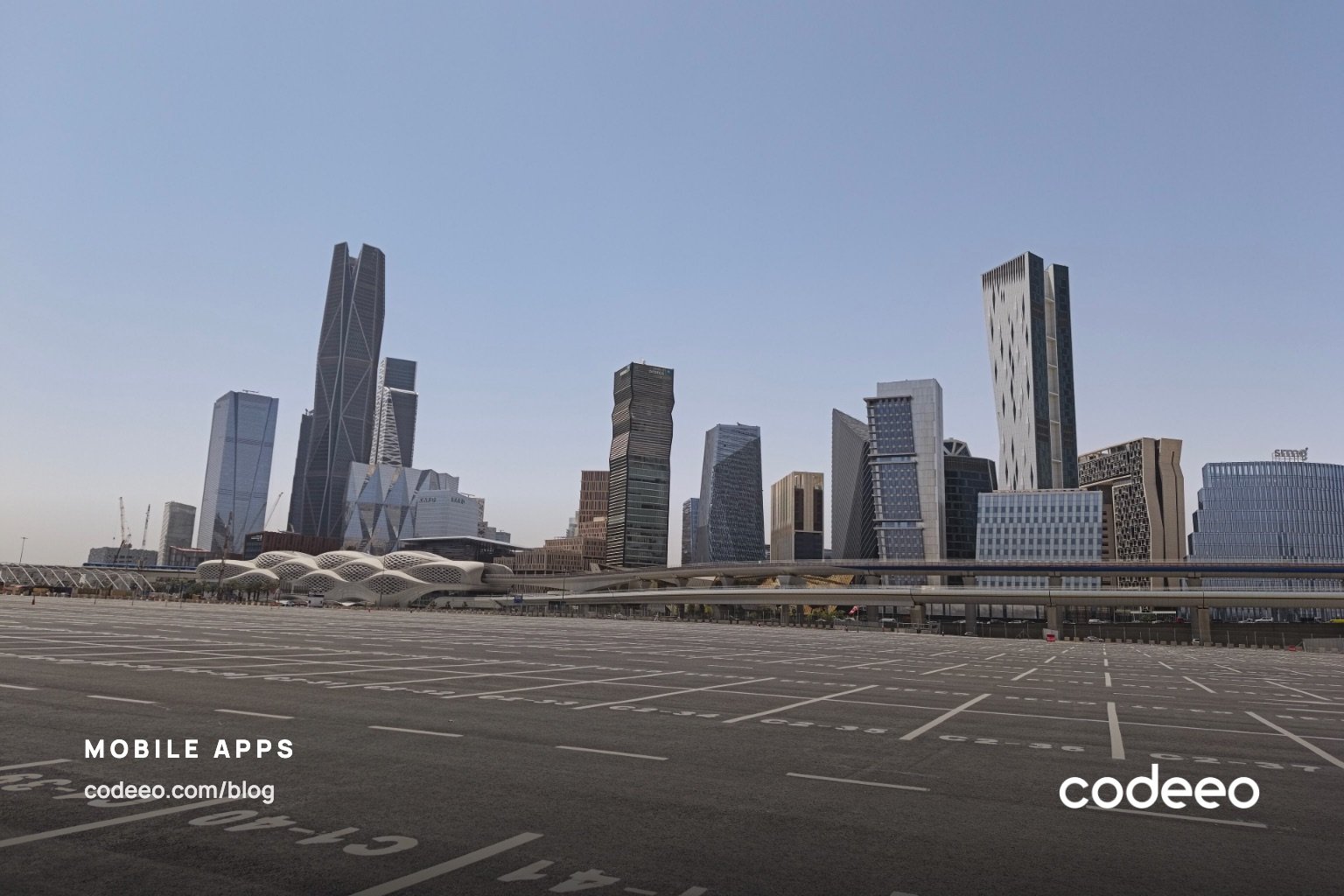
Figures in this article are taken from company filings and published research as dated and are indicative rather than current market conditions. This is general information, not legal, regulatory or investment advice. Confirm licensing and data protection requirements with the Saudi authorities or a qualified adviser before acting. Cover photo: KAFD 12, via Wikimedia Commons (CC0).