 AIAI in Cybersecurity: What It Does Well and Where It FailsAI in cybersecurity explained: where AI threat detection and security automation help, where models fail, how attackers use AI phishing and what to ask vendors.
How Fast Is AI Advancing? Drivers, Impact and What It Means
How fast AI is advancing, the forces driving it, where it is already changing industries, its effect on jobs and society, and how businesses can keep pace.
AI is advancing very fast. Capabilities that were research demos a few years ago, such as writing working code, holding natural conversations, generating realistic images and reasoning through multi step problems, are now everyday products. The pace comes from more computing power, better algorithms, vast training data and heavy investment, and it is outrunning the ability of most organizations and regulators to adapt.
This article explains what is driving that speed, where AI is already changing industries, what it means for jobs and society, and how a business can keep up without chasing every headline.
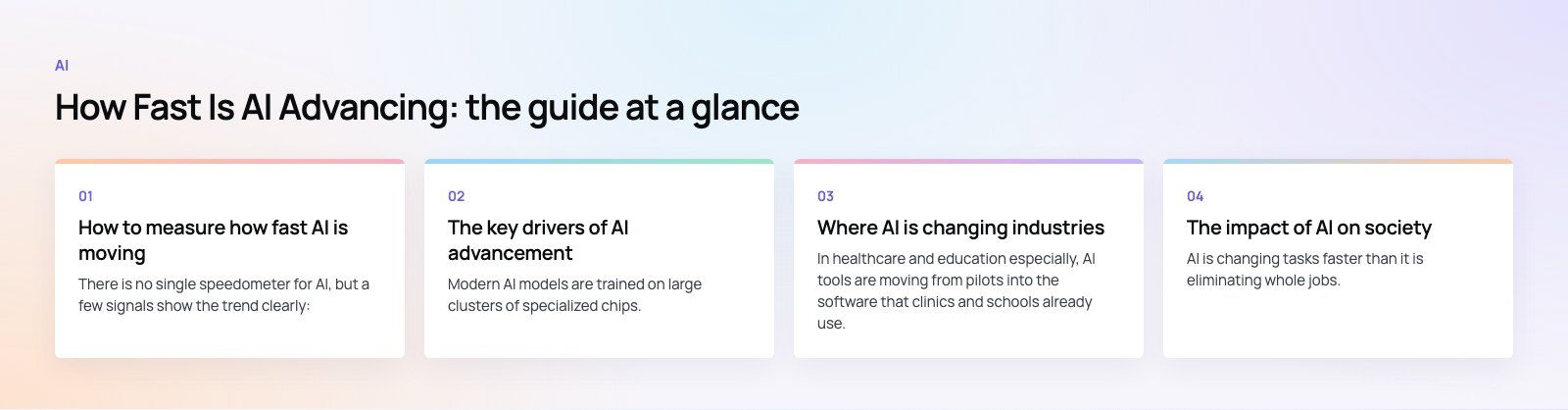
How to measure how fast AI is moving
There is no single speedometer for AI, but a few signals show the trend clearly:
- Benchmarks saturate quickly. Tests designed to be hard for AI are often matched or beaten within a short time, forcing researchers to write harder ones.
- New capabilities appear between model generations. Each major release tends to add abilities, such as handling images and audio, longer documents or tool use, not just better scores.
- Costs per task fall. Running a model of a given quality keeps getting cheaper, which pushes AI into more products.
- Adoption spreads beyond tech companies. Banks, hospitals, schools, retailers and governments now use AI in daily operations.
Stanford's annual AI Index Report is one of the most reliable independent sources tracking these trends across research, industry, policy and public opinion. Its 2026 edition describes a widening gap between what AI can do and how prepared institutions are to manage it.
The key drivers of AI advancement
Computing power
Modern AI models are trained on large clusters of specialized chips. As chips become more capable and cloud providers build bigger data centers, researchers can train larger models on more data. Computing power is now one of the main constraints and one of the main areas of investment.
Better algorithms
The transformer architecture, introduced in 2017, made it practical to train very large language models. Since then, techniques such as reinforcement learning from human feedback, mixture of experts designs, retrieval from external documents and reasoning focused training have each added capability without simply making models bigger.
Data
Models learn from enormous collections of text, code, images, audio and video. High quality data is becoming scarcer, which is pushing developers toward licensed datasets, synthetic data and learning from interaction.
Investment and competition
Large technology companies, startups and governments are spending heavily on AI research and infrastructure. Competition between labs shortens the time between releases, and open weight models spread capabilities quickly to developers everywhere.
Products feeding back into research
Once AI tools reach millions of users, usage data and feedback reveal weaknesses and new use cases. That loop between product and research is one reason progress has felt faster since AI assistants became mainstream.
Where AI is changing industries
| Industry | Where AI is used today | What still needs people |
|---|---|---|
| Healthcare | Medical image analysis, clinical note drafting, triage and scheduling | Diagnosis decisions, patient care, accountability |
| Education | Personalized practice, tutoring assistants, feedback on writing | Teaching, motivation, assessment integrity |
| Finance | Fraud detection, credit risk scoring, document review | Lending decisions, regulatory judgment |
| Customer service | Assistants answering common questions, ticket routing, sentiment analysis | Complex complaints, empathy, exceptions |
| Manufacturing | Visual quality inspection, predictive maintenance, demand forecasting | Process design, safety oversight |
| Software development | Code suggestions, test generation, documentation | Architecture, security review, product decisions |
| Transportation | Route optimization, driver assistance, autonomous vehicle trials | Safety validation and regulation |
In healthcare and education especially, AI tools are moving from pilots into the software that clinics and schools already use, which is where they start to change daily work.
The impact of AI on society
Jobs and skills
AI is changing tasks faster than it is eliminating whole jobs. Roles built around routine information processing, such as drafting standard documents, data entry and first line support, are changing most. New roles are appearing in building, evaluating and supervising AI systems. The practical response for workers and employers is continuous training, with AI treated as a tool people learn to direct.
Economic growth
Many economists expect AI to raise productivity, but the size and timing are debated. Historically, general purpose technologies took years to show up in productivity figures because businesses had to reorganize processes around them. AI is likely to follow a similar pattern, although faster.
Privacy, bias and trust
AI systems trained on large datasets can reproduce bias, expose personal information or generate convincing false content. These risks grow as AI becomes more capable and widespread, which is why transparency, testing and human oversight matter.
Regulation catching up
Governments are responding at different speeds. The European Union's AI Act sets risk based rules for AI systems, and other countries are publishing their own frameworks and guidance. For businesses, regulation now shapes which AI uses are acceptable, especially in hiring, credit, health and public services.
AI compared with human ability
AI is far faster than people at processing large volumes of data, spotting patterns, searching documents and producing first drafts. It does not get tired and works at any hour. People remain stronger at judgment in unfamiliar situations, understanding context and intent, accountability, creativity grounded in real experience and building trust. The most effective setups combine the two: AI handles volume and speed, and people handle decisions and relationships.
AI versus machine learning
Artificial intelligence is the broad goal of making machines perform tasks that normally need human intelligence. Machine learning is the main method used to get there today: systems learn patterns from data instead of following hand written rules. Deep learning is a branch of machine learning that uses layered neural networks, and it powers most of the recent progress.
Is general AI close?
Artificial general intelligence, meaning a system that can learn and perform any intellectual task as well as a person, is the stated goal of several labs. Experts disagree sharply on when, or whether, it will arrive. For planning purposes, businesses should focus on what current systems can reliably do rather than on forecasts.
How businesses can keep pace
- Focus on problems, not models. Pick processes where speed or accuracy clearly matters, and measure today's baseline.
- Use AI inside existing tools first. Many CRMs, helpdesks and office suites now include AI features. Turning them on is the fastest way to learn.
- Connect your data. AI is only as useful as the information it can reach. Integrating systems often adds more value than any single model.
- Set clear usage rules. Decide what data staff may put into AI tools, which outputs need review, and who owns each AI feature.
- Review your choices regularly. Because models improve quickly, a tool that was not good enough last year may be now, and vice versa on cost.
Areas such as sales automation and internal workflows are often the easiest places to start, because results are visible quickly. A product scoping session can help define a first AI use case with a clear measure of success.
Codeeo has delivered 200+ projects across the UAE and the US, with a team of 80+ across Dubai, Riyadh and Karachi. If you want to add AI features to a product or internal system, our custom software development team can help you scope, build and integrate them.
Frequently asked questions
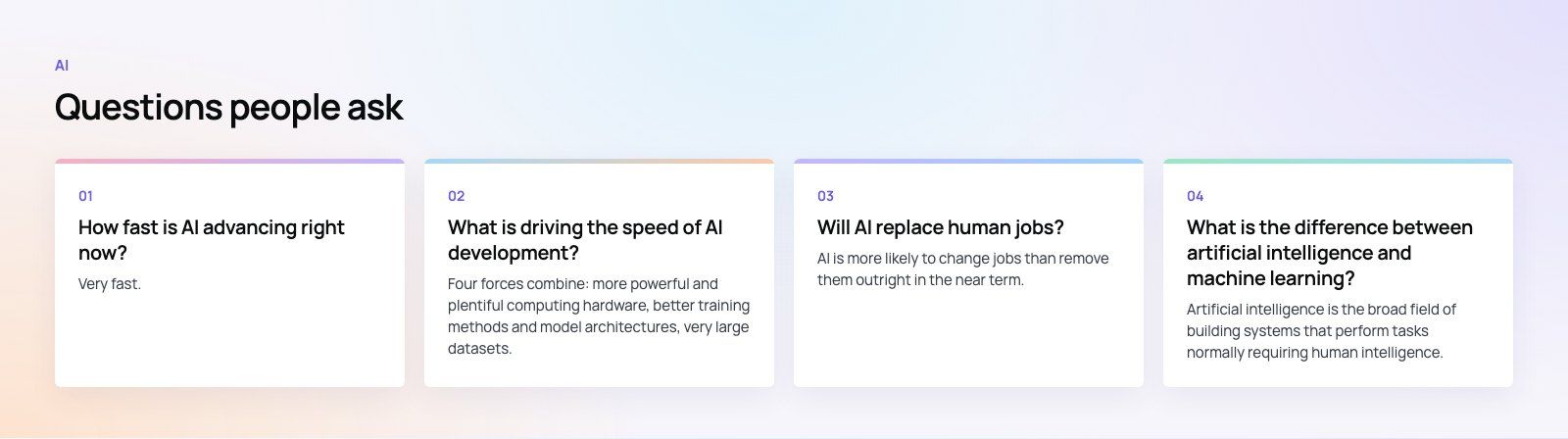
Very fast.
Major AI labs release significantly more capable models frequently, benchmarks designed to challenge AI are often matched soon after they appear, and the cost of running a model of a given quality keeps falling. Independent trackers such as Stanford's AI Index report that capability is growing faster than the readiness of organizations and regulators to manage it.
AIAI in Cybersecurity: What It Does Well and Where It FailsAI in cybersecurity explained: where AI threat detection and security automation help, where models fail, how attackers use AI phishing and what to ask vendors. AIMobile App Security Basics in the Age of Generative AIMobile app security basics for app owners: OWASP MASVS controls, secrets handling, AI feature risks such as prompt injection, testing steps and UAE rules.
 AIAI Coding Assistants: What Changed Since the Early ToolsHow the AI coding assistant moved from autocomplete to agents, and what that means for code quality, security and cost on the software projects you pay for.
Tell us what the business needs. We will tell you what to build first.
Schedule a free consultation and get a written recommendation, with costs, before you commit to anything.
Get in touchPROVEN RESULTS
4.7 / 5verified reviews on Google