 AIAI in Cybersecurity: What It Does Well and Where It FailsAI in cybersecurity explained: where AI threat detection and security automation help, where models fail, how attackers use AI phishing and what to ask vendors.
How Is AI Being Used Today? Examples by Industry
Where AI is actually working today in healthcare, finance, customer service, manufacturing and transport, plus how a business can find its own first use case.
AI is being used today to read medical scans, spot card fraud, answer customer questions, predict machine failures, route deliveries and draft documents. Most of it is not science fiction: it is pattern recognition and prediction running quietly inside software that people already use. The common thread is that AI handles high volume, repetitive judgment so people can focus on the decisions that need them.
This guide walks through how AI is used in the industries where adoption is most visible, what each use actually involves, and how a business can work out where AI fits its own operations.
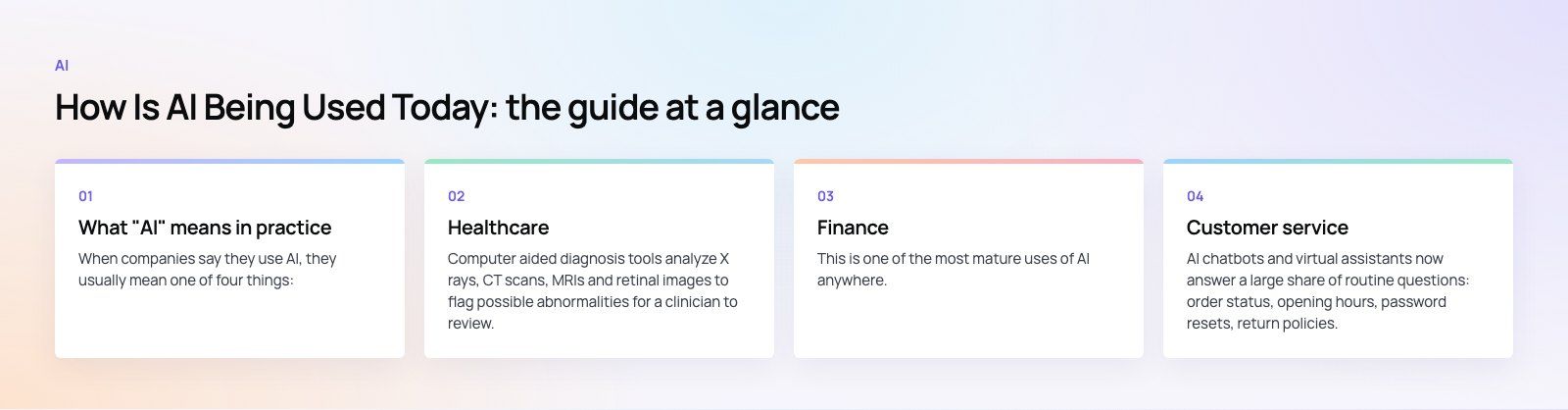
What "AI" means in practice
When companies say they use AI, they usually mean one of four things:
- Machine learning models that learn patterns from historical data and make predictions, such as which transaction looks fraudulent or which customer is likely to cancel.
- Computer vision that interprets images and video, from X rays to products moving on a conveyor belt.
- Natural language processing that reads, classifies and writes text, including chatbots and document summaries.
- Generative AI, the large language and image models that produce new text, code and images from a prompt.
Each industry below uses a different mix of these. Knowing which one you are dealing with helps you judge what data it needs and how far you can trust its output.
Healthcare
Diagnosis and medical imaging
Computer aided diagnosis tools analyze X rays, CT scans, MRIs and retinal images to flag possible abnormalities for a clinician to review. The value is speed and consistency: a model can screen a large queue of images and push the ones that look suspicious to the top. In the United States, the FDA keeps a public list of AI enabled medical devices it has authorized, and imaging tools make up a large share of it.
Personalized treatment
By combining patient history, lab results and outcomes data, models can suggest which treatment is likely to work for a given patient profile. These systems support doctors rather than replace them, and they are only as good as the records they learn from.
Drug discovery
Virtual screening models evaluate very large numbers of molecules and predict which ones are worth testing in a lab. That narrows the search before expensive physical experiments begin, which shortens early research.
Operations and patient experience
Less glamorous but widespread: AI helps hospitals forecast bed demand, schedule staff, transcribe consultations and triage appointment requests. Patient facing websites and apps increasingly use it to route people to the right service.
Finance
Fraud detection
This is one of the most mature uses of AI anywhere. Machine learning models score every card payment or transfer in real time against the customer's normal behavior and known fraud patterns. Suspicious transactions are blocked or sent for review within the time it takes to approve a payment.
Credit scoring and risk
Lenders use models that look at more signals than a traditional score, such as cash flow history, to judge creditworthiness. This can widen access to credit, but it also raises fairness questions, so regulated lenders have to explain and audit how these models decide.
Algorithmic trading
Trading systems analyze market data and execute orders far faster than a human could. AI models add pattern detection on top of rule based strategies, though markets are noisy and models need constant monitoring.
Payments and customer apps
Banking and payment apps use AI to categorize spending, predict cash shortfalls, power support chat and personalize offers. If you are building in this space, our fintech work covers the product side, and the Purpose Payment case study shows a payments app with rewards, portals and an API.
Customer service
AI chatbots and virtual assistants now answer a large share of routine questions: order status, opening hours, password resets, return policies. The better implementations connect the bot to real systems (orders, bookings, CRM) so it can actually resolve the request, and hand over to a person with full context when it cannot.
Recommendation engines are the other big use. By learning from browsing and purchase behavior, they suggest products, articles or videos a customer is likely to want. Online stores, streaming services and marketplaces all depend on them.
One issue we often see is a chatbot added to a website with no access to live data. It can only repeat the FAQ page, which frustrates customers. Integration with your sales and service systems is what makes these tools useful.
Manufacturing
Predictive maintenance
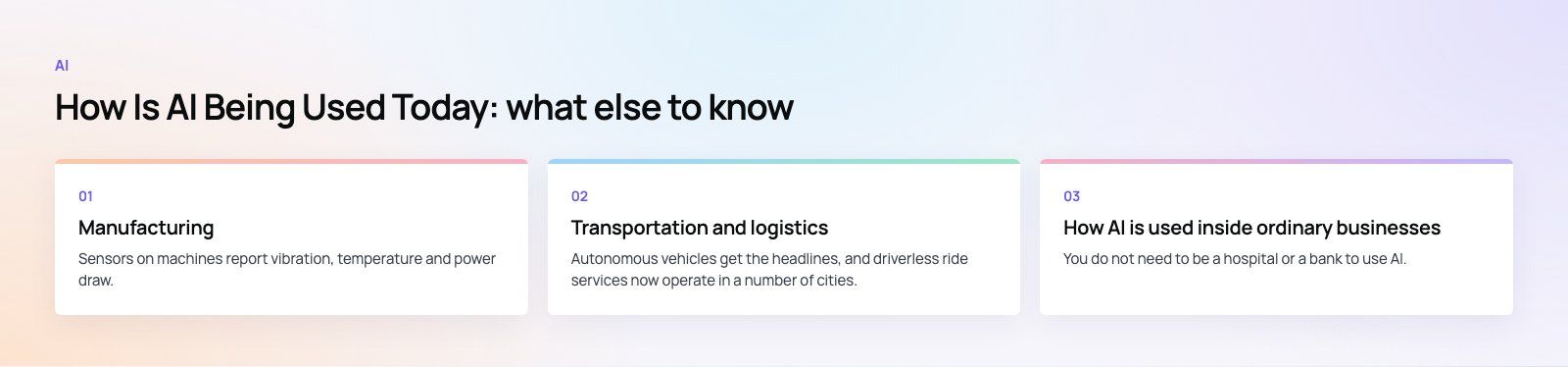
Sensors on machines report vibration, temperature and power draw. Models learn what normal looks like and warn engineers before a part fails, so maintenance happens on schedule instead of after a breakdown.
Quality control
Vision systems inspect products on the line and catch defects such as scratches, misalignment or missing parts at production speed. Consistent inspection means fewer faulty products reach customers and fewer returns.
Demand and supply planning
Forecasting models combine sales history, seasonality and external signals to plan production and purchasing. This usually lives inside or next to an ERP, which is why clean ERP data matters so much for any AI project.
Transportation and logistics
Autonomous vehicles get the headlines, and driverless ride services now operate in a number of cities. The more widespread uses today are less visible: route optimization for delivery fleets, traffic signal management that adapts to real conditions, demand forecasting for ride hailing, and predictive maintenance for aircraft and trains.
Navigation apps use AI to estimate arrival times and suggest alternative routes based on live traffic data from millions of phones.
Other industries at a glance
| Industry | Common AI uses | Main type of AI |
|---|---|---|
| Healthcare | Imaging diagnosis, treatment support, drug discovery, scheduling | Computer vision, machine learning |
| Finance | Fraud detection, credit scoring, trading, support chat | Machine learning, NLP |
| Retail and ecommerce | Recommendations, search, demand forecasting, product descriptions | Machine learning, generative AI |
| Manufacturing | Predictive maintenance, visual inspection, planning | Machine learning, computer vision |
| Transportation | Route optimization, traffic management, autonomous driving | Machine learning, computer vision |
| Education | Tutoring assistants, personalized practice, grading support | NLP, generative AI |
| Legal | Contract review, legal research, document summaries | NLP, generative AI |
| Agriculture | Crop monitoring, yield prediction, precision irrigation | Computer vision, machine learning |
How AI is used inside ordinary businesses
You do not need to be a hospital or a bank to use AI. The most common business uses today are practical:
- Writing and summarizing: drafting emails, proposals, product descriptions and meeting notes with generative AI tools.
- Customer support: a chatbot that answers routine questions and books appointments.
- Sales: lead scoring, follow up reminders and call summaries inside the CRM.
- Finance and admin: reading invoices and receipts, matching payments and flagging anomalies.
- Analytics: asking questions of your data in plain language through business intelligence tools such as Power BI.
- Software development: coding assistants that speed up routine work while developers review the output.
How to work out where AI fits your business
- Start with a problem, not a tool. List tasks that are repetitive, high volume and rule heavy, such as answering the same questions or keying in documents.
- Check your data. AI needs reasonably clean, accessible data. If your customer or stock records live in spreadsheets and email, fixing that comes first.
- Pick one measurable pilot. Choose a use case where you can measure time saved, errors reduced or response times improved.
- Keep a person in the loop. For anything that affects customers, money or health, have a human review AI output until you trust it.
- Integrate, then scale. AI works best when it is connected to the systems your team already uses, not bolted on as a separate tool.
The limits worth knowing
AI makes mistakes. Language models can state wrong facts confidently, and prediction models can inherit bias from the data they learned from. Privacy rules also apply: feeding customer data into a third party AI service needs the same care as any other data processing. Regulation is catching up too, with the EU AI Act now applying to many systems used in or sold into Europe. Treat AI output as a strong first draft or a recommendation, and design your processes so a person can catch the errors.
If you want to add AI features to a product or connect them to your existing systems, Codeeo's team of 80+ across Dubai, Riyadh and Karachi builds custom software with AI where it earns its place. You can talk to us about a specific use case.
Frequently asked questions
Most people use AI daily without noticing.
It powers navigation apps that predict traffic, spam filters in email, recommendations on shopping and streaming sites, face recognition that opens phones, voice assistants and fraud checks on card payments. Generative AI tools that write text or answer questions are the newest everyday use, and they are now built into search engines, office software and messaging apps.
AIAI in Cybersecurity: What It Does Well and Where It FailsAI in cybersecurity explained: where AI threat detection and security automation help, where models fail, how attackers use AI phishing and what to ask vendors. AIMobile App Security Basics in the Age of Generative AIMobile app security basics for app owners: OWASP MASVS controls, secrets handling, AI feature risks such as prompt injection, testing steps and UAE rules.
 AIAI Coding Assistants: What Changed Since the Early ToolsHow the AI coding assistant moved from autocomplete to agents, and what that means for code quality, security and cost on the software projects you pay for.
Tell us what the business needs. We will tell you what to build first.
Schedule a free consultation and get a written recommendation, with costs, before you commit to anything.
Get in touchPROVEN RESULTS
4.7 / 5verified reviews on Google