 E-CommerceGenerative AI in Online Retail: Uses That Pay BackGenerative AI ecommerce uses ranked by payback and risk: product descriptions, AI search and support assistants, plus Arabic quality checks for UAE stores.
How Much Can You Make Dropshipping? A Realistic Guide
Dropshipping income is margin times orders minus ad spend, fees and refunds. Learn what drives profit, the pitfalls, and how to build a store that lasts.
There is no typical dropshipping income. What you make is your gross margin on each order, multiplied by how many orders you sell, minus advertising, apps, payment fees, refunds and your own time. Many stores never cover their ad spend, while a smaller number build steady profit by choosing a focused niche, controlling customer acquisition costs and earning repeat buyers.
This guide breaks down how dropshipping profit actually works, the factors that decide it, and how to improve your odds without relying on hype.
How the dropshipping model works
In dropshipping, you sell products you do not hold in stock. When a customer orders from your store, you pass the order to a supplier, who ships it directly to the customer. Shopify's dropshipping documentation describes the same basic flow and the apps that connect stores to suppliers.
- You build an online store and list products from one or more suppliers.
- A customer places an order and pays your retail price.
- You send the order to the supplier and pay their wholesale price.
- The supplier ships directly to the customer.
- You keep the difference, minus every cost of getting and serving that customer.
The appeal is clear: no warehouse, no upfront stock and the ability to test products quickly. The catch is that the same low barrier lets thousands of other sellers list similar products.
How dropshipping profit is calculated
Revenue is easy to measure and easy to be fooled by. Profit is what matters, and it depends on several layers:
| Layer | What it includes | Why it matters |
|---|---|---|
| Gross margin per order | Your selling price minus supplier cost and shipping | The ceiling on what each sale can earn |
| Customer acquisition cost | Ad spend and marketing divided by orders | Usually the largest cost, and the one that sinks most stores |
| Transaction costs | Payment processing, platform and app fees | Small per order, significant at volume |
| Returns and refunds | Refunded orders, chargebacks, replacements | Higher with long shipping times and quality issues |
| Fixed costs | Platform plan, apps, domain, tools, content | Spread across orders, so they hurt most at low volume |
| Your time | Product research, support, supplier management | Often ignored when sellers calculate profit |
A useful rule: a product only works if its gross margin comfortably exceeds what it costs to acquire a customer. If each order needs more ad spend than the margin it earns, more sales simply means bigger losses.
Why repeat customers change the math
The first order often barely breaks even once advertising is counted. Profit tends to come from customers who buy again without another paid click, through email, SMS or direct visits. Products that are consumable or come in ranges make repeat purchases far more likely than one off novelty items.
Factors that decide how much you make
1. Niche selection
A focused niche lets you understand your buyers, write better product content and target ads more precisely. Selling "everything" puts you in direct competition with marketplaces that will usually win on price and delivery speed.
2. Marketing and acquisition cost
Paid social and search ads are the fastest way to get traffic, but costs rise as more sellers bid for the same audiences. Content, search engine optimization, email and social media build cheaper traffic over time and reduce dependence on ads.
3. Supplier reliability
Your supplier controls product quality, stock levels and delivery times, yet customers blame you for problems. Order samples, test delivery times to your main markets and keep a backup supplier for best sellers.
4. Delivery speed and customer experience
Long or unpredictable shipping drives refunds, disputes and poor reviews. Suppliers with local warehouses in your target markets usually cost more per unit but can protect margin by reducing refunds.
5. Store quality and conversion rate
A store that converts better gets more orders from the same ad spend, which directly lowers acquisition cost. Fast pages, clear product information, honest delivery times and a simple checkout all matter.
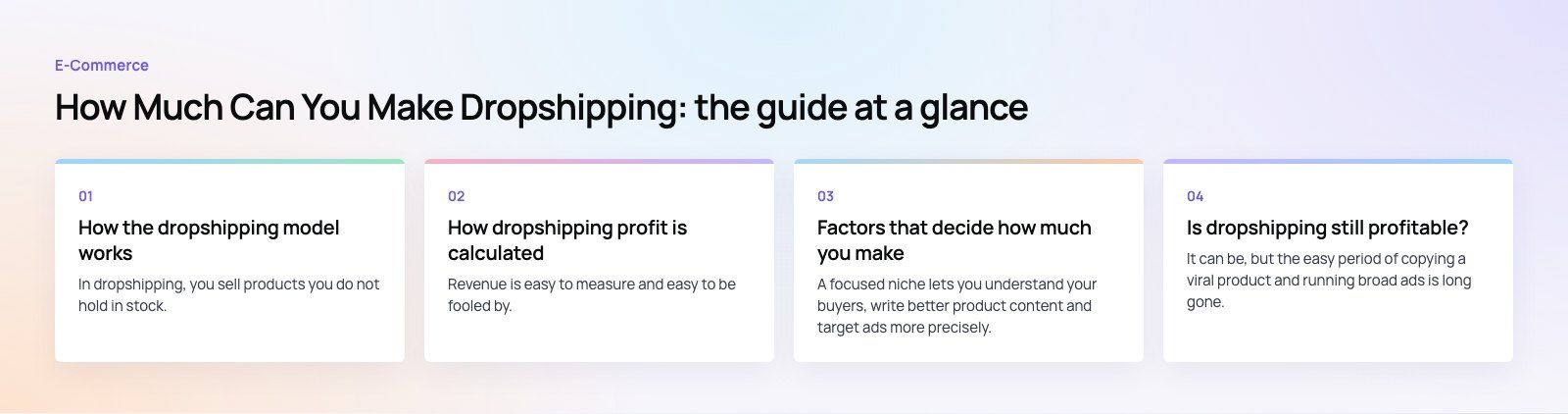
Is dropshipping still profitable?
It can be, but the easy period of copying a viral product and running broad ads is long gone. Advertising platforms have become more competitive, customers expect faster delivery, and marketplaces offer similar products at low prices. Sellers who succeed now usually treat dropshipping as a way to test demand while building a real brand, not as a passive income scheme.
Current trends that favor more durable stores:
- Niche brands: a clear audience and point of view rather than a general store.
- Social commerce: selling through short video, creator content and messaging apps.
- Omnichannel selling: combining a website with marketplaces and social shops.
- Mobile first stores: most browsing and many purchases happen on phones.
- AI assisted operations: tools for product descriptions, support replies and demand forecasting.
- Hybrid fulfillment: holding stock of best sellers while dropshipping the long tail.
How to improve your dropshipping earnings
- Validate before you scale. Test products with small budgets and only increase spend on those with healthy margin after acquisition costs.
- Write original product content. Supplier descriptions are copied across hundreds of stores; your own copy, photos and size guides help conversion and search visibility.
- Raise average order value. Bundles, related products and free shipping thresholds spread acquisition cost across more items.
- Build an email and SMS list. Owned channels bring repeat orders without paying for each click.
- Answer customers fast. Quick, honest support reduces disputes and earns better reviews.
- Review numbers weekly. Track margin, acquisition cost, refund rate and repeat purchase rate by product.
Pros and cons of dropshipping
| Pros | Cons |
|---|---|
| Low upfront investment, no stock to buy | Thin margins and heavy price competition |
| Test new products quickly | Dependence on supplier quality and stock |
| Run the business from anywhere | Limited control over shipping and packaging |
| Wide product choice from many suppliers | Harder to build a distinctive brand |
| Easy to add or drop products | Customer service burden falls on you |
Pitfalls to avoid
Relying on a single supplier
One supplier running out of stock or changing prices can stop your business overnight. Line up alternatives for your best selling products.
Ignoring legal and tax obligations
You are the seller of record. Consumer protection rules, product safety requirements, sales tax or VAT, import duties and intellectual property law all apply to you, not just your supplier. Avoid branded or trademarked products you are not authorized to sell.
Promising delivery times you cannot meet
Overstated delivery promises lead to chargebacks and can get your ad or payment accounts restricted. Show realistic timelines on product pages and at checkout.
Chasing trends without data
Viral products attract many sellers at once and fade quickly. Base decisions on your own margin and acquisition data, not on what other sellers claim to earn.
Building a store that can last
The store itself is where margin is won or lost: page speed, product content, checkout and the integrations that keep orders flowing to suppliers. Codeeo has delivered 200+ projects across the UAE and the US, including Clock Springs Australia, a parts store with fitment on every product. Our Shopify developers and WooCommerce developers build and improve stores, and our digital marketing team works on lowering acquisition costs. If you already sell, a checkout teardown shows where orders are being lost, or talk to us about your store.
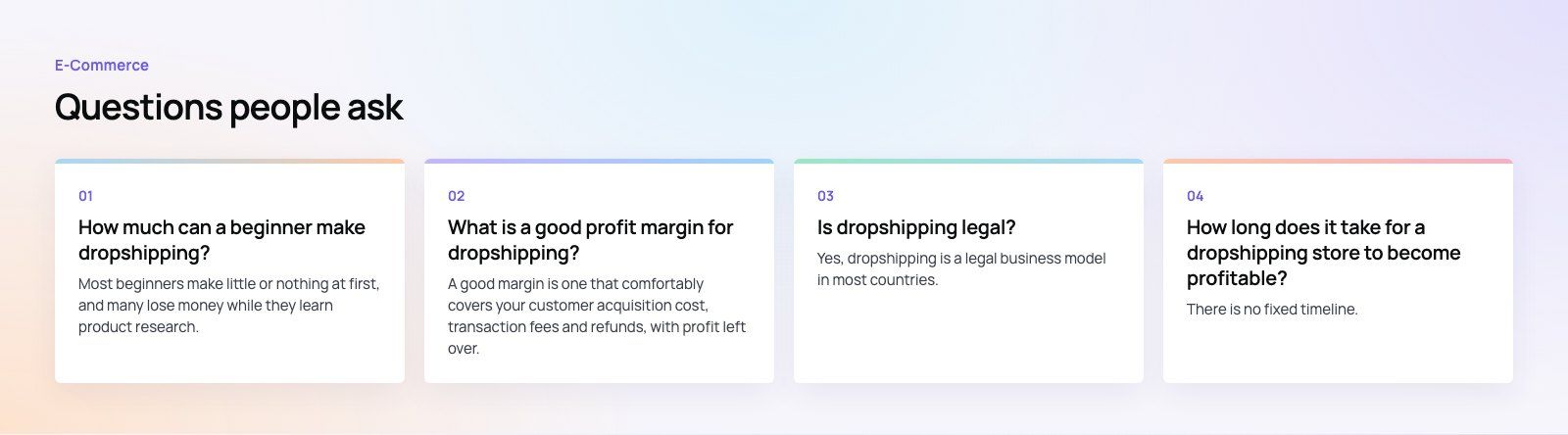
Frequently asked questions
Most beginners make little or nothing at first, and many lose money while they learn product research, advertising and supplier management.
Earnings depend on margin per order, sales volume and acquisition cost, so there is no reliable average. Treat the first months as paid learning, keep test budgets small, and judge progress by profit after ad spend rather than revenue.
E-CommerceGenerative AI in Online Retail: Uses That Pay BackGenerative AI ecommerce uses ranked by payback and risk: product descriptions, AI search and support assistants, plus Arabic quality checks for UAE stores. E-CommerceConnecting WooCommerce to ERP, CRM and Shipping Without DuplicatesPlan a WooCommerce ERP integration that avoids duplicates: data ownership rules, idempotent order sync, CRM matching and UAE shipping, with Odoo and Dynamics.
 E-CommerceEnterprise Ecommerce Platform Selection: Requirements Before DemosChoose an enterprise ecommerce platform by setting integration, multi entity, data residency and order management requirements before any vendor demo starts.
Tell us what the business needs. We will tell you what to build first.
Schedule a free consultation and get a written recommendation, with costs, before you commit to anything.
Get in touchPROVEN RESULTS
4.7 / 5verified reviews on Google