 E-CommerceGenerative AI in Online Retail: Uses That Pay BackGenerative AI ecommerce uses ranked by payback and risk: product descriptions, AI search and support assistants, plus Arabic quality checks for UAE stores.
How Much Money Does Ecommerce Make? Revenue and Margins Explained
How ecommerce businesses make money: revenue streams, gross and net margins, what Amazon, Alibaba and Shopify do differently, and what drives store profit.
How much money ecommerce makes depends on the business model, the products, the margins and the scale of the operation. The largest marketplaces earn enormous revenue, while many small stores earn a modest income or run at a loss in their first years. What separates them is rarely the website alone; it is margin, repeat customers and the cost of acquiring each sale.
This guide explains how online businesses make money, how to read profit margins, what the biggest ecommerce companies do differently and what affects how much an online store can earn.
Revenue is not profit
Before looking at earnings, separate two ideas that often get mixed up. Revenue is the total value of sales. Profit is what remains after every cost: products, shipping, payment fees, marketing, staff, software and tax. A store with high revenue and thin margins can make less money than a smaller store selling fewer, better priced products. For official data on how large online retail is as a share of all retail, the US Census Bureau's quarterly ecommerce report is a reliable primary source.
How ecommerce businesses make money
Most online businesses combine more than one revenue stream.
| Revenue stream | How it works | Strength | Watch out for |
|---|---|---|---|
| Product sales | Selling physical goods you make, buy wholesale or dropship | Simple and scalable with volume | Stock risk, shipping, returns, price competition |
| Subscriptions | Recurring boxes, replenishment orders, memberships or software | Predictable income and high customer lifetime value | Churn and the need to keep delivering value |
| Digital products | Courses, templates, downloads, licenses | Low cost per extra sale, no shipping | Piracy and the effort of constant marketing |
| Marketplace commission | Taking a share of sales made by other sellers on your platform | Grows without owning stock | Needs both buyers and sellers to reach scale |
| Advertising and affiliate income | Selling ad space or earning commission for referring buyers | Extra income from existing traffic | Only meaningful at high traffic levels |
Product sales
Selling products is the core of most ecommerce. Profit per order depends on product cost, competition and pricing power. Brands that make their own products usually keep more margin than resellers, but carry more risk.
Subscriptions
Subscriptions turn one sale into many. They work well for consumables such as coffee, pet food, flowers or skincare, and for software and memberships. A loyal subscriber base also makes revenue easier to forecast.
Advertising and affiliates
Once a store has steady traffic, it can earn extra income by promoting partner products or selling sponsored placements. This is a supplement, not a foundation, for most stores.
Understanding ecommerce profit margins
Gross profit margin
Gross margin measures how profitable your products are. It is revenue minus the cost of goods sold, divided by revenue. A higher gross margin means either lower product costs or stronger pricing. It tells you whether each sale leaves room to pay for everything else.
Net profit margin
Net margin measures the profitability of the whole business. It takes every expense into account: marketing, payment fees, shipping, salaries, software, rent and taxes. Net margin is the number that tells you how much the business really makes.
What moves your margins
- Customer acquisition cost: how much you spend on ads and marketing to win each customer.
- Average order value: bundles, upsells and free shipping thresholds raise it.
- Repeat purchase rate: returning customers cost far less to win than new ones.
- Supplier terms: better buying prices go straight to gross margin.
- Returns and fulfillment: high return rates and expensive shipping quietly erase profit.
- Conversion rate: a faster, clearer checkout turns more of the same traffic into orders.
Checkout is often where the easiest gains hide. Our checkout teardown looks at the steps between cart and payment where shoppers drop off.

For example, EGO Sustainable is a bilingual Shopify store for a GCC athleisure label with Tabby and Tamara, five markets and 56K active users in 2026. Offering the payment methods your customers already use is one of the more direct ways to protect conversion.
How the biggest ecommerce companies make money
The largest players show which models scale. None of them relies on one revenue stream.
Amazon
Amazon started as an online bookstore and expanded into almost every product category. Its main strategies are:
- Diversification: moving far beyond books into general retail and services.
- A third party marketplace: independent sellers list products alongside Amazon's own, which widens the range without Amazon holding all the stock.
- Logistics: its own fulfillment centers and delivery network, which it also sells to marketplace sellers.
- Subscriptions: Amazon Prime creates recurring revenue and keeps members buying.
- Advertising: sellers pay to promote listings on its own pages.
Alibaba
Alibaba Group runs business to consumer and business to business platforms that connect sellers and buyers in China and around the world. It grew through heavy use of data to understand buyers, large investment in logistics, and close ties with the Alipay payment system run by its affiliate Ant Group, which made paying online easy for millions of shoppers.
Shopify
Shopify makes money by helping other businesses sell. It earns subscription revenue from merchants' plans and merchant solutions revenue from services such as Shopify Payments. Its app ecosystem lets merchants extend their stores, and built in marketing tools help them attract customers. Its success depends on merchants succeeding.
What smaller stores can take from them
- Add a second revenue stream, such as subscriptions or bundles, once the first one works.
- Own the customer relationship with email and accounts, not just one off orders.
- Treat delivery speed and reliability as part of the product.
- Use your own data to decide what to stock and promote.
Opportunities and challenges in ecommerce
Competition
New sellers enter every market constantly, from every country. Standing out needs a clear brand, a niche you can own and service that customers talk about.
Economic conditions
Consumer spending rises and falls with the economy. In a downturn, discretionary products suffer first. Watching your numbers monthly and adjusting stock and spend quickly protects cash.
Supply chain and logistics
Late deliveries, stock outs and returns hurt both profit and reputation. Reliable suppliers, good inventory management and clear return policies reduce the damage.
Cybersecurity
Online stores are a common target for fraud and data theft. Secure payments, regular updates and monitoring protect customers and your reputation. Card payment security follows the PCI DSS standards.
New technology
AI product recommendations, conversational shopping, augmented reality try ons and mobile first checkout can give an edge, but only when they solve a real customer problem.
Turning an online store into a profitable one
Profit in ecommerce comes from a fast, trustworthy store, the right products at the right margins and steady, affordable traffic. Codeeo has delivered 200+ projects across the UAE and the US, including Shopify and WooCommerce stores, and our digital marketing team works on the traffic side. See our retail and ecommerce work to learn more.
Frequently asked questions
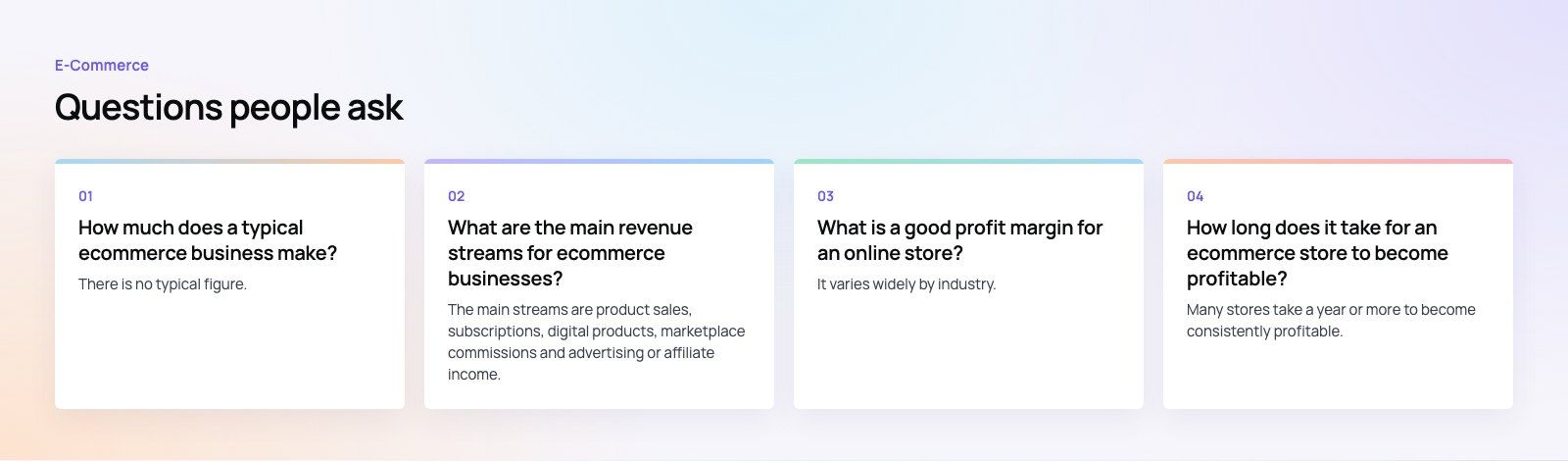
There is no typical figure.
Earnings depend on the niche, the products, the business model, margins and how much is spent on marketing. Some stores grow into large businesses, while many small stores earn modest income or lose money in their first years. Tracking net profit, not just revenue, is the only reliable way to know how much your own store makes.
E-CommerceGenerative AI in Online Retail: Uses That Pay BackGenerative AI ecommerce uses ranked by payback and risk: product descriptions, AI search and support assistants, plus Arabic quality checks for UAE stores. E-CommerceConnecting WooCommerce to ERP, CRM and Shipping Without DuplicatesPlan a WooCommerce ERP integration that avoids duplicates: data ownership rules, idempotent order sync, CRM matching and UAE shipping, with Odoo and Dynamics.
 E-CommerceEnterprise Ecommerce Platform Selection: Requirements Before DemosChoose an enterprise ecommerce platform by setting integration, multi entity, data residency and order management requirements before any vendor demo starts.
Tell us what the business needs. We will tell you what to build first.
Schedule a free consultation and get a written recommendation, with costs, before you commit to anything.
Get in touchPROVEN RESULTS
4.7 / 5verified reviews on Google