 E-CommerceGenerative AI in Online Retail: Uses That Pay BackGenerative AI ecommerce uses ranked by payback and risk: product descriptions, AI search and support assistants, plus Arabic quality checks for UAE stores.
How to Start Dropshipping on Amazon: Rules, Steps and Strategy
Amazon's drop shipping policy in plain terms, the steps to start selling, strategies for new sellers and how to choose a supplier that keeps your account healthy.
To start dropshipping on Amazon, you open a seller account in Seller Central, choose a niche and products that are allowed in your category, line up a supplier who will ship under your name, list the products and keep stock and prices in sync. The key rule is Amazon's drop shipping policy: you must be the seller of record, your name must be the only one on the packing slip and invoice, and you handle returns. Buying from another retailer and having them ship to your Amazon customer is not allowed.
This guide covers the policy, the setup steps, strategies that help new sellers succeed and how to choose a supplier you can trust.
How dropshipping on Amazon works
Dropshipping means you sell products without holding inventory. When a customer buys on Amazon, you pass the order to your supplier, who ships it directly to the customer. You keep the difference between your selling price and your total costs, including Amazon's fees.
On Amazon this sits under merchant fulfilled orders, where you, not Amazon, are responsible for getting the order to the customer on time. It differs from Fulfillment by Amazon (FBA), where you send stock to Amazon's warehouses and Amazon ships it.
Amazon's drop shipping policy in plain terms
Amazon permits dropshipping, but only on its terms. Its drop shipping policy in Seller Central requires that you:
- Are the seller of record for every product.
- Identify yourself as the seller on packing slips, invoices, external packaging and anything else included with the order.
- Remove any packing slips, invoices or other material that identifies a third party supplier before the order ships.
- Are responsible for accepting and processing customer returns.
- Comply with all other terms of your seller agreement and Amazon's policies.
Amazon does not allow you to buy products from another online retailer and have that retailer ship directly to your customer when the shipment does not show you as the seller, or when it carries the other retailer's name or contact details. Breaking the policy can lead to restrictions on selling or account suspension, so read the current version in your marketplace's Seller Central before you list anything. Policies are set per marketplace and can change.
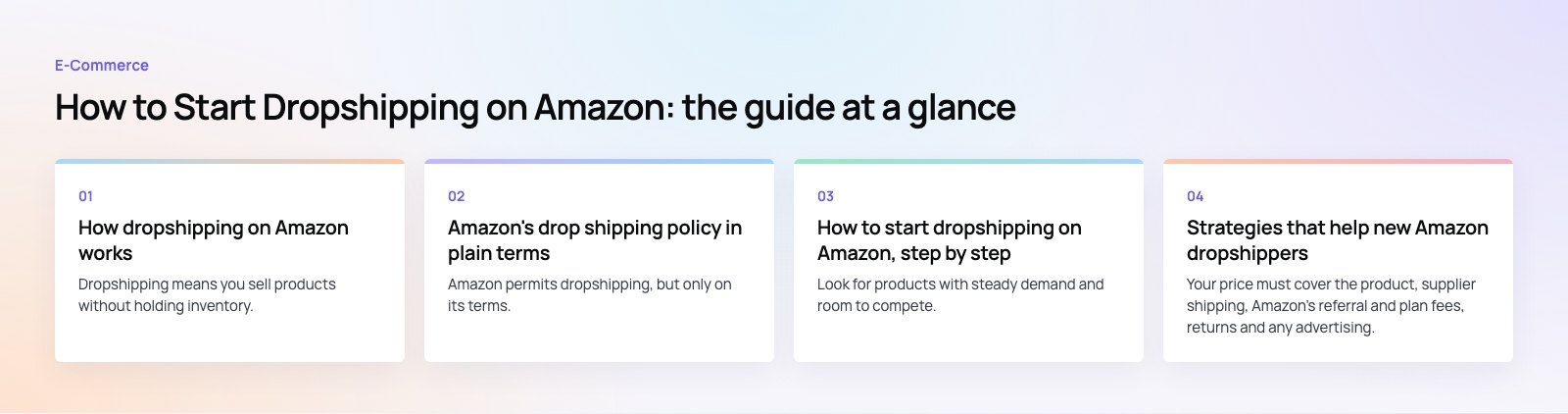
How to start dropshipping on Amazon, step by step
1. Research a niche and check category rules
Look for products with steady demand and room to compete. Study search results, competing listings, customer reviews and questions to find gaps you can fill, such as better descriptions, bundles or faster delivery. At the same time, check whether the category is restricted or needs approval, and whether the brands you plan to sell allow resellers.
2. Choose your selling plan and register
Register through Amazon Seller Central with your business details, identity documents, bank account and tax information. Amazon offers an Individual plan, which charges per item sold, and a Professional plan, which charges a monthly subscription and opens more selling tools. Compare current fees on Amazon's selling plans page. Sellers who expect regular volume usually choose Professional.
3. Find and vet a supplier
Your supplier must be willing to ship blind or under your branding, with no supplier invoices or marketing in the box. Confirm they are authorized to sell the brands they offer, ask for dispatch times in writing and order samples before listing.
4. Create listings
Match existing product listings where they exist, or create new ones if you have the rights to do so. Write clear titles with the terms buyers search for, use accurate bullet points and specifications, and add good images. Set handling times that your supplier can actually meet.
5. Keep stock, prices and orders in sync
Overselling a product the supplier has run out of leads to cancellations, which damage your account health. Sync inventory from the supplier frequently, forward orders the same day and upload tracking as soon as the supplier ships.
6. Handle customer service and returns
As seller of record, you answer customer messages and process returns within Amazon's time limits. Agree a returns process with your supplier before your first sale.
Strategies that help new Amazon dropshippers
| Strategy | Why it matters | How to apply it |
|---|---|---|
| Product research | Picks products with demand you can serve profitably | Study reviews and questions on competing listings for unmet needs |
| Optimized titles and content | Titles and keywords drive visibility in Amazon search | Lead with the product type and key attributes, keep it readable |
| Careful pricing | Amazon fees, shipping and returns eat into thin margins | Calculate total cost per order before setting a price |
| Strong account health | Late shipments and cancellations hurt visibility and can restrict selling | Watch metrics daily and fix problems quickly |
| Promotions | Coupons and deals can lift conversion on new listings | Use Amazon's promotion tools and check the margin first |
Price for the full cost, not the supplier cost
Your price must cover the product, supplier shipping, Amazon's referral and plan fees, returns and any advertising. Many new dropshippers price close to competitors and only later discover they lose money on each order. Build a simple per order calculator before listing.
Protect your account health
Amazon watches late shipment, cancellation and order defect rates, along with customer feedback. Dropshipping makes these harder to control because you depend on someone else to ship. Choose suppliers with dependable dispatch, set realistic handling times and respond to messages quickly.
Build a brand where you can
Reselling the same generic product as dozens of other sellers turns into a price fight. Bundles, private label products made by your supplier, or a clear niche give buyers a reason to choose your listing.
How to choose a reliable dropshipping supplier
- Policy fit. They must ship without their own invoices or branding, so you meet Amazon's rules.
- Authorization. They should have the right to sell the brands they supply, with paperwork to prove it.
- Stock depth. They should handle peak periods without running out or delaying orders.
- Dispatch speed. Ask for typical dispatch times and check them with test orders.
- Quality. Order samples and check packaging as well as the product.
- Data. A stock feed or API makes inventory sync far more reliable than manual updates.
- Clear charges. Prefer suppliers who charge per order with transparent shipping costs over fixed monthly fees you pay whether or not you sell.
Mistakes that get new sellers into trouble
- Retail arbitrage dropshipping. Ordering from another online store and shipping to your Amazon customer breaks the policy.
- Listing restricted products or brands you are not authorized to sell.
- Overselling because stock is not synced.
- Setting handling times shorter than the supplier can meet.
- Ignoring returns until customers file claims.
Amazon or your own store?
Amazon brings buyers who are ready to purchase, but you follow its rules, pay its fees and do not own the customer relationship. Many sellers use Amazon alongside their own online store, where they control branding, pricing and customer data. If you want a store of your own next to your marketplace sales, Codeeo builds them on Shopify and WooCommerce through our Shopify developers and WooCommerce developers, and our digital marketing team helps bring traffic to it. A platform fit review is a quick way to decide which setup suits your products.
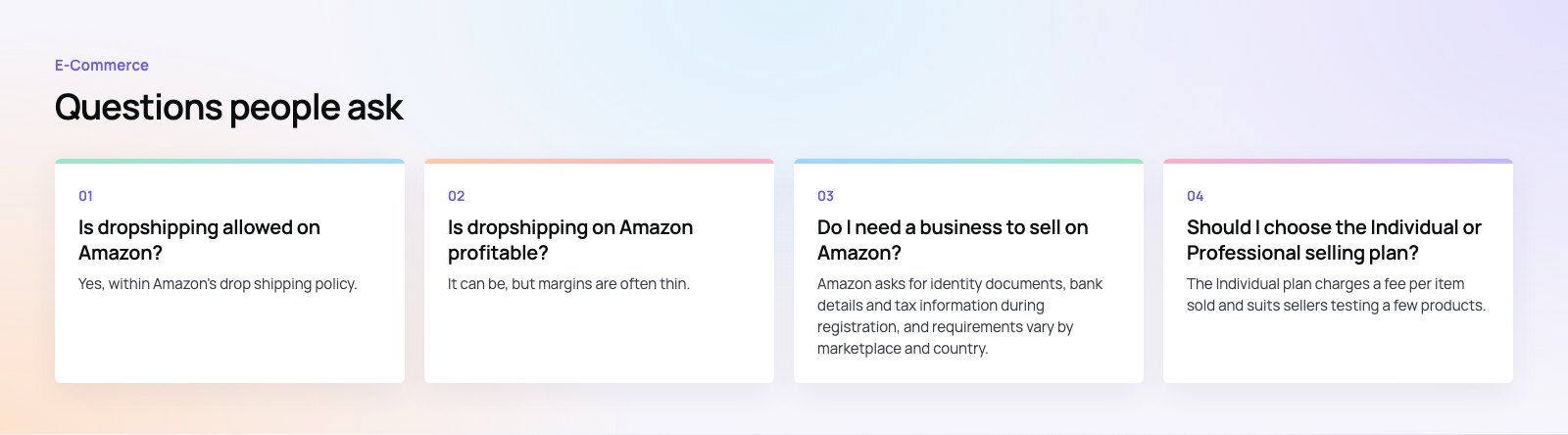
Frequently asked questions
Yes, within Amazon's drop shipping policy.
You must be the seller of record, appear as the seller on all packing slips, invoices and packaging, remove any supplier paperwork before shipping, and handle returns yourself. Buying from another online retailer and having it ship to your customer is not allowed when the shipment shows that retailer rather than you. Breaking the rules can lead to selling restrictions or suspension.
E-CommerceGenerative AI in Online Retail: Uses That Pay BackGenerative AI ecommerce uses ranked by payback and risk: product descriptions, AI search and support assistants, plus Arabic quality checks for UAE stores. E-CommerceConnecting WooCommerce to ERP, CRM and Shipping Without DuplicatesPlan a WooCommerce ERP integration that avoids duplicates: data ownership rules, idempotent order sync, CRM matching and UAE shipping, with Odoo and Dynamics.
 E-CommerceEnterprise Ecommerce Platform Selection: Requirements Before DemosChoose an enterprise ecommerce platform by setting integration, multi entity, data residency and order management requirements before any vendor demo starts.
Tell us what the business needs. We will tell you what to build first.
Schedule a free consultation and get a written recommendation, with costs, before you commit to anything.
Get in touchPROVEN RESULTS
4.7 / 5verified reviews on Google