 App DevelopmentProtecting Your Website Content From Copying and ScrapingHow to protect website content from copying and scraping: AI crawler rules in robots.txt, scraper controls, DMCA takedowns and UAE copyright basics explained.
Real Estate Management App Development: What to Consider
Planning a real estate management app: user types, core features, custom versus off the shelf, payments, regulation, challenges and benefits.
Real estate management app development is worth considering when you manage enough properties, tenants or listings that email, spreadsheets and phone calls can no longer keep up. A custom app brings leases, rent collection, maintenance requests, documents and tenant communication into one system that owners, managers and tenants can use from their phones. It pays off most when your operation has workflows that generic property software does not handle well.
This guide walks through what to consider before you build, the features that matter, the challenges to expect and the benefits a well built app can bring.
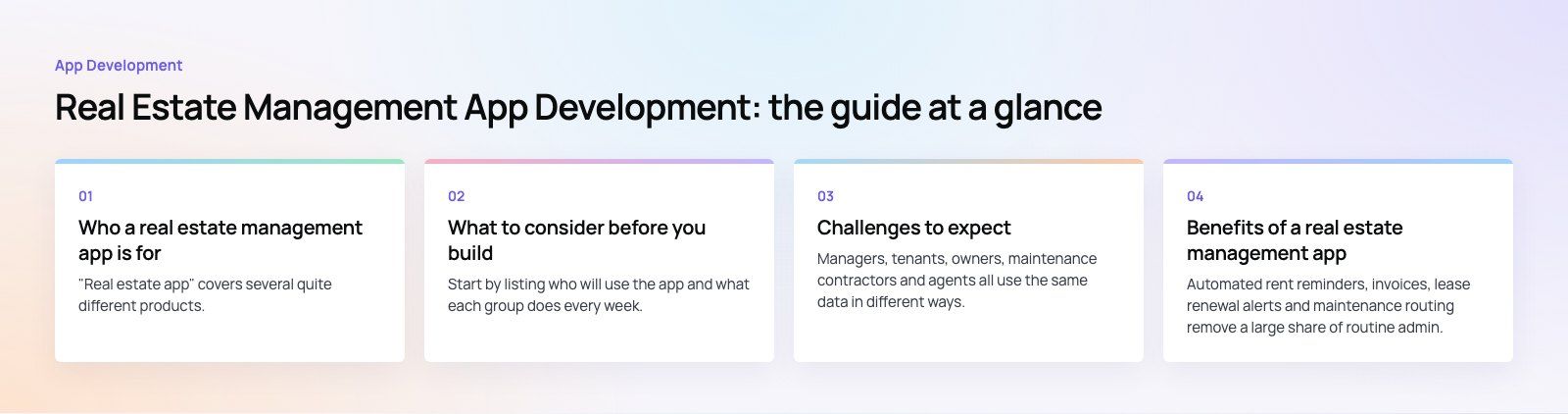
Who a real estate management app is for
"Real estate app" covers several quite different products. Be clear which one you are building, because the users and features change completely:
- Property management apps for landlords and managers who handle leases, rent, maintenance and tenant communication.
- Tenant or resident apps for paying rent, raising requests, booking shared facilities and receiving notices.
- Brokerage and listings apps for agents who manage listings, leads, viewings and offers.
- Owner and investor portals that show income, expenses, occupancy and statements across a portfolio.
Many businesses need two of these working together, such as a manager dashboard and a tenant app sharing the same data. Our real estate industry page covers the kinds of platforms property businesses tend to need.
What to consider before you build
Your users and their daily tasks
Start by listing who will use the app and what each group does every week. A property manager wants to see overdue rent and open maintenance jobs at a glance. A tenant wants to pay and report a leak in under a minute. A landlord wants a monthly statement. Each group needs its own flow through the app, and trying to serve everyone on one screen makes the app harder for all of them.
Core features
Common features in a property management app include:
- Property, unit and tenant records
- Lease management with renewal reminders
- Online rent collection, invoices and receipts
- Maintenance requests with photos, assignment and status updates
- Document storage for contracts, IDs and inspection reports
- Messaging and notices between managers and tenants
- Owner statements and financial reports
- Listings and vacancy management
Pick the handful that solve your biggest pain points for the first release. Extras such as virtual tours, digital lease signing or facility booking can follow once the core is working.
Custom build or off the shelf
| Approach | Strengths | Weaknesses |
|---|---|---|
| Off the shelf property software | Quick to start, proven features | Fixed workflows, per unit subscription, limited branding |
| Off the shelf plus custom integrations | Keeps a proven core, fills gaps | Depends on the vendor's API and roadmap |
| Fully custom app | Fits your process, your brand, your data | Longer to build, you own maintenance |
Custom makes sense when you run a large or unusual portfolio, need a branded tenant experience, combine several services (for example management plus brokerage), or have local rules that packaged tools do not support.
Integrations
Plan connections to accounting software, your CRM, payment gateways, listing portals and any access control or smart building systems. Decide which system holds the master record for each tenant and property. Payment integration needs particular care because it involves recurring charges, partial payments, refunds and reconciliation.
Regulation and data protection
Real estate is regulated differently in every market. Tenancy rules, deposit handling, contract registration, fair housing obligations and advertising permits vary by country and city. Check which apply where you operate and build them into workflows rather than relying on staff to remember. Tenant data includes identity documents and financial details, so plan encryption, access controls and retention rules from the start. If you take card payments, the PCI Security Standards Council sets the card data rules your payment setup must meet; using a hosted payment page from your gateway keeps most of that burden off your own servers.
Cost drivers and ongoing support
Cost is shaped by the number of user types, the number of integrations, payment complexity, whether you need native apps for both iOS and Android, and reporting depth. After launch, budget for hosting, bug fixes, operating system updates and new features as your portfolio grows.
Challenges to expect
Many user types with different needs
Managers, tenants, owners, maintenance contractors and agents all use the same data in different ways. Getting permissions right so each group sees only what it should is one of the hardest parts of the build. Test every role thoroughly.
Payments and reconciliation
Rent rarely arrives neatly. Tenants pay late, pay in part, pay by different methods or pay several units at once. The app must match payments to charges correctly and give finance a clear audit trail.
Integrating existing systems
Most property businesses already run accounting software and a CRM, sometimes with years of data in them. Migrating or syncing that data cleanly takes planning, and poor integration creates the very data silos the app was meant to remove.
Adoption by staff and tenants
Some staff are comfortable with their current routine and some tenants will prefer to call. Keep common tasks simple, make the app the fastest route for rent and maintenance, and phase out the old channels gradually.
Competing with established products
If you plan to sell the app to other property firms rather than use it internally, you will be up against mature products. Find a specific gap, such as a niche property type or an underserved market, and build around it.
Performance and reliability
Tenants expect payments and requests to work every time. Crashes, slow screens or failed payments quickly lead to calls and complaints. Monitoring, automated testing and a clear process for releases keep quality steady.
Benefits of a real estate management app
Less manual work
Automated rent reminders, invoices, lease renewal alerts and maintenance routing remove a large share of routine admin. Managers can look after more units without adding headcount at the same rate.
Faster maintenance
Tenants report issues with photos, the right contractor is assigned and everyone sees the status. Jobs close faster and fewer requests are lost in email threads.
Better cash flow visibility
Online payments, automatic reminders and real time reports show who has paid, who is late and what each property earns. Owners get statements without manual preparation.
One place for records
Leases, inspection reports, IDs and correspondence are stored against the right unit and tenant, which helps with disputes, audits and handovers between staff.
Happier tenants
Clear communication, quick responses and easy payment make renting less stressful. Tenants who have a good experience are more likely to renew.
Room to grow
A system built around your processes scales as you add buildings, cities or services, without a new tool for each one.
Getting started
- Choose the main product type: management, tenant, brokerage or owner portal.
- List each user group and their top weekly tasks.
- Map the systems you already use and the data in them.
- Check the local rules that affect leases, deposits and payments.
- Scope a first release around rent, maintenance and leases.
- Pilot with one building or portfolio, then expand.
Patterns from other products carry over well. The Remin Diary app handles notes, checklists, documents and renewal dates with reminders, and Lynxnet lets providers list services while customers book, chat and resolve disputes through an admin.
If you are planning a property platform, Codeeo's mobile app development and custom software teams can help you scope it, connect it to your finance and CRM systems and launch a first version tenants will use. We are a team of 80+ across Dubai, Riyadh and Karachi with 200+ projects delivered across the UAE and the US. Contact us to discuss your portfolio.
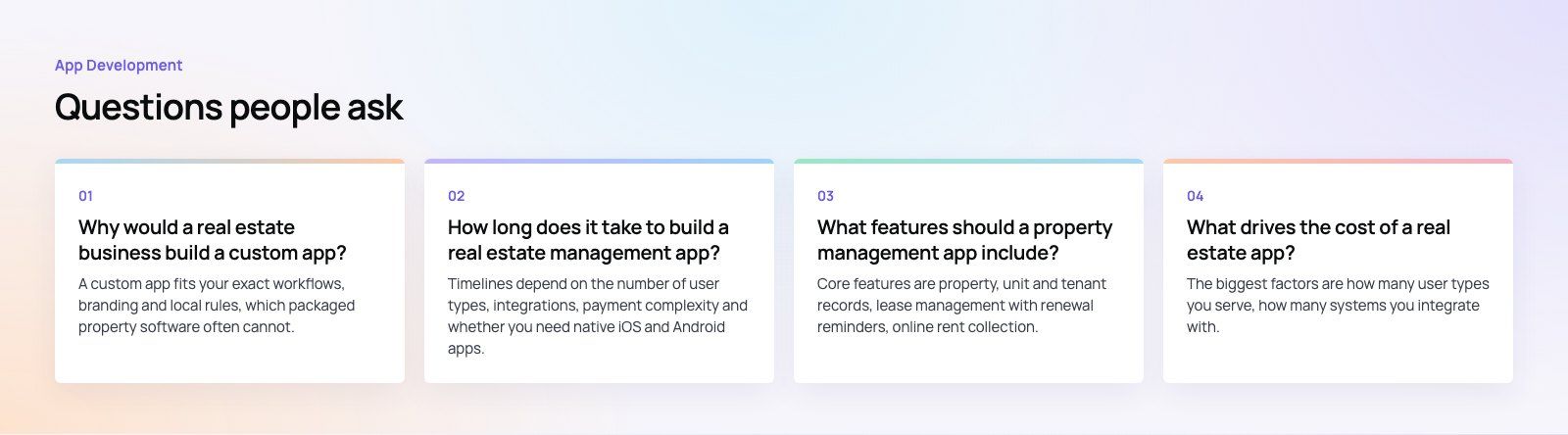
Frequently asked questions
A custom app fits your exact workflows, branding and local rules, which packaged property software often cannot.
It makes sense when you manage a large or unusual portfolio, combine services such as management and brokerage, want a branded tenant experience, or need integrations a vendor does not offer. It also means you own the product and its data rather than renting access per unit.
App DevelopmentProtecting Your Website Content From Copying and ScrapingHow to protect website content from copying and scraping: AI crawler rules in robots.txt, scraper controls, DMCA takedowns and UAE copyright basics explained. App DevelopmentWeb Application Penetration Testing: When It Is NecessaryWeb application penetration testing explained: when contracts, launches or major changes make it necessary, how it differs from scanning and how to prepare.
 App DevelopmentSteganography Explained: How Data Hiding Works and Is DetectedSteganography in cybersecurity explained: common data hiding techniques, how attackers use them, legitimate digital watermarking and how steganalysis works.
Tell us what the business needs. We will tell you what to build first.
Schedule a free consultation and get a written recommendation, with costs, before you commit to anything.
Get in touchPROVEN RESULTS
4.7 / 5verified reviews on Google