 Web DevelopmentWordPress VIP or Self Hosted Enterprise WordPress in the UAEWordPress VIP or self hosted enterprise WordPress in the UAE: compare data residency, hosting SLA, cost drivers and code review rules, plus key setup notes.
Static vs Dynamic Websites: Differences and Which to Choose
How static and dynamic websites differ in speed, security, hosting and editing, where each fits, and how hybrid builds give you the best of both.
A static website serves the same prebuilt files to every visitor, while a dynamic website builds each page on request from a database, so content can change by user, time or action. Static sites are faster, cheaper to host and harder to attack, which makes them ideal for brochure sites, portfolios and campaign pages. Dynamic sites are needed when people log in, buy, book, search or see personalized content.
The line between the two has blurred in recent years. Many modern sites are built statically but pull in dynamic features where needed, and many dynamic sites cache pages so they load almost like static ones. This guide explains both types, where each one fits, and how to choose.
What is a static website?
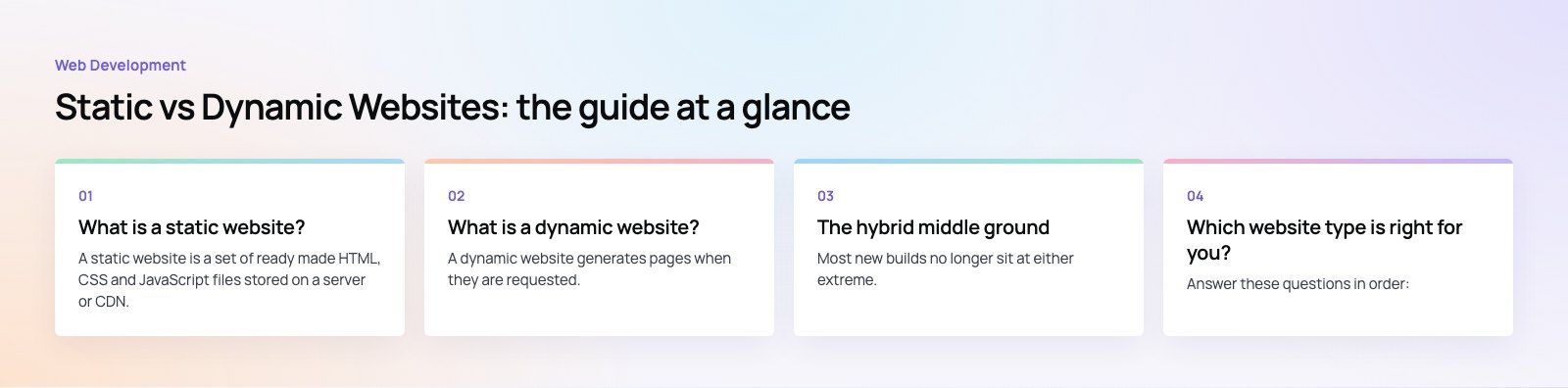
A static website is a set of ready made HTML, CSS and JavaScript files stored on a server or CDN. When someone visits a page, the server simply sends the file. Nothing is calculated or looked up in a database, so every visitor sees the same content until someone edits and republishes it.
Static sites used to mean hand coded HTML that only a developer could change. Today they are usually produced by a static site generator or a framework such as Next.js, Astro or Hugo, often connected to a headless CMS. Editors change content in a friendly interface, and the site rebuilds itself automatically.
Typical static websites
- Brochure sites for service businesses that list services, team and contact details.
- Portfolios for designers, photographers, architects and agencies.
- Landing pages for ad campaigns with a single call to action.
- Event sites with a schedule, speakers and venue information.
- Documentation and help centers that change in planned releases.
What is a dynamic website?
A dynamic website generates pages when they are requested. Server side code, written in a language such as PHP, Python, Node.js, Ruby or C#, reads from a database, applies business rules and returns HTML or data. That allows the content to depend on who is visiting and what they do.
Typical dynamic websites
- Online stores with live stock, carts, checkout and order history.
- Booking platforms for clinics, salons, hotels and services.
- Membership and learning sites where users log in to see their own content and progress.
- News and media sites that publish many times a day.
- Marketplaces and portals with accounts, listings, messages and dashboards.
- Content managed websites on platforms like WordPress, where pages are assembled from the database on request.
Static vs dynamic websites compared
| Feature | Static website | Dynamic website |
|---|---|---|
| How pages are made | Built in advance and served as files | Generated on request from code and a database |
| Speed | Very fast, served straight from a CDN | Depends on server, queries and caching |
| Security | Small attack surface, no database to breach | More moving parts to patch and protect |
| Hosting | Simple and low cost, often on a CDN | Needs a server or platform that runs code and a database |
| Content updates | Through a CMS and rebuild, or code changes | Instant through an admin panel |
| User accounts and personalization | Not built in, added through third party services | Native |
| Ecommerce | Possible with a headless commerce backend | Native on platforms like WooCommerce and Magento |
| Ongoing maintenance | Low | Regular updates for core, plugins and server |
| Best for | Brochure sites, portfolios, landing pages, docs | Stores, bookings, portals, memberships, news |
Advantages and trade offs of static sites
Advantages
- Speed. Prebuilt files served from a CDN close to the visitor load quickly, which helps both conversions and Core Web Vitals, the loading, responsiveness and stability metrics described in Google's web.dev guidance.
- Security. With no database or server side code exposed to the public, common attacks such as SQL injection simply do not apply.
- Reliability. A CDN can absorb traffic spikes from a campaign or press mention without the site slowing down.
- Low running costs. Hosting is simple and maintenance is light.
Trade offs
- Interactivity needs extra services. Forms, search and comments rely on third party tools or small serverless functions.
- Rebuild time. Very large sites with thousands of pages can take a while to rebuild after each change, although incremental builds help.
- Editor experience. Without a headless CMS, every change needs a developer.
Advantages and trade offs of dynamic sites
Advantages
- Real time content. Stock levels, prices, availability and news update instantly.
- Personalization. Users see their own orders, bookings, courses and recommendations.
- Easy editing. Platforms like WordPress let non technical teams publish and update pages directly.
- Rich features. Accounts, payments, search, filtering and dashboards are built in or easy to add.
Trade offs
- Performance work. Without caching and query tuning, pages slow down as traffic and data grow.
- Security upkeep. Core software, plugins and the server need regular updates.
- Higher hosting and maintenance effort. More components mean more to monitor and back up.
The hybrid middle ground
Most new builds no longer sit at either extreme. Frameworks such as Next.js let you choose per page: marketing pages are generated statically, product pages are regenerated in the background when data changes, and account pages are rendered on the server for each user. A headless CMS feeds content to all of them.
The same idea applies to stores. A headless commerce setup keeps the catalog, cart and checkout in a commerce backend while the storefront is served as fast, largely static pages. This gives you the speed of a static site with the features of a dynamic one, at the cost of a more complex build.
Going the other way, a dynamic WordPress site with good page caching and a CDN can serve most visitors cached HTML, so it behaves much like a static site for anonymous traffic.
The Diyafah case study covers a bilingual school website built on Strapi, right to left from the start.
Which website type is right for you?
Answer these questions in order:
- Do visitors need to log in, pay, book or see their own data? If yes, you need dynamic features, either a fully dynamic platform or a hybrid build.
- How often does content change, and who changes it? If marketing staff publish weekly, you need a CMS. That can be a traditional dynamic CMS or a headless CMS feeding a static or hybrid front end.
- How important is raw speed? For paid campaign landing pages and sites competing hard in search, static or hybrid pages give you a head start.
- Who will maintain it? A static site needs little upkeep. A dynamic platform needs someone to apply updates and watch security.
- Will the site grow into an application? If you expect to add accounts or ecommerce later, choose a stack that can grow, rather than rebuilding from scratch.
As a rule of thumb, a small service business that mainly needs to be found and contacted is well served by a static or hybrid site. A business that sells, books or serves logged in users needs dynamic features, and a platform like WordPress or Shopify is often the quickest way to get them. If you are torn between options, a platform fit review will compare them against your actual requirements.
Switching from static to dynamic later
Moving from a static site to a dynamic one is common as a business grows. The content usually carries over, but the templates and hosting change, and URLs must be preserved with redirects to protect search rankings. Planning a hybrid stack from the start often avoids the full rebuild, because dynamic pages can be added alongside the static ones.
Choosing your build
Static and dynamic are not rival camps any more but two ends of a scale, and the best sites pick the right approach page by page. Codeeo has delivered 200+ projects across the UAE and the US, from fast marketing sites to full portals and stores. Our web development team can help you choose the right mix and build it.
Frequently asked questions
A static website serves prebuilt files, so every visitor sees the same content until it is republished.
A dynamic website generates pages on request using server side code and a database, so content can change by user, time or action. Static sites are faster and simpler to run, while dynamic sites support logins, payments, bookings and personalized content.
Web DevelopmentWordPress VIP or Self Hosted Enterprise WordPress in the UAEWordPress VIP or self hosted enterprise WordPress in the UAE: compare data residency, hosting SLA, cost drivers and code review rules, plus key setup notes. Web DevelopmentWhat a WordPress Maintenance SLA Should CoverWhat WordPress maintenance services should cover in writing: core and plugin updates, security, backups, multilingual publishing support and response times.
 Web DevelopmentWordPress Release Management: Staging, QA and RollbackA WordPress deployment workflow that releases safely: Git based builds, a staging site that mirrors live, smoke tests to run and a rollback plan written first.
Tell us what the business needs. We will tell you what to build first.
Schedule a free consultation and get a written recommendation, with costs, before you commit to anything.
Get in touchPROVEN RESULTS
4.7 / 5verified reviews on Google