 E-CommerceGenerative AI in Online Retail: Uses That Pay BackGenerative AI ecommerce uses ranked by payback and risk: product descriptions, AI search and support assistants, plus Arabic quality checks for UAE stores.
WooCommerce ERP Integration: Approaches, Systems and Steps
How to integrate WooCommerce with an ERP: what to sync, which system owns each record, connectors versus custom APIs, and a step by step process.
WooCommerce ERP integration connects your online store to the system that runs your stock, purchasing, finance and fulfillment, so orders, products, inventory and customers flow between them automatically. It removes double entry, keeps stock figures in line across channels and gives finance clean order data without exports. For a growing store, it is usually the point where ecommerce stops being a side system and becomes part of how the business actually runs.
This guide covers what to sync, the main integration approaches, ERP systems that commonly sit behind WooCommerce, a step by step process and the mistakes to avoid.
Why integrate WooCommerce with an ERP
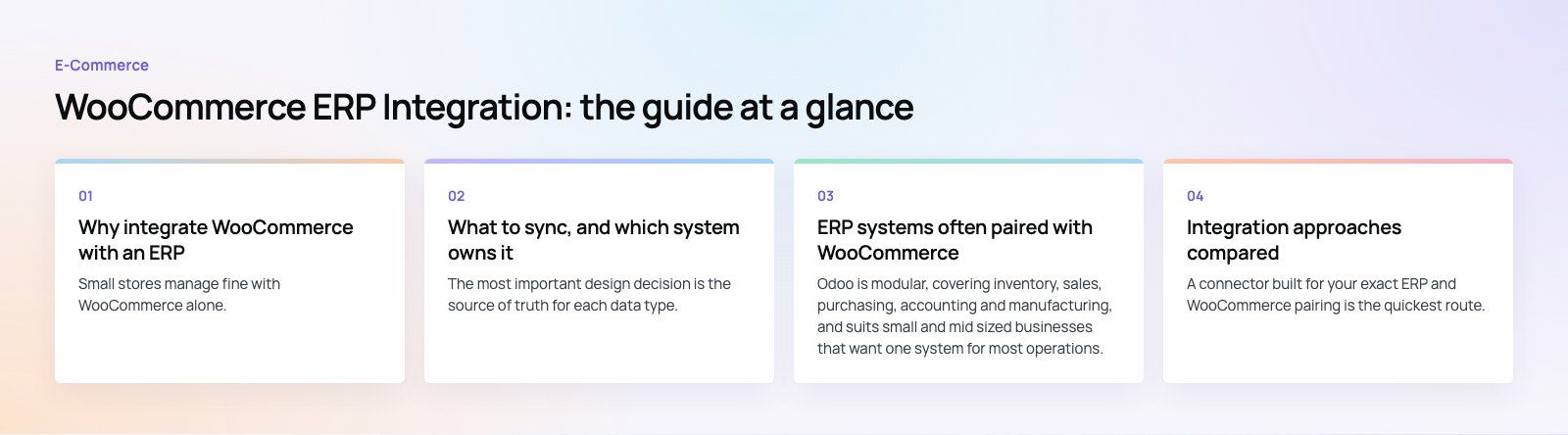
Small stores manage fine with WooCommerce alone. Problems appear as volume grows or when you also sell through shops, wholesale accounts or marketplaces:
- Staff retype web orders into the ERP, which is slow and error prone.
- Stock is updated in two places, so the website sells items the warehouse no longer has.
- Prices and product data drift apart between the ERP and the store.
- Finance reconciles payments and refunds by hand at month end.
Integration fixes these by making one system the owner of each type of data and syncing the rest automatically. Orders are created in the ERP the moment they are placed, stock changes flow back to the store, and invoices, shipments and refunds stay consistent.
What to sync, and which system owns it
The most important design decision is the source of truth for each data type. A typical split looks like this:
| Data | Usual owner | Direction |
|---|---|---|
| Products, SKUs and attributes | ERP | ERP to WooCommerce |
| Marketing content and images | WooCommerce | Stays in WooCommerce |
| Prices and price lists | ERP | ERP to WooCommerce |
| Stock levels | ERP | ERP to WooCommerce, near real time |
| Orders | WooCommerce at creation | WooCommerce to ERP |
| Fulfillment and tracking | ERP or warehouse system | ERP to WooCommerce |
| Customers | Depends on B2B or B2C | Usually two way |
| Refunds and returns | Agreed per process | Two way with clear rules |
Write this table for your own business before choosing any tool. It tells you exactly what the integration has to do.
ERP systems often paired with WooCommerce
Odoo
Odoo is modular, covering inventory, sales, purchasing, accounting and manufacturing, and suits small and mid sized businesses that want one system for most operations. WooCommerce connectors are available from third parties, and custom integrations are common where stores have complex products. See our Odoo services for how we approach it.
Microsoft Dynamics 365 Business Central
Business Central covers finance, inventory, purchasing and sales for growing businesses, and fits well where a company already runs Microsoft 365. Integration usually goes through its APIs, often with Azure services in between. Read more on Business Central and the wider Dynamics 365 family.
SAP Business One
SAP Business One targets small and mid sized companies that need strong inventory, purchasing and financial controls. Integration typically uses its service layer API or a partner connector.
Oracle NetSuite
NetSuite is a cloud ERP used by many multi entity and fast growing ecommerce businesses. It is commonly connected to WooCommerce through integration platforms or custom code against its APIs.
Sage
Sage products are widely used for accounting and inventory, especially in mid sized companies. Integration options depend on which Sage product and version you run, so check API access early.
Integration approaches compared
Ready made connectors and plugins
A connector built for your exact ERP and WooCommerce pairing is the quickest route. It works well when your data model is standard. Check how it handles variations, bundles, taxes, multiple warehouses and failures before committing. Accounting focused tools such as Webgility cover order and financial sync for stores whose main need is clean bookkeeping rather than full ERP integration.
Integration platforms (middleware)
An integration platform sits between WooCommerce and the ERP, maps fields and runs scheduled or event based syncs. It suits businesses with several systems to connect, since one platform can handle the store, ERP, marketplaces and shipping. You pay for the platform and still need someone to design and maintain the mappings.
Custom API integration
A custom integration uses the WooCommerce REST API and webhooks on one side and the ERP's API on the other. It takes longer to build but handles unusual products, B2B pricing, complex tax rules and high order volumes exactly as you need. You also control logging, retries and alerts.
| Approach | Speed to launch | Flexibility | Best for |
|---|---|---|---|
| Connector or plugin | Fast | Limited | Standard catalogs and processes |
| Integration platform | Medium | Good | Several systems to connect |
| Custom API integration | Slower | Full | Complex catalogs, B2B, high volume |
Step by step integration process
- Document your processes. Map how an order moves from checkout to delivery and invoice today, including returns and partial shipments.
- Agree on data ownership. Fill in the ownership table above and get sign off from operations and finance.
- Choose the approach. Compare connectors, platforms and custom options against your ownership table and volume.
- Clean the data. Align SKUs, units of measure, tax codes and customer records in both systems before the first sync. Bad data synced faster is still bad data.
- Map the fields. Match every product, order, customer and payment field, including variations, discounts, shipping and taxes.
- Build error handling. Decide what happens when a sync fails: retries, a queue, alerts to a named person and a log you can search.
- Test with real scenarios. Run orders with discounts, mixed tax, partial refunds, out of stock items and cancelled payments in a staging environment.
- Go live in stages. Start with one direction or one data type, watch it closely, then switch on the rest.
- Monitor and maintain. WooCommerce, plugins and ERP updates can all change behavior, so check logs and retest after major updates.
Common mistakes to avoid
- Two systems editing the same field. If both the store and the ERP can change a price, they will eventually overwrite each other.
- Syncing stock too slowly. An hourly stock sync is fine for some stores and causes overselling in others. Match frequency to how fast stock moves.
- Ignoring variations and bundles. Variable products and kits are where most connectors struggle. Test them first.
- No owner for failures. Silent sync errors are the most expensive kind. Someone must receive and act on alerts.
- Skipping performance testing. Sales peaks generate bursts of orders and stock updates. Make sure the integration and hosting can handle them.
Where to start
Begin with the data ownership table and a list of the order scenarios that cause the most manual work today. That alone narrows the choice of approach and gives any developer a clear brief. Large catalogs need extra care: the Clock Springs Australia store, for example, is a WooCommerce parts store with 4,540 parts across 37 makes, fitment on every product and trade pricing, which is exactly the kind of data an ERP sync has to respect.
If you want WooCommerce and your ERP working as one system, Codeeo's WooCommerce developers and integration specialists can design the data flows, build the connection and keep it running. We are a team of 80+ across Dubai, Riyadh and Karachi with 200+ projects delivered across the UAE and the US. Get in touch to talk about your setup.
Frequently asked questions
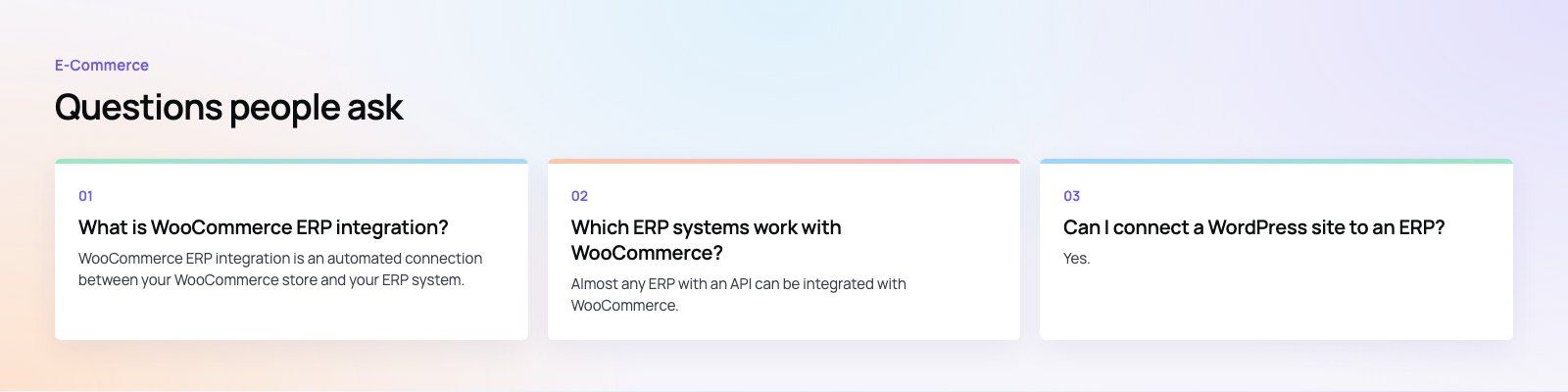
WooCommerce ERP integration is an automated connection between your WooCommerce store and your ERP system.
Products, prices and stock usually flow from the ERP to the store, while orders and customer details flow from the store to the ERP. Fulfillment, tracking and refunds are synced too. The goal is that nobody retypes data and every system shows the same figures.
E-CommerceGenerative AI in Online Retail: Uses That Pay BackGenerative AI ecommerce uses ranked by payback and risk: product descriptions, AI search and support assistants, plus Arabic quality checks for UAE stores. E-CommerceConnecting WooCommerce to ERP, CRM and Shipping Without DuplicatesPlan a WooCommerce ERP integration that avoids duplicates: data ownership rules, idempotent order sync, CRM matching and UAE shipping, with Odoo and Dynamics.
 E-CommerceEnterprise Ecommerce Platform Selection: Requirements Before DemosChoose an enterprise ecommerce platform by setting integration, multi entity, data residency and order management requirements before any vendor demo starts.
Tell us what the business needs. We will tell you what to build first.
Schedule a free consultation and get a written recommendation, with costs, before you commit to anything.
Get in touchPROVEN RESULTS
4.7 / 5verified reviews on Google