 InsightsCybersecurity Best Practices for Engineering Teams: A Defense-in-Depth ApproachDefense-in-depth security architecture for engineering teams: zero-trust design, MFA, encryption, incident response, and compliance. Built on OWASP top 10 and industry benchmarks.
How to Become a Web and App Development Reseller in the UK
How UK agencies, MSPs and consultancies can resell web and app development, covering VAT, UK GDPR contracts, IP ownership and how to apply to Codeeo.

To become a web and app development reseller in the UK, you need three things: a trading entity that can contract with British clients, a delivery partner that will build under your name and your contract, and paperwork that settles VAT, data protection and intellectual property before the first project starts. You sell, you invoice, you own the relationship; the partner scopes and builds behind you. If you already sell technology services into UK businesses, you can apply to Codeeo's reseller programme and have your application reviewed within two business days.
What a web and app development reseller actually does
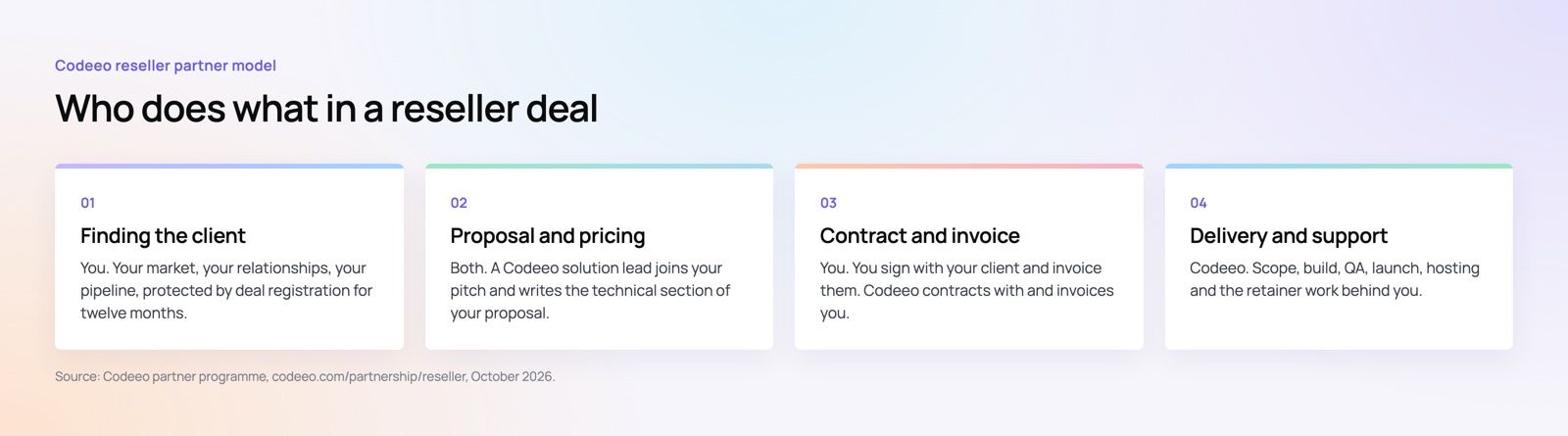
A reseller holds the commercial side of a technology project. You find the client, win the work, sign the contract in your own name and send the invoice. Your delivery partner sizes the job, designs it, builds it, tests it and launches it, then supports it afterwards. The client deals with you, and your name is on the work.
That is different from passing on a lead. When you resell, the contract is yours, so the renewal conversation is yours too.
Why UK firms add development to what they sell
Most firms that move into reselling do it because clients keep asking for things they cannot deliver. A creative agency designs a brand and then gets asked who will build the booking platform. An IT support company looks after a client's devices and Microsoft 365 tenancy and then gets asked to replace a creaking internal system. A consultancy writes a digital strategy and then watches the build go to another firm.
Reselling keeps that work inside the relationship you already have, without a permanent development bench that sits idle between projects.
Who buys these services in the UK
The demand comes from a broad base. Small and medium sized enterprises want websites that generate enquiries, ecommerce stores and simple customer apps. Scale ups need product work done quickly, often a web platform and companion mobile apps sharing one backend. Charities need donation flows, volunteer portals and content managed sites that a small team can update. Mid market firms need integrations, internal tools and ERP or CRM projects that touch finance, sales and operations at once.
All four groups tend to expect a written proposal with a clear scope, a named contact and a contract that addresses data protection and ownership. They are rarely moved by bold claims and ask detailed questions about process.
How the reseller model works with a delivery partner
Under Codeeo's model, the split looks like this. You keep the client relationship and the renewal conversation, the contract and the invoice to your client, your own price on top of the agreed margin, and the pitch, with Codeeo's solution lead beside you. Codeeo handles the scope and estimate within two business days; architecture, build, QA and launch; hosting, support and retainer work behind you; and deal registration with a quarterly review.
Codeeo contracts with you, not with your client, unless you ask Codeeo to contract directly. You invoice your client, and Codeeo invoices you in the currency and from the entity agreed in your contract.
What you can sell under one agreement
One reseller agreement with Codeeo covers the full catalogue: websites, apps, custom software, Dynamics 365, Odoo, design, developers and marketing. In practice that means an agency can lead with web development, an IT support firm can add mobile app development for a client's field teams, and a Microsoft partner can bring in Dynamics 365 implementation without signing a separate contract for each line.
Presales support when the pitch gets technical
UK procurement often asks for a technical section in the proposal, even for modest projects. Codeeo assigns a solution lead who joins your pitch, sizes the work and writes the technical section of your proposal. Standard scopes come back within two business days; anything that needs architecture work starts with a call with the solution lead first.
Setting up to resell in the UK
You do not need a special licence to resell web and app development in the UK. You do need a business structure that can sign contracts, take payment and carry the liability that comes with delivering software to clients.
Choosing a trading structure
GOV.UK sets out the main business legal structures. A sole trader is personally responsible for the business's debts. A limited company is legally separate from its owners, whose liability is generally limited to their investment, and it pays Corporation Tax on its profits. A limited company also carries more administration, including filing accounts and following the rules directors must keep.
For a reseller the liability point matters, because any claim lands on the contracting party. Many resellers therefore trade through a limited company. To form one, you register with Companies House, appoint at least one director, provide a registered office address and choose a SIC code that describes what the company does. Take advice from your accountant on which structure suits your circumstances.
VAT on what you sell to UK clients
The UK standard rate of VAT is 20%, and it applies to most goods and services. If you are VAT registered, website builds, app development and support retainers you sell to UK clients will normally be charged at the standard rate on your invoice. Your accountant will confirm when registration becomes compulsory for your turnover and whether voluntary registration makes sense earlier, since many business buyers expect to see a VAT number on supplier invoices.
VAT when your delivery partner is overseas
This is the point UK resellers most often miss. When a UK VAT registered business buys services from a supplier that belongs outside the UK, the reverse charge usually applies. HMRC's guidance on the place of supply of services (Notice 741A) states that the general rule for business to business services is that the supply is made where the customer belongs. Where the place of supply is the UK, the supplier belongs outside the UK and the customer belongs in the UK, the customer accounts for the VAT as if it were both supplier and recipient.
In practical terms, a UK reseller buying development from an overseas partner such as Codeeo receives an invoice without UK VAT, then accounts for the reverse charge on its own VAT return. Notice 741A sets out exceptions, including use and enjoyment provisions, so ask your accountant to confirm the treatment for your specific services before the first invoice arrives.
Data protection: UK GDPR and the Data Protection Act 2018
Almost every web or app project touches personal data: contact forms, bookings, logins, donor records. Data protection is part of the commercial setup, not a detail to sort out later.
Controller, processor and sub processor
In a typical reseller arrangement, your client is the controller: it decides why and how the personal data is used. You, as the contracted supplier, will usually act as a processor when you handle that data on the client's instructions. Your delivery partner, working behind you, then acts as a sub processor. The roles depend on the facts of each project, so map them before you sign.
The written contract the ICO expects
The Information Commissioner's Office is clear that every time a controller uses a processor there must be a written contract. The ICO also explains that a processor must have the controller's prior written authorisation before engaging a sub processor, and that the contract between processor and sub processor must offer an equivalent level of data protection.
For a reseller that means two documents. The first sits between you and your client and names your delivery partner as an authorised sub processor. The second sits between you and your partner and passes the same obligations down. Those obligations include processing only on documented instructions, confidentiality, security measures, help with data subject requests and breaches, and deleting or returning data at the end of the contract.
Why this matters more in the UK and Europe
UK buyers, especially charities and regulated mid market firms, increasingly ask suppliers to show their data processing terms during procurement. The UK and Europe is where most of Codeeo's white label delivery partners operate, and engagements there are GDPR aligned and run in UK English. That gives a UK reseller a starting point for the data processing schedule rather than a blank page.
Contracts and intellectual property
Ownership is the other clause UK clients read closely. Many assume that paying for a website means owning it. That is not automatic.
GOV.UK guidance on ownership of copyright works explains that for commissioned work the first legal owner of copyright is the person or organisation that created it, not the commissioner, unless the parties agree otherwise in writing. Without a clear term, the commissioner may only receive a limited non exclusive licence.
For a reseller, this means the chain of ownership must be written into both contracts. Your agreement with the delivery partner should assign or licence the work to you on terms that let you pass the same rights to your client. Your client contract should then state what the client owns, what stays licensed (such as third party components or reusable frameworks) and when ownership transfers, which is often on final payment.
The client contract should also cover change control, acceptance testing, liability limits, support terms and early termination. Match your liability to the client with your partner's liability to you as closely as possible.
Reseller, white label or referral: which model fits
Reselling is one of four ways to work with Codeeo. The others are white label delivery, referral and product partnership. You can see them together on the partnership overview. The table below compares the three most common for UK firms.
| Question | Reseller | White label delivery | Referral |
|---|---|---|---|
| Who holds the client contract | You | You | Codeeo |
| Who invoices the client | You | You | Codeeo |
| Whose brand the client sees | Yours, with Codeeo's solution lead beside you in the pitch | Yours only; Codeeo stays out of sight | Codeeo's, after your introduction |
| Who finds the client | You | You | You |
| Best fit | Firms with a sales team that want to carry the full catalogue in a market | Agencies that deliver under their own brand and need extra build capacity | Firms that want to introduce clients without running the project |
If you want Codeeo completely invisible to your clients, the white label delivery model is built for that. If you would rather introduce a client and step back, the referral model fits better. If you want to hold contracts, sell across a territory and grow terms with volume, reselling is the right choice.
Typical UK resellers and how they sell
Digital and creative agencies
Agencies already own the brand conversation and often the website brief. Reselling lets them take on larger platform builds, apps and integrations that sit outside their in house skills. The agency keeps its design lead and account management; the build happens behind it.
IT support companies and managed service providers
MSPs hold long running, trusted relationships with SME and mid market clients. Those clients ask them about line of business apps, customer portals and automations. Reselling turns those questions into projects and support retainers that sit naturally next to existing managed services.
Microsoft partners
Partners selling Microsoft 365 and Azure are often asked about Dynamics 365 and connected apps. One agreement covering all of it lets them say yes without a separate practice.
What a delivered project can look like
A good test of any delivery partner is the depth of the work it has shipped. Codeeo has delivered 200+ projects across the UAE and the US with a team of 80+ across Dubai, Riyadh and Karachi, and is rated 4.7 from 23 Google reviews. The team covers UK working hours, so your clients are not waiting overnight for answers.
One example is Distinct, a healthcare workforce platform with a catalogue, shifts, bookings, incident reports, reviews, rewards and a design system shared by web and admin. It is the kind of multi part platform a UK agency or consultancy might be asked to deliver for a client and could not easily staff in house.

More examples are in Codeeo's case studies.
What to check in any reseller agreement
Before you sign with any delivery partner, check the following points are written down rather than promised verbally.
- Margin and terms. With Codeeo, rates are set per territory and per service line in your agreement and improve as registered volume grows.
- Deal registration. Register an opportunity with Codeeo and it is yours for twelve months, with no second Codeeo route into the same account. If two partners bring the same account, the first valid registration on a named opportunity holds for twelve months.
- Minimums. Codeeo has no minimum volume, no quota and no certification gate. Terms move with volume, and nothing is withheld at the start.
- Territory. Your territory sets your default terms; it does not fence you in. Register an out of territory deal and Codeeo will look at it.
- Data processing terms. A written sub processor agreement that matches your obligations to your client.
- IP assignment. Rights in the work that flow from partner to you, and from you to your client.
- Invoicing. The currency and the contracting entity, so your accountant can apply the right VAT treatment.
How to apply to Codeeo's reseller programme
The process runs in four stages.
- Apply. Tell Codeeo your market, your client base and the service lines you want to carry. Applications are reviewed within two business days.
- Align. A call with your partner manager covers territory, lines, margin and deal registration, and all of it goes in writing.
- Enable. You receive a sales kit, pricing guidance, demo environments and a named solution lead.
- Grow. You register deals, review progress quarterly and move up the terms as volume builds.
Reselling fits firms that already sell technology services or software into a defined market, want to hold the contract and the client relationship, have a sales team but not the engineering bench, and are being asked for capabilities they currently turn away. If that describes your business, complete the reseller application at the bottom of the programme page.
Frequently asked questions
No specific licence is needed to resell web, app or software development services in the UK.
You need a business that can contract and invoice, usually a limited company registered with Companies House or a sole trader, plus VAT registration when your turnover requires it. You also need proper contracts covering data protection and intellectual property, because those are the areas UK clients and procurement teams check most closely.
InsightsCybersecurity Best Practices for Engineering Teams: A Defense-in-Depth ApproachDefense-in-depth security architecture for engineering teams: zero-trust design, MFA, encryption, incident response, and compliance. Built on OWASP top 10 and industry benchmarks. InsightsPostgreSQL JSON and JSONB: Complete Guide to Data Types and PerformanceMaster PostgreSQL JSON and JSONB data types: use cases, performance, indexing, real-world patterns, and when to use each.
 InsightsRedis Caching Patterns: Cache-Aside, Write-Through, and Operational StrategiesMaster Redis caching patterns: cache-aside, write-through, invalidation strategies, and operational best practices for production systems.
Tell us what the business needs. We will tell you what to build first.
Schedule a free consultation and get a written recommendation, with costs, before you commit to anything.
Get in touchPROVEN RESULTS
4.7 / 5verified reviews on Google