 InsightsHealth Information Management Websites Worth BookmarkingAHIMA, HIMSS, HealthIT.gov and HL7 FHIR explained: what each health information management website is for and what it means for health software teams.
How to Resell Web Development and Software Services in the US
How a US company becomes a web development reseller: entity and EIN, MSA and SOW contracts, IP ownership, state sales tax, and how to apply to Codeeo's reseller program.

To resell web development and software services in the United States, you form a business entity in your state, get an Employer Identification Number from the IRS, and sign a reseller agreement with a delivery partner that lets you sell its services under your own contract. You then sign a master services agreement and statements of work with each client, invoice them yourself, and check your own state's sales tax rules for the services you sell. Codeeo runs a web development reseller program built for exactly this, and you can apply to become a Codeeo reseller through the form on the reseller page.
This guide covers what that looks like for a US company: who buys these services, which companies tend to resell them, the paperwork, how contracts and intellectual property should be structured, where sales tax gets complicated, and how to describe your delivery partner without trouble from the Federal Trade Commission.
What reselling software and web services means in the US
Reselling services is different from reselling a software license. When you resell software development services, you sell a project or a retainer to your client, and a partner does the engineering. The client signs with you. You set your price, carry the relationship and handle renewals. The delivery partner prices its work to you, scopes it, builds it and supports it. Of the partner models on offer, reselling gives you the most control over the account and the most responsibility, because the contract and the invoice carry your name.
Who buys these services
- Small and midsize businesses. A regional manufacturer, a dental group or a distributor needs a new website, a customer portal or an integration between two systems. They want one trusted vendor, not a team of hires.
- Mid market companies. These buyers run ERP or CRM platforms and need custom modules, reporting or apps for field teams. They expect a formal proposal, a security conversation and a named contact.
- Startups. Founders need a web app plus iOS and Android apps built fast, and they care about who owns the code when they raise money.
Who typically resells
The companies that do well with an it services reseller program in the US already sell something technical and keep getting asked for more:
- Managed service providers whose clients keep asking for a new website or a line of business app.
- IT consultancies that advise on systems but keep no bench of developers.
- Marketing and branding agencies that design the brand and then lose the website or app build to someone else.
- Microsoft and ERP partners who implement Dynamics 365 or Odoo and need extra capacity for custom modules and integrations.
- Solo consultants with a client book, such as a fractional CTO, who hold relationships but not a delivery team.
How the Codeeo reseller model works
Codeeo is a web, app, software and marketing company with a team of 80+ across Dubai, Riyadh and Karachi. It has delivered 200+ projects across the UAE and the US, and it is rated 4.7 from 23 Google reviews. For the United States, Codeeo offers contracting, invoicing and delivery with overlap hours for US and Canadian clients. The team is not based in the US, but the working day is arranged so your clients get live calls during US business hours.
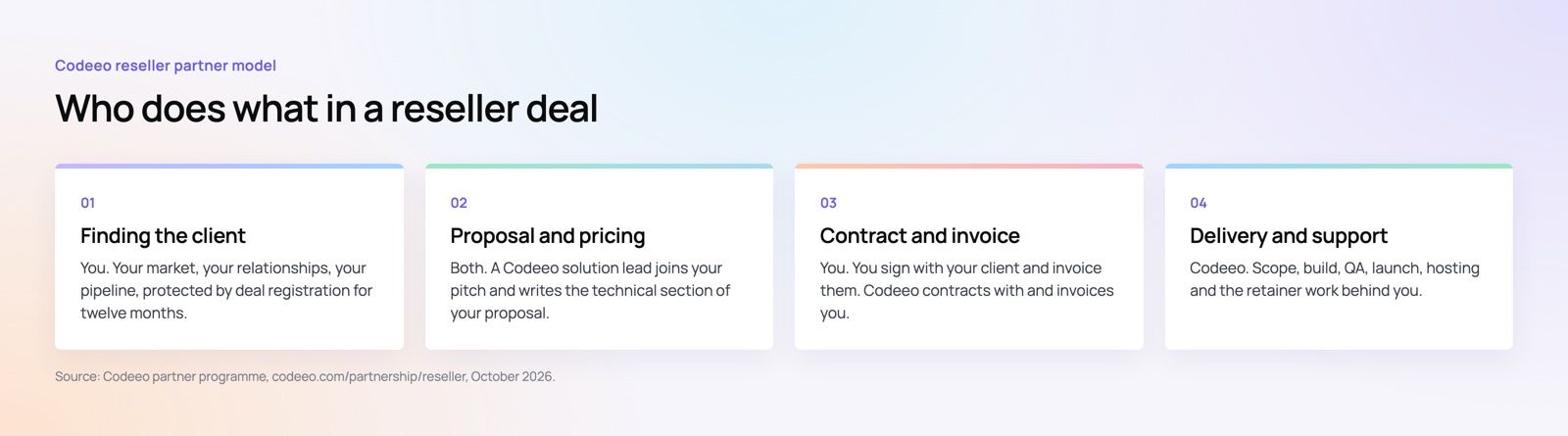
Under a reseller agreement, you take Codeeo's services to your market. You own the client and the contract; Codeeo prices, scopes and delivers behind you. One agreement covers the full catalog: websites, apps, custom software, Dynamics 365, Odoo, design, developers and marketing.
What you keep
- The client relationship and the renewal conversation.
- The contract and the invoice to your client.
- Your own price on top of the agreed margin.
- The pitch, with Codeeo's solution lead beside you.
What Codeeo does
- Scope and estimate within two business days.
- Architecture, build, QA and launch.
- Hosting, support and retainer work behind you.
- Deal registration and a quarterly review.
Codeeo contracts with you, not your client, unless you ask Codeeo to contract directly. You invoice your client; Codeeo invoices you, in the currency and from the entity agreed in your contract. Margins are set per territory and per service line in your agreement and improve as registered volume grows. There is no minimum volume, no quota and no certification gate.
Deal registration and pre-sales help
Register an opportunity and it is yours for twelve months, with no second Codeeo route into the same account. If two partners bring the same account, the first valid registration on a named opportunity holds. Mid market sales cycles in the US can run for months, so you need to know the account will still be yours when the purchase order arrives.
On larger deals, a Codeeo solution lead joins your pitch, sizes the work and writes the technical section of your proposal. Standard scopes come back within two business days; anything needing architecture work gets a call with the solution lead first.
Setting up your US business to resell services
Most of the US requires no special license to resell development services, but you do need a proper business structure, tax registration and clean contracts. Speak with an attorney and an accountant in your state before you sign your first client.
Choose a business entity
The SBA's guide to choosing a business structure notes that a sole proprietor can be held personally liable for the debts and obligations of the business, while LLCs protect owners from personal liability in most instances. For a reseller signing development contracts, that matters. If a project goes wrong and a client sues, you want the claim aimed at the company, not your house. Many small resellers start as an LLC; your accountant can tell you whether a corporation suits your plans better.
Get an EIN
An Employer Identification Number is your federal business tax ID. The IRS says you generally need one to hire employees, operate a partnership or corporation, or pay sales and excise taxes. Its EIN application page states that you never have to pay a fee for one, and advises forming your LLC or corporation with your state first to avoid delays. Clients will ask for your EIN on a Form W-9 before they pay you.
Register with your state
Your state may also require a sales tax permit, local business licenses and annual reports. The SBA's page on paying business taxes says tax laws vary by location and business structure, and links to every state's department of revenue so you can check your own obligations.
Contracts: the master services agreement and statements of work
Most US technology services are sold on a two layer contract. The master services agreement sets the general terms once: payment, confidentiality, warranties, limitation of liability, indemnities, insurance and intellectual property. Each project then gets a statement of work defining deliverables, milestones, acceptance criteria and fees.
As a reseller you sit between two contract stacks. Your client signs your MSA and SOWs; you sign a reseller agreement with your delivery partner. The terms you promise your client should be backed by the terms your partner promises you. Line up these clauses before you sign:
- Acceptance. If your client gets ten business days to accept a milestone, make sure you can pass defects back to your partner in time.
- Warranty and support. Any bug fix period you promise after launch should exist in your partner agreement too.
- Subcontracting and confidentiality. Some mid market buyers require consent before you subcontract, and your MSA should allow you to share their data with subcontractors bound by equal confidentiality terms.
Who owns the code and the client
Intellectual property is where US startups and mid market buyers ask the hardest questions. Work made by an outside contractor does not automatically belong to the company that paid for it. The US Copyright Office explains in Circular 30 on works made for hire (revised August 2024) that a commissioned work only counts as made for hire if it falls within one of nine listed categories and both parties sign a written agreement saying so. That is why US development contracts usually add a written assignment of rights that transfers ownership once the client has paid.
For a reseller, the chain has to be complete: your partner assigns the deliverables to you or your client, and your client MSA passes them on at payment. Ask your attorney to check that the documents connect.
The client relationship is a separate question from the code. In the Codeeo reseller program you own the client and the contract, and that is written into your agreement, not assumed.
What to check in a reseller agreement
| Clause | What to ask | Codeeo reseller program |
|---|---|---|
| Client ownership | Who holds the client relationship and the contract? | You own the client and the contract. |
| Contracting party | Does the partner sign with you or your client? | Codeeo contracts with you, unless you ask it to contract directly. |
| Invoicing | Who invoices whom, in which currency and from which entity? | You invoice your client; Codeeo invoices you as agreed in your contract. |
| Account protection | Can the partner approach your client directly? | A registered opportunity is yours for twelve months, with no second Codeeo route in. |
| Margin | How is your margin set and does it improve? | Set per territory and per service line, improving as registered volume grows. |
| Commitments | Are there quotas, minimums or certification exams? | No minimum volume, no quota, no certification gate. |
| Territory | Can you sell outside your home market? | Territory sets default terms; out of territory deals can be registered and reviewed. |
Sales tax on web and software services varies by state
There is no national sales tax in the US. Each state decides whether website development, hosting, custom software or software as a service is taxable, and the answers differ widely. Some states tax few services at all; others tax specific digital or data services, and some look at how a bundled invoice is broken down.
Texas shows how specific this gets. The Texas Comptroller's publication Data Processing Services are Taxable (revised March 2022) defines data processing as a service performed with a computer using the customer's data, and lists creating a web page and providing server space among taxable internet services. A reseller in another state may face a different rule for the same project.
Because you invoice your client, the sales tax question is yours, not your partner's. Before you quote, check your state's department of revenue, check the rules where your clients are located, and ask your accountant whether to itemize design, development, hosting and support as separate lines. This article lists no rates, because they change and depend on both states involved.
Describing your delivery partner honestly
Selling under your own brand is fine. Making claims you cannot back up is not. The FTC's advertising guide for small business says advertising must be truthful and non-deceptive, and advertisers must have evidence for their claims before the ad runs. For a reseller, that means:
- Do not claim a US development team if the work is done elsewhere.
- Use case studies accurately. Say a project was delivered with your engineering partner, and describe it as it was.
- Answer security questionnaires truthfully about where data is processed and who has access.
A line in your proposal such as "delivery is provided by our engineering partner, with live overlap during US business hours" is honest and usually reassures buyers.
What US resellers sell, and how to package it
US buyers ask for a specific outcome, not "software development" in the abstract. Agencies and MSPs usually start with sites, portals and booking systems through Codeeo's web development services. Startups and firms with field teams ask for mobile apps, internal tools and integrations, which fall under custom software development. Microsoft partners with more demand than consultants can resell Dynamics 365 services for custom modules, portals and integrations.

One example is Ourcast Live, an assistive listening product that streams a venue's audio to attendees' phones in real time, with native iOS and Android apps and an admin. Two native apps plus an admin panel is a common shape for what US startups bring to a reseller.
The most valuable part of a resold account is often what follows launch: hosting, updates and new features. Under the Codeeo agreement that retainer work runs behind you, so the recurring invoice stays with you. When a buyer wants proof, point them to published case studies that match their sector, answer fast, and be on their calls in their hours.
Other ways to partner with Codeeo
Reselling is one of four partner models. A referral partnership lets you introduce clients while Codeeo signs them. White label delivery suits companies that want Codeeo to deliver quietly behind their brand. Software vendors can become product partners. The partnership overview compares all four.
Reselling fits companies that already sell technology services or software into a defined market, want to hold the contract and client relationship, have a sales team but not the engineering bench, and are asked for capabilities they currently turn away.
How to apply to the Codeeo reseller program
- Apply. Tell Codeeo your market, your client base and the lines you want to carry. Applications are reviewed within two business days.
- Align. A call with your partner manager puts territory, lines, margin and deal registration in writing.
- Enable. You receive a sales kit, pricing guidance, demo environments and a named solution lead.
- Grow. You register deals, review quarterly and move up the terms as volume builds.
Your territory sets default terms but does not fence you in; register an out of territory deal and Codeeo will look at it. Nothing is withheld at the start. Set up your entity and EIN, talk to your accountant about sales tax, and apply to the Codeeo reseller program using the form at the bottom of the page.
Frequently asked questions
Most states do not require a specific license to resell web development or software services.
You do need a registered business entity, an EIN from the IRS, and any state or local registrations your location requires, which may include a sales tax permit if your state taxes the services you sell. Check your state's department of revenue and ask a local accountant before you invoice your first client.
InsightsHealth Information Management Websites Worth BookmarkingAHIMA, HIMSS, HealthIT.gov and HL7 FHIR explained: what each health information management website is for and what it means for health software teams. InsightsCybersecurity Best Practices for Engineering Teams: A Defense-in-Depth ApproachDefense-in-depth security architecture for engineering teams: zero-trust design, MFA, encryption, incident response, and compliance. Built on OWASP top 10 and industry benchmarks.
 InsightsPostgreSQL JSON and JSONB: Complete Guide to Data Types and PerformanceMaster PostgreSQL JSON and JSONB data types: use cases, performance, indexing, real-world patterns, and when to use each.
Tell us what the business needs. We will tell you what to build first.
Schedule a free consultation and get a written recommendation, with costs, before you commit to anything.
Get in touchPROVEN RESULTS
4.7 / 5verified reviews on Google