 Software DevelopmentAPI Integration for Saudi Business Websites: ERP, CRM and Payment GatewaysHow Saudi websites connect to ERP, CRM, payment gateways like mada and Tabby, ZATCA e-invoicing, logistics and WhatsApp through APIs.
CodeeoInsightsSoftware Development
Agile Software Development Practices That Make Teams Efficient
Scrum, Kanban, XP and Lean explained, plus the Agile practices that make teams faster, the benefits to expect and the adoption problems to avoid.
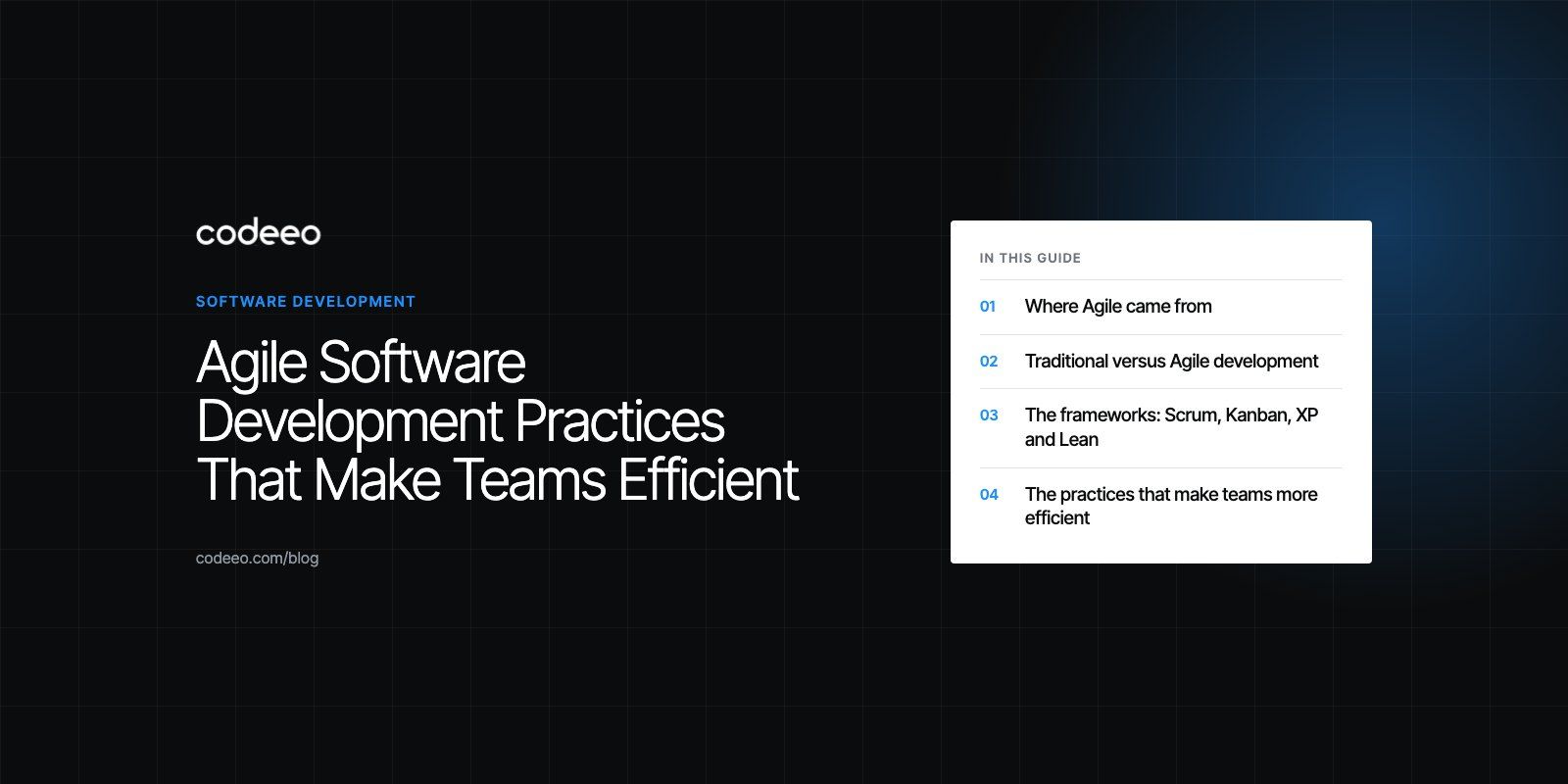
Agile software development practices are working habits that help a team ship small, tested pieces of software often, learn from real feedback and adjust the plan as it goes. The core ones are short iterations, a prioritized backlog, user stories, daily coordination, continuous integration and regular retrospectives. Frameworks such as Scrum, Kanban and Extreme Programming package these habits in different ways, and most effective teams borrow from more than one.
This guide explains how Agile differs from traditional delivery, the practices that actually make teams more efficient, the benefits you can expect, and the problems teams hit when they adopt it.
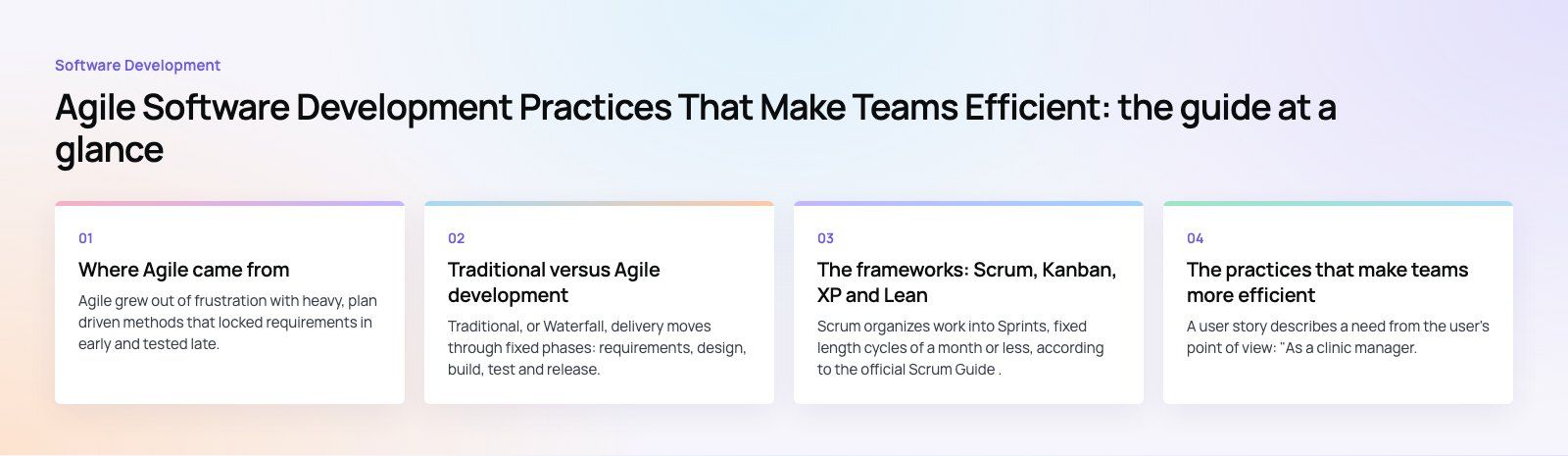
Where Agile came from
Agile grew out of frustration with heavy, plan driven methods that locked requirements in early and tested late. In February 2001, seventeen practitioners met at the Snowbird ski resort in Utah and wrote the Manifesto for Agile Software Development, as recorded in the manifesto's own history page. Its four values still sum up the approach:
- Individuals and interactions over processes and tools.
- Working software over comprehensive documentation.
- Customer collaboration over contract negotiation.
- Responding to change over following a plan.
The items on the right still matter. Agile teams simply value the items on the left more when the two conflict.
Traditional versus Agile development
Traditional, or Waterfall, delivery moves through fixed phases: requirements, design, build, test and release. Agile runs those activities together in short cycles. The table compares the two.
| Aspect | Traditional (Waterfall) | Agile |
|---|---|---|
| Approach | Sequential phases | Iterative, incremental cycles |
| Planning | Detailed plan up front | Continuous planning and replanning |
| Requirements | Fixed at the start | Refined as the team learns |
| Customer involvement | Mainly at the start and the end | Throughout the project |
| Delivery | One release near the end | Frequent working increments |
| Testing | A phase after the build | Continuous, alongside development |
| Risk | Problems surface late | Problems surface early |
| Team structure | Role based handoffs | Cross functional, self organizing |
| Progress measure | Tasks completed against plan | Working software in users' hands |
Waterfall still suits work where requirements are fixed by regulation or hardware and change is genuinely expensive. For most web, app and business software, requirements move as soon as real users touch the product, which is why Agile has become the default.
The frameworks: Scrum, Kanban, XP and Lean
Scrum
Scrum organizes work into Sprints, fixed length cycles of a month or less, according to the official Scrum Guide. Many teams choose one or two weeks. Each Sprint has four events:
- Sprint Planning to agree a goal and select the work.
- Daily Scrum, a short check on progress toward the goal and any blockers.
- Sprint Review to show the increment to stakeholders and gather feedback.
- Sprint Retrospective to decide how the team will work better next time.
Scrum defines three accountabilities: the Product Owner, who orders the backlog; the Scrum Master, who coaches the process and removes impediments; and the Developers, who build the increment.
Kanban
Kanban focuses on flow rather than fixed cycles. The team visualizes work on a board with columns such as To do, In progress, Review and Done, and sets work in progress limits on each column. Those limits stop people starting new tasks before finishing old ones, which exposes bottlenecks quickly. Kanban suits support, maintenance and operations work where requests arrive unpredictably.
Extreme Programming (XP)
XP concentrates on engineering discipline. Its best known practices are pair programming, test driven development, continuous integration, small releases and constant refactoring. Teams that run Scrum for planning often adopt XP practices for how the code itself gets written.
Lean
Lean comes from manufacturing and asks one question: does this step add value for the customer? It encourages teams to remove waiting, handoffs, half finished work and features nobody uses, and to improve continuously in small steps.
The practices that make teams more efficient
User stories and a single backlog
A user story describes a need from the user's point of view: "As a clinic manager, I want to see open shifts by location so that I can fill gaps faster." Stories live in one ordered backlog. That single list is what keeps a team working on the most valuable thing rather than the loudest request.
Backlog refinement
Refinement is the regular habit of splitting large items, adding acceptance criteria and estimating effort before work reaches a Sprint. Teams that skip it spend planning meetings arguing about what a story means.
Definition of done
A shared definition of done (code reviewed, tests passing, deployed to staging, documentation updated) prevents work being called finished when it is not. It is one of the simplest ways to raise quality.
Continuous integration and continuous deployment
Developers merge small changes into the main branch often, and an automated pipeline builds and tests every change. Continuous deployment goes one step further and releases changes that pass all checks. Both shorten the time between writing code and learning whether it works.
Testing throughout
Agile testing happens inside each iteration, not after it. Automated unit and integration tests run in the pipeline, and testers work with developers while stories are being built rather than receiving them at the end.
Burndown and burnup charts
A burndown chart shows work remaining over time; a burnup chart shows work completed against total scope. Burnup charts are often more honest, because they make scope growth visible instead of hiding it.
Retrospectives
Retrospectives turn experience into change. A useful retrospective ends with one or two specific actions with an owner, not a long list of complaints.
Incremental delivery and customer collaboration
Delivering a working slice early lets stakeholders react to something real. Regular reviews with the people who will use the product catch misunderstandings while they are still cheap to fix.
Benefits of Agile practices
- Faster feedback. Working software reaches users in weeks, so the team learns what matters before investing heavily.
- Better quality. Continuous integration and testing find defects close to the change that caused them.
- Lower risk. Small increments mean a wrong assumption costs one iteration, not a whole project.
- Visibility. Boards, reviews and charts show stakeholders exactly where things stand.
- Flexibility. Priorities can change between iterations without derailing work in progress.
- Better use of budget. Teams stop building features once the value has been delivered, instead of finishing a long specification for its own sake.
- Stronger teams. Cross functional ownership and regular reflection tend to improve morale and shared responsibility.
Common challenges when adopting Agile
Cultural resistance
People used to sign offs and fixed plans can find iterative work uncomfortable. Start with one pilot team, show results in a few iterations, and let the evidence do the persuading.
Ceremony without substance
One issue we often see is teams that hold every Scrum meeting but never ship working software at the end of a Sprint. The meetings exist to support delivery. If increments are not reaching users, fix that first.
Weak product ownership
If the Product Owner is unavailable or lacks authority to make decisions, the backlog drifts and the team guesses. Give the role to someone with the time and mandate to say no.
Inconsistent practices across teams
Large organizations end up with teams using different definitions of done, estimation scales and tools. Agree a small set of shared standards so teams can coordinate, while leaving each team room to adapt.
Lack of management support
Agile changes how plans, budgets and status reports work. Without leadership agreeing to fund outcomes rather than fixed scopes, teams fall back into old habits.
Skipping engineering practices
Short iterations without automated tests and continuous integration produce fast, fragile software. Process changes need technical practices behind them.
How to get started
- Pick one product and one team for a pilot.
- Build a single ordered backlog and write the top items as user stories with acceptance criteria.
- Choose Scrum if work can be planned in short cycles, or Kanban if it arrives continuously.
- Agree a definition of done that includes testing and deployment.
- Set up a basic continuous integration pipeline before the first iteration ends.
- Run a retrospective after every cycle and act on at least one improvement.
- Review the pilot after a few cycles and decide what to keep before scaling.
Work with an Agile delivery team
Codeeo's team of 80+ across Dubai, Riyadh and Karachi delivers custom software in short, reviewable increments, from products like Distinct and Edsidera to internal tools. If you need extra capacity, our dedicated developers and team options slot into your existing Sprints, and a product scoping session is a practical way to build a first backlog.
Frequently asked questions
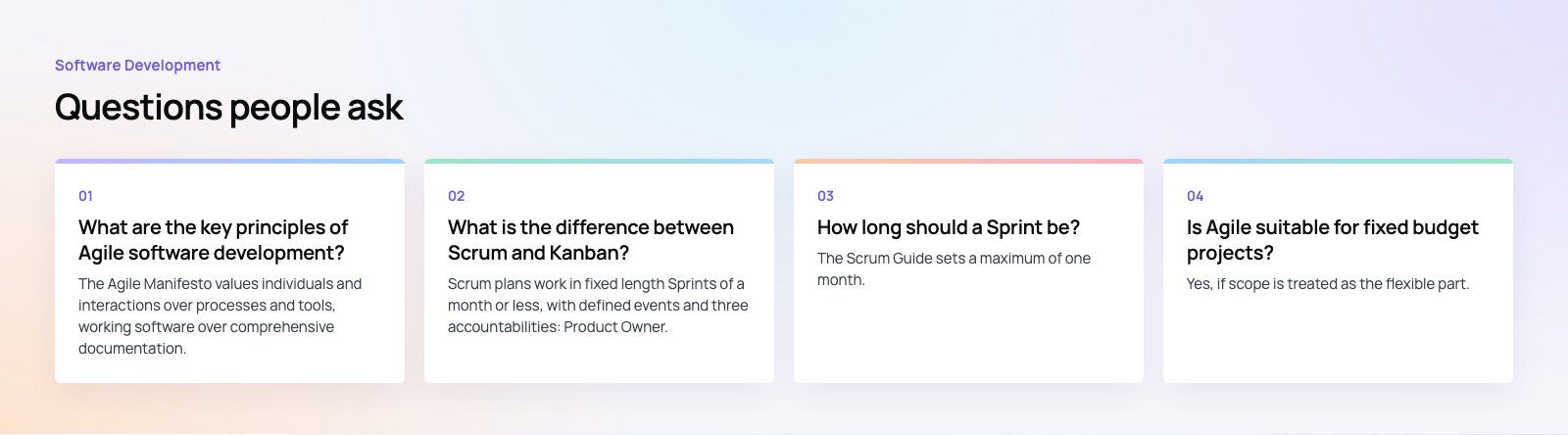
The Agile Manifesto values individuals and interactions over processes and tools, working software over comprehensive documentation, customer collaboration over contract negotiation, and responding to change over following a plan. In practice that means short iterations, frequent delivery of working software, close contact with users, continuous testing and regular reflection on how the team can improve its way of working.
Software DevelopmentAPI Integration for Saudi Business Websites: ERP, CRM and Payment GatewaysHow Saudi websites connect to ERP, CRM, payment gateways like mada and Tabby, ZATCA e-invoicing, logistics and WhatsApp through APIs. Software DevelopmentAI Workflow Automation for Case Management: Where AI Saves Case Teams Real TimeHow AI workflow automation fits into case management: practical uses, human review, data security and when to build a custom AI workflow.
 Software DevelopmentLaw Firm Client Portal, Legal CRM and Intake Software: Turning Inquiries into Signed ClientsTurn more legal inquiries into signed clients with intake software, a legal CRM and a secure client portal built around your firm.
Tell us what the business needs. We will tell you what to build first.
Schedule a free consultation and get a written recommendation, with costs, before you commit to anything.
Get in touchPROVEN RESULTS
4.7 / 5verified reviews on Google