 Software DevelopmentAPI Integration for Saudi Business Websites: ERP, CRM and Payment GatewaysHow Saudi websites connect to ERP, CRM, payment gateways like mada and Tabby, ZATCA e-invoicing, logistics and WhatsApp through APIs.
CodeeoInsightsSoftware Development
API Testing Tools: How to Choose the Right Ones for Your Team
Postman, Bruno, SoapUI, REST Assured, Karate, JMeter and k6 compared: what each API testing tool does best and how to build a practical testing setup.
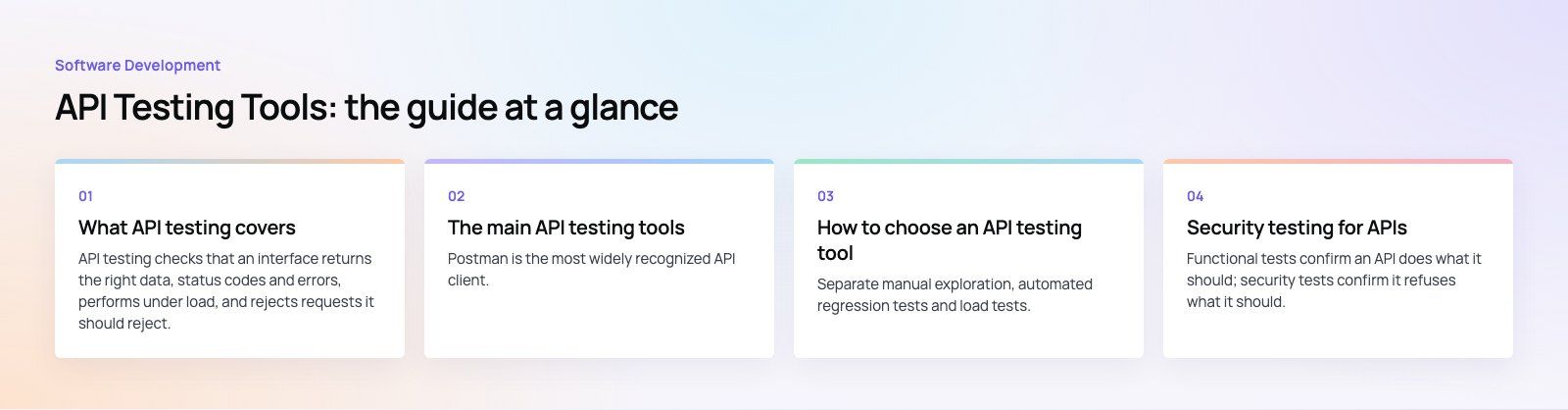
The best API testing tools for most teams are Postman or Bruno for exploring and testing endpoints by hand, REST Assured or Karate for automated tests in code, and JMeter or k6 for load testing, with SoapUI still useful where SOAP services are involved. No single tool covers everything well. Choose by the job you need done, the language your team writes, and how easily the tool runs in your CI pipeline.
This guide explains what each tool is good at, compares them side by side, and shows how to build a sensible API testing setup.
What API testing covers
API testing checks that an interface returns the right data, status codes and errors, performs under load, and rejects requests it should reject. It sits below the user interface, so tests run faster and break less often than browser tests. A complete approach usually includes several layers:
- Functional tests that send requests and assert on responses.
- Contract tests that confirm a provider still matches what its consumers expect.
- Integration tests across services, databases and third party APIs.
- Performance and load tests that measure response times and limits.
- Security tests for authentication, authorization and injection flaws.
Most tools specialize in one or two of these layers, which is why teams end up with a small toolkit rather than one product.
The main API testing tools
Postman
Postman is the most widely recognized API client. You build requests, group them into collections, store variables per environment and write test scripts in JavaScript that run after each response. Collections can run from the command line, which lets them join a CI pipeline. Its strengths are speed of learning, collaboration through shared workspaces, and documentation generated from collections. The trade off is that collections live in Postman's cloud by default, which some teams dislike for sensitive projects.
Bruno
Bruno is an open source API client that stores collections as plain text files inside your repository. Tests and requests are versioned in Git alongside the code they test, and reviewed in pull requests like any other change. It suits teams that want Postman style manual testing without a cloud account.
SoapUI
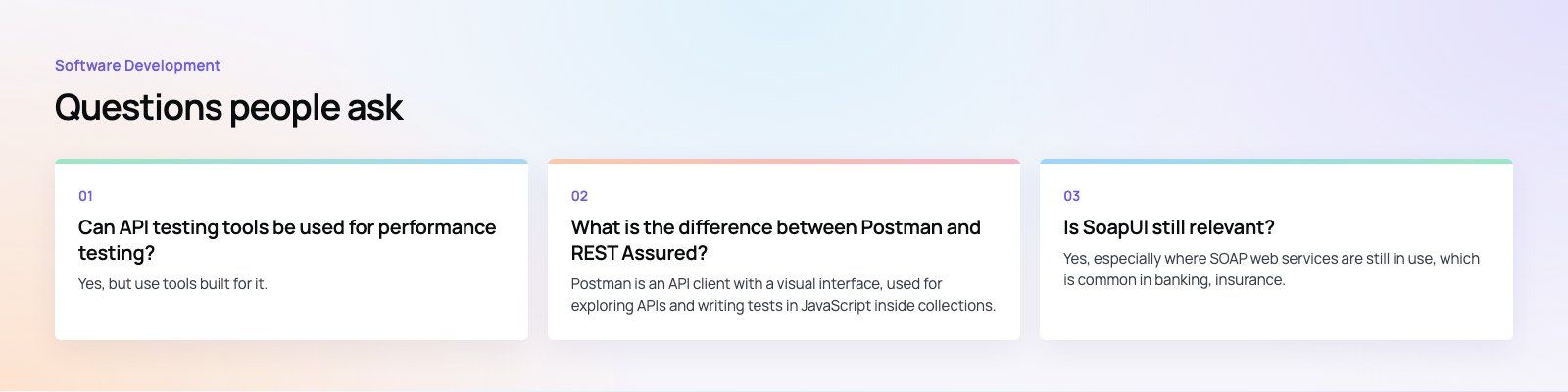
SoapUI, from SmartBear, has long been the standard for SOAP and WSDL based services and also supports REST. The open source edition handles functional testing, mock services and data driven tests; SmartBear's commercial ReadyAPI adds deeper reporting, load and security features. It remains a common choice in banking, insurance and enterprise systems where SOAP is still in use.
REST Assured
REST Assured is a Java library for testing REST APIs with a readable, fluent syntax. Tests run with JUnit or TestNG, fit naturally into Maven or Gradle builds and sit beside the application's own code. It is the default choice for Java and Kotlin teams who want API tests written and reviewed by developers.
Karate
Karate lets you write API tests in a readable, Gherkin style syntax without writing Java step definitions. It includes assertions on JSON and XML, mocks, and data driven scenarios, and can reuse functional tests for performance runs. It suits mixed teams where testers and developers both write tests.
Apache JMeter
Apache JMeter is an open source load testing tool that supports HTTP and many other protocols. You design test plans in a desktop interface, then run them headless from the command line or distributed across machines for large loads. It is mature and flexible, though test plans are stored as XML and can become hard to review.
k6
Grafana k6 is an open source load testing tool where tests are written in JavaScript. Scripts are small, readable and easy to keep in Git, and thresholds let a CI build fail automatically when response times exceed a target. Many teams now prefer it to JMeter for API load testing because it fits a code first workflow.
API testing tools compared
| Tool | Main use | How tests are written | Best fit |
|---|---|---|---|
| Postman | Manual and automated functional testing | GUI plus JavaScript scripts | Teams that want a quick start and shared collections |
| Bruno | Manual and functional testing | Plain text files in Git | Teams that want collections versioned with code |
| SoapUI | SOAP and REST functional testing | GUI plus Groovy scripts | Enterprise and SOAP heavy systems |
| REST Assured | Automated functional testing | Java code | Java and Kotlin backend teams |
| Karate | Functional, mocks, some performance | Readable feature files | Mixed teams of testers and developers |
| JMeter | Load and performance testing | GUI test plans saved as XML | Complex, multi protocol load tests |
| k6 | Load and performance testing | JavaScript | Code first teams running load tests in CI |
How to choose an API testing tool
Start with the job
Separate manual exploration, automated regression tests and load tests. A team building a new REST API might pair Bruno or Postman for exploration, REST Assured or Karate for automated tests, and k6 for load. Trying to stretch one tool across all three usually leaves gaps.
Match your team's language
Tests written in the same language as the application get maintained. Java teams lean toward REST Assured, JavaScript and TypeScript teams toward test frameworks in their own stack plus k6, and mixed teams toward Karate or Postman.
Check CI fit
Every tool you choose should run headless from the command line, return a failing exit code when tests fail, and produce reports your pipeline can read. If a test cannot run on every pull request, it will quietly stop being run at all.
Consider where data lives
Some tools sync collections, environments and sometimes secrets to a vendor cloud. For regulated projects, check where data is stored, or prefer tools that keep everything in your repository.
Look at licensing and support
Many tools have free or open source editions with paid tiers for collaboration, reporting or enterprise features. Check what your team size and workflow actually require before committing, and confirm the project is actively maintained.
Building a practical API testing setup
- Write the contract first. Describe the API in an OpenAPI specification so tests, mocks and documentation share one source.
- Automate the core flows. Cover authentication, the main create, read, update and delete paths, validation errors and permission checks.
- Use realistic test data. Seed and clean up data per run so tests do not depend on each other.
- Run tests on every change. Functional tests on each pull request; heavier load tests on a schedule or before releases.
- Test against staging, not production. Keep secrets in your CI's secret store, never inside collections or scripts.
- Review failures quickly. A suite that is red for days teaches everyone to ignore it.
Security testing for APIs
Functional tests confirm an API does what it should; security tests confirm it refuses what it should. The OWASP API Security Top 10 is the standard list of risks to cover, including broken object level authorization, broken authentication and unrestricted resource consumption. Add tests that try to read another user's records, call admin endpoints without the right role and send oversized or malformed payloads. Dedicated scanners help, but these targeted tests catch the issues scanners often miss.
Common API testing challenges
- Authentication. Token based flows need tests that log in, refresh tokens and handle expiry, not hard coded tokens that break overnight.
- Dynamic data. IDs and timestamps change every run; assert on structure and rules rather than exact values.
- Third party dependencies. Use mocks or sandboxes for payment gateways and external services so tests are stable.
- Flaky tests. Tests that pass and fail at random usually share data or depend on timing. Fix them or remove them.
- Coverage drift. New endpoints ship without tests. Make API tests part of the definition of done.
On products such as Runvse, where a mobile app and firmware both depend on one API, that API is the part that most needs a reliable test suite. If you want help setting up API testing, or building an API that is easy to test from the start, our custom software team and dedicated developers can help, and a codebase review is a fast way to see where your current coverage stands.
Frequently asked questions
Postman is the easiest starting point for most people because you can send requests and see responses through a visual interface before writing any test code.
Bruno is a good alternative if you prefer an open source tool that stores collections in your Git repository. Once the basics are clear, move repeated checks into automated tests that run in your CI pipeline.
Software DevelopmentAPI Integration for Saudi Business Websites: ERP, CRM and Payment GatewaysHow Saudi websites connect to ERP, CRM, payment gateways like mada and Tabby, ZATCA e-invoicing, logistics and WhatsApp through APIs. Software DevelopmentAI Workflow Automation for Case Management: Where AI Saves Case Teams Real TimeHow AI workflow automation fits into case management: practical uses, human review, data security and when to build a custom AI workflow.
 Software DevelopmentLaw Firm Client Portal, Legal CRM and Intake Software: Turning Inquiries into Signed ClientsTurn more legal inquiries into signed clients with intake software, a legal CRM and a secure client portal built around your firm.
Tell us what the business needs. We will tell you what to build first.
Schedule a free consultation and get a written recommendation, with costs, before you commit to anything.
Get in touchPROVEN RESULTS
4.7 / 5verified reviews on Google