 Web DevelopmentWordPress vs Drupal: Which CMS Is Right for Your Business?WordPress vs Drupal compared on ease of use, content modeling, security, performance, ecommerce and cost drivers, with five questions to help you choose.
Benefits of PWA: Why Progressive Web Apps Suit Modern Products
The benefits of PWA for users, businesses and developers, where native apps still win, and a practical checklist for deciding if a progressive web app fits.
The main benefits of a progressive web app (PWA) are fast, reliable loading, offline support for core features, installation to the home screen, push notifications, and one codebase that serves every device through the browser. For businesses that means wider reach through search and links, no app store gatekeeping for updates, and lower build and maintenance effort than separate iOS and Android apps. PWAs still trail native apps for deep hardware access and app store visibility.
This guide covers what a PWA is, the benefits for users, businesses and developers, where native apps still win, and how to decide whether a PWA fits your product.
What a progressive web app is
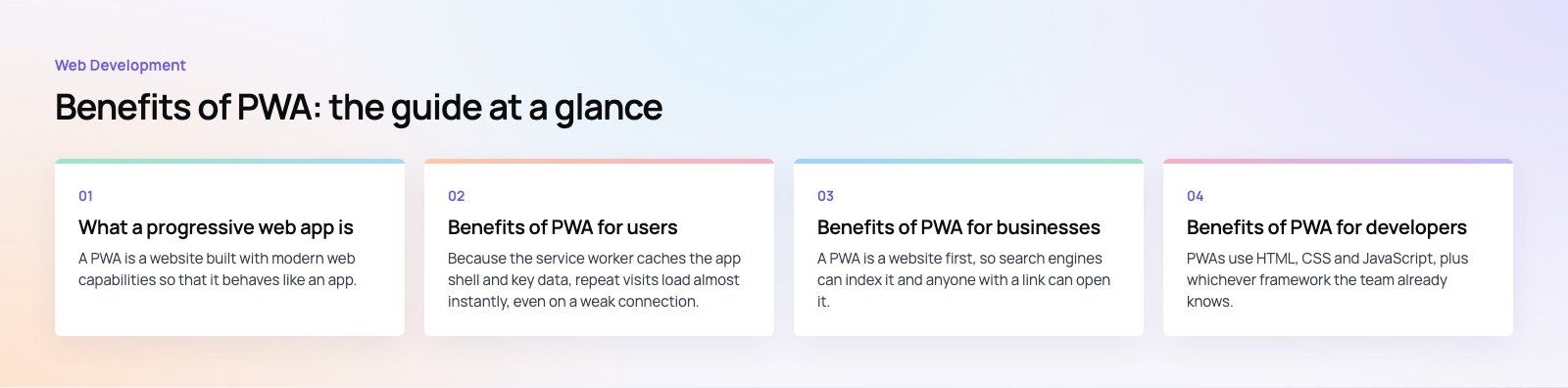
A PWA is a website built with modern web capabilities so that it behaves like an app. Three parts make that work:
- A web app manifest, a small file that gives the app a name, icons and display settings so it can be installed and opened without browser chrome.
- A service worker, a script that runs in the background, caches files and data, handles requests when the network is slow or missing, and receives push messages.
- HTTPS, which browsers require before they allow service workers and installation.
The MDN guide to progressive web apps is the clearest reference for how these pieces fit together.
| Feature | Traditional website | PWA | Native app |
|---|---|---|---|
| Offline use | None | Core features can work offline | Full, if designed for it |
| Installation | Bookmark only | Home screen and desktop install | App store download |
| Push notifications | Limited | Supported, including on iOS once installed | Supported |
| Discovery | Search and links | Search and links | Mainly app stores |
| Updates | Instant | Instant | Through app store review |
| Device hardware access | Basic | Growing but partial | Full |
Benefits of PWA for users
Fast loading and reliability
Because the service worker caches the app shell and key data, repeat visits load almost instantly, even on a weak connection. Users on trains, in lifts or in areas with patchy coverage can still open the app and see their content. Speed also affects search performance, which is why PWAs pair well with work on Core Web Vitals.
Offline access to core features
A well designed PWA decides which features must work offline, such as viewing recent orders, reading saved articles or filling in a form, and queues actions to sync when the connection returns. Users get an app that degrades gracefully rather than a blank error page.
An app like experience without the app store
Users can install a PWA from the browser in a couple of taps. It opens full screen with its own icon and no address bar. There is no large download, no account for the app store, and storage use is usually small, which matters on budget phones.
Push notifications
PWAs can send push notifications for reminders, order updates and messages. Apple added web push for home screen web apps in iOS and iPadOS 16.4 in 2023, so notifications now work on iPhone as well as Android and desktop, provided the user has added the app to the home screen.
Benefits of PWA for businesses
Wider reach and lower friction
A PWA is a website first, so search engines can index it and anyone with a link can open it. There is no store page to visit and no download to wait for. Each step removed between interest and use means more people actually try the product.
One codebase, lower cost to maintain
A single web codebase serves phones, tablets and desktops. Instead of funding separate iOS, Android and web teams, you maintain one product. Updates go live when you deploy, without waiting for app store review, so bug fixes and content changes reach every user at once.
Better engagement than a plain website
Installation and notifications give a PWA ways to bring users back that a normal site lacks. Combined with fast loading, that tends to support repeat visits for products people use often, such as ordering, booking, learning and internal tools.
Benefits of PWA for developers
Familiar web technology
PWAs use HTML, CSS and JavaScript, plus whichever framework the team already knows. Teams working in React or Next.js can add a manifest and service worker to an existing app rather than learning Swift and Kotlin.
Capable browser APIs
Modern browsers expose a growing set of device features to web apps: camera access, geolocation, notifications, file handling, sharing and, in some browsers, Bluetooth and USB. WebAssembly lets performance heavy code such as image processing or editors run in the browser at near native speed.
Simpler release process
Deploying a PWA is the same as deploying a website. There is no binary to sign, no store listing to update and no review queue. Rollbacks are equally quick.
Where native apps still win
PWAs are not the right answer for every product. Native apps remain stronger when:
- The app depends on hardware. Advanced camera control, background location, Bluetooth on iPhone, health data and other device features are fuller or only available natively.
- Performance is the product. Games, heavy media editing and complex animation still run best natively.
- App store presence matters. Some audiences search the store first, and some businesses rely on store features such as in app purchases.
- iOS behavior is critical. Safari supports less of the PWA feature set than Chromium based browsers, so test carefully if most users are on iPhone.
Many products combine both: a PWA for broad reach and quick access, and a native app for the most engaged users. Our mobile app development team often helps clients decide the split.
How to decide if a PWA fits your product
- List the device features you need. If every one is available on the web in the browsers your users run, a PWA is a strong candidate.
- Look at how users find you. If most arrive from search, ads or shared links, a PWA removes a step. If they search the app store, plan for native or a store listing.
- Define offline needs. Decide which screens and actions must work without a connection and design the caching around them.
- Check your audience's platforms. Test install and notifications on the iPhone and Android models your users actually carry.
- Plan the data layer. Offline sync, conflict handling and cache invalidation are where PWAs succeed or fail.
Common mistakes
- Caching too much. Stale prices or stock shown offline cause more harm than a clear offline message.
- Forgetting update flows. Users can keep an old version running until the service worker updates. Prompt them when a new version is ready.
- Asking for notification permission too early. Ask after the user has seen value, not on the first page load.
- Treating it as a wrapper. A slow website with a manifest is still a slow website. Performance work comes first.
Is a PWA right for you?
The benefits of PWA are strongest for content, commerce, booking, learning and internal tools, where reach, speed and simple updates matter more than deep hardware access. If you want a second opinion on whether a PWA, a native app or both suits your roadmap, Codeeo's web development team can review your requirements. A short product scoping session is a good place to start.
Frequently asked questions
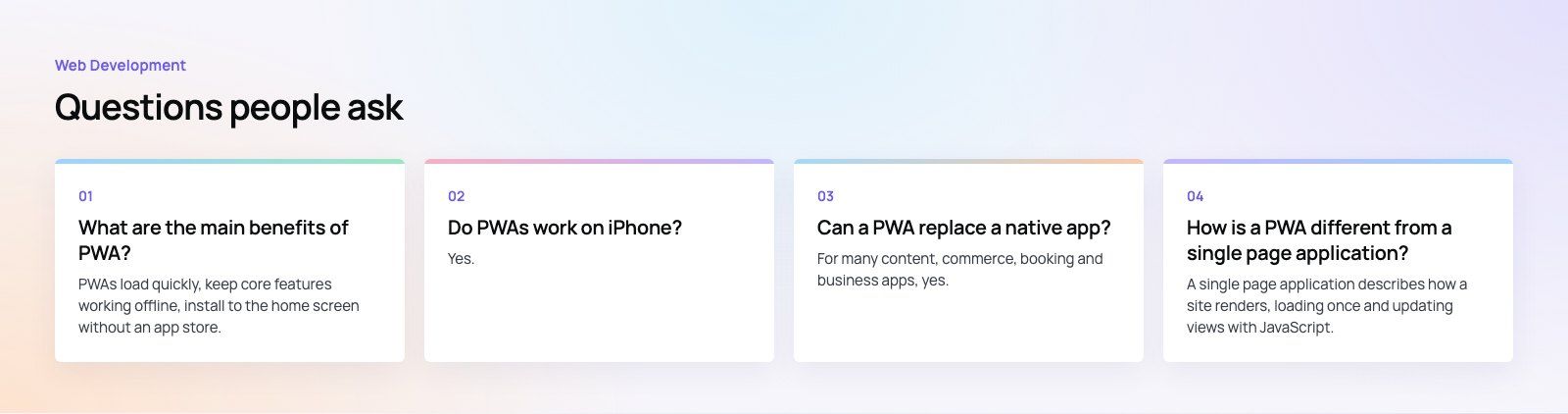
PWAs load quickly, keep core features working offline, install to the home screen without an app store, and can send push notifications.
For businesses they offer one codebase across devices, instant updates without store review, and discovery through search and links. Together these make PWAs a cost effective way to deliver an app like experience to a broad audience.
Web DevelopmentWordPress vs Drupal: Which CMS Is Right for Your Business?WordPress vs Drupal compared on ease of use, content modeling, security, performance, ecommerce and cost drivers, with five questions to help you choose. Web DevelopmentCustom Website Development vs Website Builders: Pros and ConsAn honest comparison of custom website development and website builders: control, cost over time, SEO, integrations, and how to decide which fits your business.
 Web DevelopmentWeb Development Consultant: What They Do and When to Hire OneWhat a web development consultant does, how the role differs from a developer or agency, when hiring one pays off and how to choose the right one.
Tell us what the business needs. We will tell you what to build first.
Schedule a free consultation and get a written recommendation, with costs, before you commit to anything.
Get in touchPROVEN RESULTS
4.7 / 5verified reviews on Google