 Web DevelopmentWordPress vs Drupal: Which CMS Is Right for Your Business?WordPress vs Drupal compared on ease of use, content modeling, security, performance, ecommerce and cost drivers, with five questions to help you choose.
Custom Website Development vs Website Builders: Pros and Cons
An honest comparison of custom website development and website builders: control, cost over time, SEO, integrations, and how to decide which fits your business.
A website builder is the faster, cheaper way to get a simple site online, while custom website development gives you full control over design, features, performance and growth. Builders suit small sites with standard needs and tight timelines. Custom development suits businesses that need unique functionality, integrations, specific SEO control or a site that will grow considerably over time.
The right answer depends on what the website has to do for the business, not on which option sounds more professional. Here is how to compare them honestly.
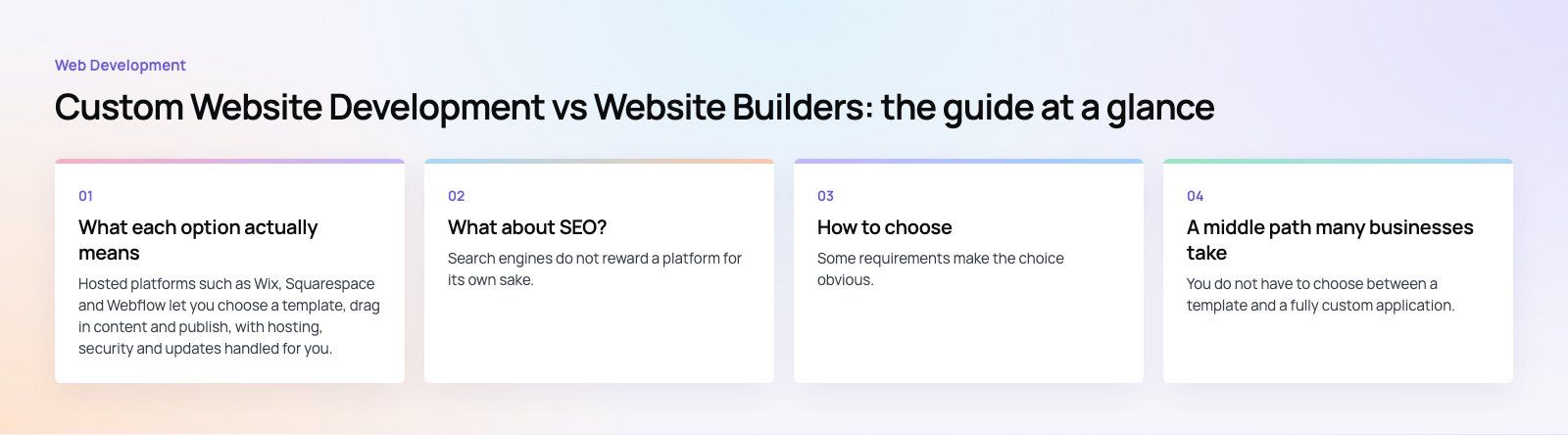
What each option actually means
Website builders
Hosted platforms such as Wix, Squarespace and Webflow let you choose a template, drag in content and publish, with hosting, security and updates handled for you. You pay a recurring subscription and work inside the platform's features and rules.
Custom website development
A custom site is designed and built for your business, usually on a CMS such as WordPress or a headless CMS, or on a framework such as Next.js or Laravel. You decide the design, the content structure, the integrations and where it is hosted, and you own the code.
In practice there is a spectrum rather than two boxes:
| Approach | Effort to launch | Control | Typical use |
|---|---|---|---|
| Builder with a template | Lowest | Limited to the platform | Simple brochure or personal sites |
| CMS with a premium theme | Low to moderate | Good, with full ownership | Small business sites |
| CMS with a custom theme | Moderate | High | Service, lead generation and content sites |
| Fully custom application | Highest | Complete | Portals, platforms and complex integrations |
Custom website development: pros and cons
The pros
- Design that fits your brand. Layouts, interactions and content are shaped around your customers, not a template.
- Any functionality you need. Portals, calculators, booking, multi step forms and integrations with CRM, ERP or payment systems.
- Full SEO and performance control. You decide markup, URL structure, structured data, caching and what scripts load.
- Room to grow. New sections, languages and features can be added without hitting platform limits.
- Ownership. You own the code and content and can move hosts or suppliers at any time.
The cons
- Higher upfront investment. Design, development and testing take skilled time.
- Longer timeline. Weeks to months rather than days.
- Maintenance is your responsibility. Updates, hosting and security need a plan and an owner.
- You need a good partner. The quality of the result depends on who builds it.
Website builders: pros and cons
The pros
- No coding needed. Visual editors let non technical owners build and edit pages.
- Fast to launch. A simple site can go live within days.
- Lower upfront cost. A subscription instead of a development project.
- Hosting and security included. The platform handles servers, SSL and core updates.
The cons
- Limited customization. You work within the templates, components and settings the platform offers.
- Recurring costs add up. Subscriptions, premium plans and paid apps continue for as long as the site exists.
- Less technical SEO control. Most builders cover the basics well, but advanced control over markup, redirects or rendering can be restricted.
- Platform lock in. Moving to another platform usually means rebuilding the site.
- Scaling limits. Complex catalogs, member areas, multilingual content and deep integrations can outgrow the platform.
Side by side comparison
| Factor | Custom development | Website builder |
|---|---|---|
| Technical skills needed | A development partner | None to build basic pages |
| Time to launch | Longer | Shorter |
| Upfront cost | Higher | Lower |
| Ongoing cost | Hosting and maintenance | Subscriptions and paid add ons |
| Design freedom | Complete | Within templates and components |
| SEO control | Full | Good basics, less advanced control |
| Integrations | Anything with an API | Limited to supported apps |
| Ownership and portability | You own the code | Tied to the platform |
What about SEO?
Search engines do not reward a platform for its own sake. Google's SEO Starter Guide (2026) focuses on helpful content, descriptive titles, sensible URLs and making sure Google can crawl and render your pages, all of which most modern platforms can handle. Builders cover these basics. Custom sites matter when you need finer control: large numbers of pages generated from data, complex redirects, multilingual setups, structured data at scale or tight performance budgets.
How to choose
Choose a website builder if
- You need a simple site with a handful of pages, quickly.
- Your needs fit standard features such as a gallery, contact form or basic store.
- You want to manage everything yourself without a developer.
- You are testing an idea before investing further.
Choose custom development if
- The website is a main source of leads or revenue.
- You need integrations with your CRM, ERP, booking or payment systems.
- You need bilingual content, member areas, portals or complex catalogs.
- Search visibility is central to your growth plan.
- You expect the site to grow substantially over the next few years.
Some requirements make the choice obvious. On the Modon Holding project, a listed company website is a disclosure surface rather than a brochure: governance documents, board changes and financial reporting all had to be published reliably. That kind of requirement points firmly to a custom build.
A middle path many businesses take
You do not have to choose between a template and a fully custom application. A custom designed theme on WordPress, or a modern front end built with Next.js on a headless CMS, gives you design freedom and ownership while keeping editing simple for your team. Many businesses also start on a builder and move to a custom site once they outgrow it; if you do, plan the move as a proper site migration so you keep the rankings you have earned.
If you are unsure which route fits, a platform fit review compares your requirements against the options.
Getting the right website for your business
Codeeo has delivered 200+ projects across the UAE and the US, with a team of 80+ across Dubai, Riyadh and Karachi. If your site needs more than a template can offer, our web development team can scope a custom build that matches your goals and the budget you set.
Frequently asked questions
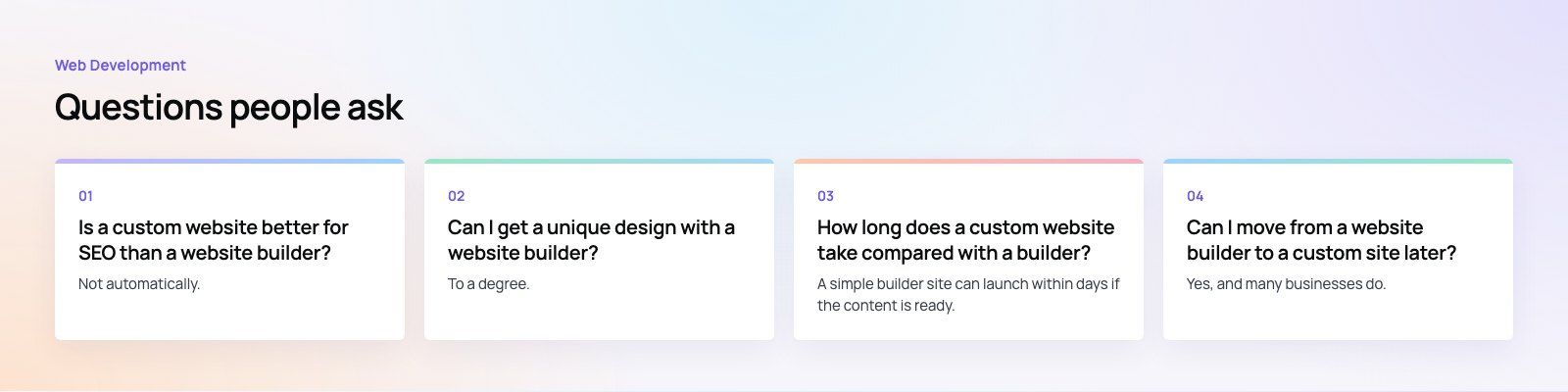
Not automatically.
Good content, clear structure and fast pages matter more than the platform. Builders handle SEO basics well. A custom site gives you more control over markup, URLs, redirects, structured data and performance, which matters most for large, multilingual or data driven sites. For a small brochure site, a well built builder site can rank perfectly well.
Web DevelopmentWordPress vs Drupal: Which CMS Is Right for Your Business?WordPress vs Drupal compared on ease of use, content modeling, security, performance, ecommerce and cost drivers, with five questions to help you choose. Web DevelopmentWeb Development Consultant: What They Do and When to Hire OneWhat a web development consultant does, how the role differs from a developer or agency, when hiring one pays off and how to choose the right one.
 Web DevelopmentHow to Secure a Website Against Hackers and CyberattacksThe attacks business websites face most, mapped to the OWASP Top 10:2025, and the layered defenses that stop them: MFA, secure code, WAF, headers and testing.
Tell us what the business needs. We will tell you what to build first.
Schedule a free consultation and get a written recommendation, with costs, before you commit to anything.
Get in touchPROVEN RESULTS
4.7 / 5verified reviews on Google