 Web DevelopmentWordPress vs Drupal: Which CMS Is Right for Your Business?WordPress vs Drupal compared on ease of use, content modeling, security, performance, ecommerce and cost drivers, with five questions to help you choose.
Best Language for Web Development: How to Choose
JavaScript, PHP, Python, Java and Ruby compared for web development, with strengths, limits and a six step way to pick the right language for your project.
There is no single best language for web development; the right choice depends on what you are building and who will maintain it. JavaScript, usually written as TypeScript, is the one language every website uses in the browser, and it also runs servers through Node.js. For the back end, PHP, Python, Java and Ruby are all proven options, each strongest in different kinds of projects.
This guide compares the main options, explains where each one fits, and gives a simple way to decide for your next project.
Front end versus back end
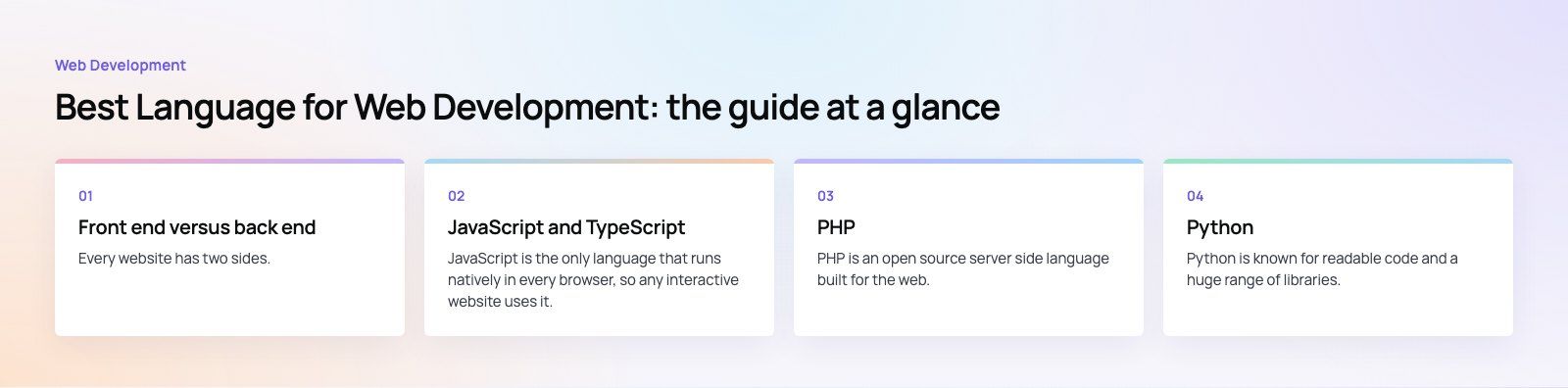
Every website has two sides. The front end is what runs in the visitor's browser, and browsers understand only three things: HTML for structure, CSS for presentation and JavaScript for behavior. Frameworks such as React, Vue and Angular are all written in JavaScript or TypeScript. The MDN web development curriculum is the most reliable place to learn these foundations.
The back end runs on a server. It handles databases, logins, payments, business rules and APIs. Here you have a genuine choice of language, and that choice is what most "best language" debates are really about.
The main options compared
| Language | Main use on the web | Typical frameworks and platforms | Best suited to |
|---|---|---|---|
| JavaScript / TypeScript | Front end and back end | React, Next.js, Vue, Angular, Node.js, Express | Interactive apps, real time features, one language across the stack |
| PHP | Back end | Laravel, Symfony, WordPress, WooCommerce | Content sites, CMS builds, online stores, business web apps |
| Python | Back end | Django, Flask, FastAPI | Data heavy products, AI and machine learning features, APIs |
| Java | Back end | Spring Boot, Jakarta EE | Large enterprise systems, banking, high volume transactions |
| Ruby | Back end | Ruby on Rails | Fast product development, startups and MVPs |
JavaScript and TypeScript
JavaScript is the only language that runs natively in every browser, so any interactive website uses it. With Node.js, the same language runs on the server, which lets one team work across the whole stack. TypeScript adds static types on top of JavaScript, catching many errors before code runs, and has become the norm for serious front end and Node.js projects.
Strengths
- One language for browser and server, which simplifies hiring and code sharing.
- A very large package ecosystem and community.
- Non blocking I/O on Node.js suits real time features such as chat, live updates and streaming.
- Modern frameworks such as Next.js handle server rendering, which helps both speed and SEO.
Limitations
- The ecosystem moves quickly, so dependencies need regular maintenance.
- CPU heavy work on the main thread can block a Node.js server unless it is moved to workers or other services.
- Plain JavaScript lets type errors slip through; TypeScript largely fixes this.
PHP
PHP is an open source server side language built for the web. It powers WordPress and WooCommerce, and Laravel has made it a strong choice for custom applications too. Hosting is widely available and inexpensive to run.
Strengths
- Easy to deploy on almost any host.
- Mature frameworks with authentication, queues and testing built in.
- A large pool of developers, especially for WordPress and Laravel.
Limitations
- Older PHP codebases earned a reputation for security problems; modern versions and frameworks address most of them, but legacy sites need care.
- Large projects without a framework or clear structure become hard to maintain.
- Less natural for long running real time processes than Node.js.
Python
Python is known for readable code and a huge range of libraries. On the web, Django gives a full framework with an admin panel out of the box, while Flask and FastAPI are lighter options for APIs. Python's real advantage is that the same language runs data analysis and machine learning, so products with AI features often choose it.
Strengths
- Clear syntax that is quick to learn and read.
- Direct access to data science and AI libraries.
- Django's built in admin and security features speed up content and data driven apps.
Limitations
- Slower raw execution than compiled languages for CPU intensive work.
- The Global Interpreter Lock in the standard interpreter limits multi threaded CPU work, so scaling relies on multiple processes or async code.
- Higher memory use than some alternatives.
Java
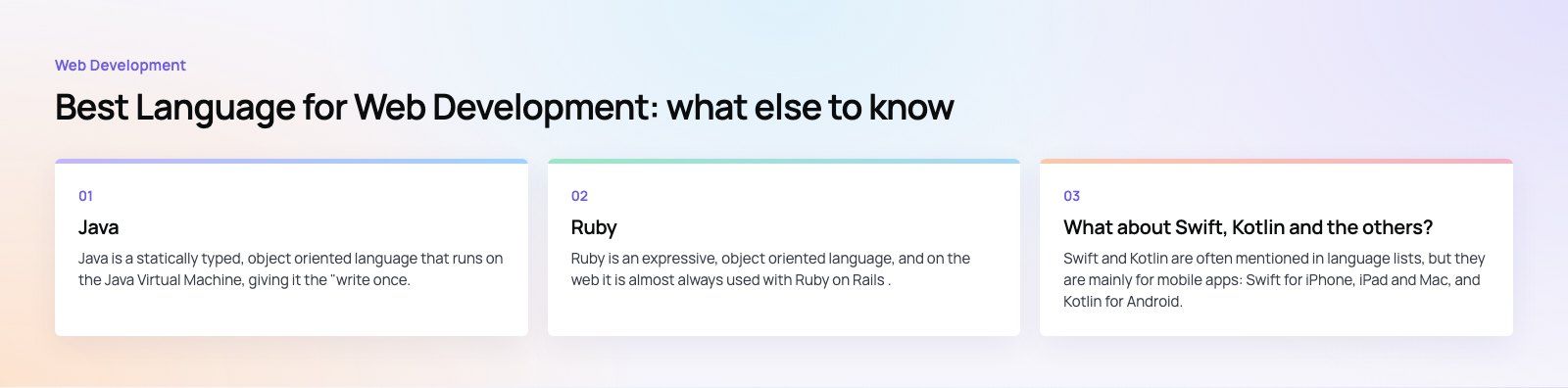
Java is a statically typed, object oriented language that runs on the Java Virtual Machine, giving it the "write once, run anywhere" portability it is known for. Spring Boot is the usual framework for web services. Java dominates in banks, insurers and large enterprises where long lived systems, strict typing and mature tooling matter.
Strengths
- Strong performance for large, concurrent workloads thanks to the JVM's just in time compilation and mature multithreading.
- Excellent tooling for testing, monitoring and refactoring large codebases.
- Stable, well documented and backed by a large enterprise community.
Limitations
- More code and configuration than lighter languages for simple projects.
- Higher memory use, which can raise hosting costs for small services.
- Slower to prototype with than Ruby, Python or JavaScript.
Ruby
Ruby is an expressive, object oriented language, and on the web it is almost always used with Ruby on Rails. Rails follows "convention over configuration", which means sensible defaults for most decisions and very fast development of database backed applications.
Strengths
- Very productive for building an MVP or internal tool quickly.
- Readable code and strong testing culture.
- Rails includes most of what a typical web app needs.
Limitations
- A smaller hiring pool than JavaScript, PHP, Python or Java in many markets.
- Slower raw performance and higher memory use than compiled languages.
- Rails conventions can feel restrictive when a project departs from them.
What about Swift, Kotlin and the others?
Swift and Kotlin are often mentioned in language lists, but they are mainly for mobile apps: Swift for iPhone, iPad and Mac, and Kotlin for Android. If your project is a website plus native apps, you might use one of them alongside a web language, or choose a cross platform framework instead. Go and C# are also strong back end options, particularly for high performance APIs and Microsoft based organizations.
How to choose the right language for your project
- Start with the product, not the language. A content site, an online store, a marketplace and an AI powered dashboard have very different needs.
- Check the platform you might build on. If WordPress or WooCommerce fits, the answer is PHP. If you want Shopify, most custom work is in Liquid and JavaScript.
- Consider your team. The best language is often the one your developers already know well, because maintenance lasts far longer than the first build.
- Think about hiring. Choose a language with a healthy local and remote talent pool so you are not dependent on one person.
- Match performance to real needs. Most business sites never hit the limits of any mainstream language. Real time features and very high transaction volumes are where the differences start to matter.
- Plan for integrations. Check that good libraries exist for the payment gateways, CRMs and APIs you need.
Common mistakes
- Picking a language because it is fashionable rather than because it suits the product.
- Mixing too many languages early, which multiplies the skills needed to maintain the system.
- Ignoring the front end: whatever the back end, quality JavaScript and accessible HTML decide how fast and usable the site feels.
- Rewriting a working system in a new language without a clear business reason.
Get the stack right from the start
Codeeo has delivered 200+ projects across the UAE and the US, with a team of 80+ working in React, Next.js, Laravel, WordPress and more. If you are weighing options for a new build, our web development team can help, and a platform fit review is a quick way to test your choice before you commit.
Frequently asked questions
JavaScript is the most widely used language on the web because every browser runs it, so practically every interactive site depends on it.
With Node.js it also runs on servers. On the back end, PHP remains very common because it powers WordPress, while Python, Java and Ruby are popular for custom applications, data products and enterprise systems.
Web DevelopmentWordPress vs Drupal: Which CMS Is Right for Your Business?WordPress vs Drupal compared on ease of use, content modeling, security, performance, ecommerce and cost drivers, with five questions to help you choose. Web DevelopmentCustom Website Development vs Website Builders: Pros and ConsAn honest comparison of custom website development and website builders: control, cost over time, SEO, integrations, and how to decide which fits your business.
 Web DevelopmentWeb Development Consultant: What They Do and When to Hire OneWhat a web development consultant does, how the role differs from a developer or agency, when hiring one pays off and how to choose the right one.
Tell us what the business needs. We will tell you what to build first.
Schedule a free consultation and get a written recommendation, with costs, before you commit to anything.
Get in touchPROVEN RESULTS
4.7 / 5verified reviews on Google