 Web DevelopmentWordPress vs Drupal: Which CMS Is Right for Your Business?WordPress vs Drupal compared on ease of use, content modeling, security, performance, ecommerce and cost drivers, with five questions to help you choose.
How to Build a Freelance Marketplace Website Like Fiverr
How to build a freelance marketplace like Fiverr: the gig model, buyer and seller features, held payments, build options, cost drivers and monetization.
To build a website like Fiverr, you need a service marketplace where freelancers publish fixed scope offers called gigs, buyers search and order them, money is held by the platform until the work is delivered, and both sides rate each other afterwards. Start in one skill category, launch with gigs, search, ordering, messaging, held payments and reviews, then add seller levels, buyer requests and promotion tools as volume grows. The cost depends on how much you build custom, the payment flow and how many integrations you need.
Below we cover how the Fiverr model differs from traditional freelancing, the features each side needs, platform choices, design, cost drivers, monetization and the legal points to settle first.
How the Fiverr model works
Traditional freelancing runs on proposals, hourly rates and trust built over time. Fiverr turned services into products. A seller describes exactly what the buyer gets, how long it takes and what it costs, usually in two or three package tiers. A buyer can order straight away, the way they would buy an item in an online store. The platform holds the payment, manages delivery and revisions, and releases funds to the seller when the order is complete.
| Aspect | Gig marketplace model | Traditional freelancing |
|---|---|---|
| Finding work | Buyers search a catalog of ready made offers | Networking, referrals, proposals |
| Pricing | Fixed packages with set scope and delivery time | Hourly or quoted per project |
| Payment | Held by the platform until delivery is accepted | Invoiced and paid directly by the client |
| Trust | Reviews, seller levels and platform dispute handling | Reputation, contracts and personal relationships |
The platform earns through service fees on each order, typically charged to both buyer and seller, plus paid promotion and premium programs. Its value comes from making small purchases of services quick and safe.
Start with one category
Fiverr covers hundreds of categories. A new marketplace cannot. The successful alternatives go deep on one area where general platforms fall short: verified healthcare writers, Arabic translators and voice artists, architectural drafting, video editors for a specific platform, or local tradespeople. Depth lets you define standard packages for that work, vet sellers properly and market to a clear group of buyers.
Ask yourself who the buyers are, why existing platforms frustrate them, and where your first sellers will come from. A product scoping session helps turn those answers into a feature list and a realistic first release.
Features for buyers
Discovery
- Categories and subcategories that match how buyers think about the work.
- Search with filters for budget, delivery time, seller level, language and location.
- Recommendations based on browsing and past orders.
- A request board where buyers post a brief and sellers send offers.
Gig pages
- A clear description, package comparison, delivery time and number of revisions.
- Portfolio samples, seller profile, response time and reviews from real orders.
- Requirement questions the buyer answers when ordering.
Orders
- Secure checkout with payment held by the platform.
- An order page with messaging, file delivery, revision requests and status updates.
- Dispute handling and a clear refund process.
Features for sellers
Profiles and gigs
- A profile with skills, languages, portfolio and verification badges.
- A gig editor with up to three packages, add ons, FAQs and sample work.
- Seller levels based on completed orders, ratings and response times.
Order management
- A queue of active orders with deadlines and buyer requirements.
- Delivery, revision and extension tools.
- Availability settings so sellers can pause new orders.
Earnings
- A balance showing pending, cleared and withdrawn funds.
- Withdrawal methods suited to where your sellers live, with tax forms where required.
- Analytics on impressions, clicks, orders and conversion.
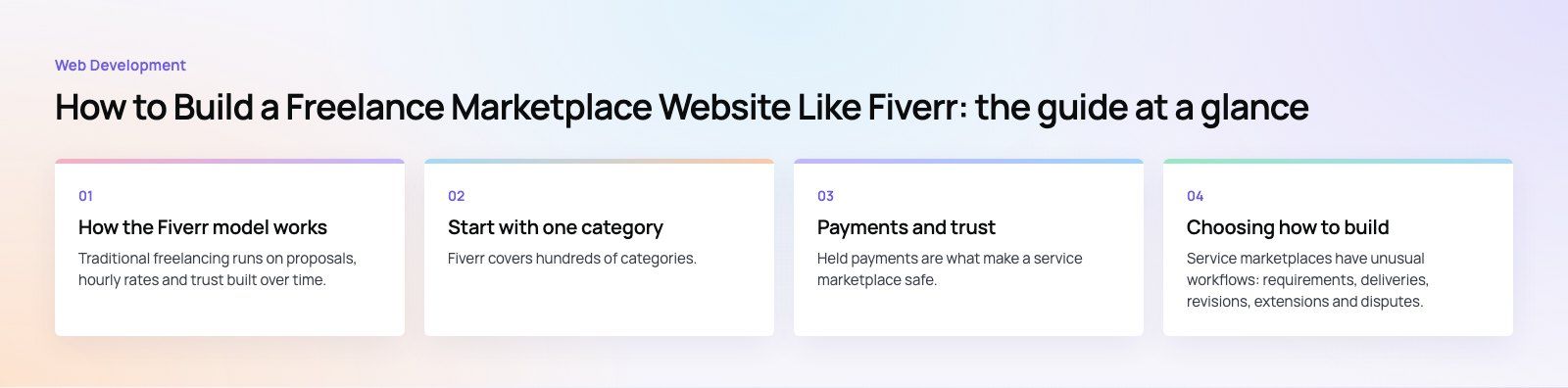
Payments and trust
Held payments are what make a service marketplace safe. The buyer pays upfront, the platform keeps the money while work is in progress, and funds release to the seller only after delivery is accepted or a set review period passes. Building that from scratch means handling money for third parties, which is regulated in most countries. Most platforms use a marketplace payments product such as Stripe Connect, or a regional provider, to collect, hold, split and pay out, and to verify seller identity.
Trust also comes from rules and tools around the payment:
- Reviews only from completed orders, from both sides.
- Identity and skills checks for sellers, at least for higher levels.
- Messaging filters that discourage taking payments off the platform.
- A clear dispute process with human review for larger orders.
Our payment integration team builds these split and delayed payout flows.
Choosing how to build
| Approach | Strengths | Limits |
|---|---|---|
| Marketplace software as a service | Fast launch, payments and listings included | Hard to add gig packages, levels and custom order flows |
| Open source or plugin based marketplace | Lower upfront effort, can be extended | Performance and upgrade issues as custom code grows |
| Custom build | Full control of order workflow, data and design | Longer timeline and more engineering effort |
Service marketplaces have unusual workflows: requirements, deliveries, revisions, extensions and disputes. Generic marketplace tools are built for physical products, so many founders move to custom software sooner here than with a product marketplace.
A typical custom stack uses a React or Next.js front end, a Node.js, Laravel or Python back end, PostgreSQL for orders and accounts, a search service for gig discovery, object storage for deliveries and a real time layer for messaging and notifications.
Design and user experience
A service marketplace sells confidence. Buyers need to understand quickly what they will get, when, and from whom. Good design here means:
- Clear packages. A side by side comparison of tiers, with scope written in plain words.
- Strong profiles. Real photos, portfolio samples and response time near the order button.
- Simple onboarding. Guided steps for new sellers to create a good first gig, and a short tour for new buyers.
- Error prevention. Requirement forms that make buyers give sellers what they need, so fewer orders go wrong.
- Mobile first. Sellers reply to messages and check orders on their phones all day.
- Accessibility. Follow the WCAG guidelines so the platform works for everyone.
Consistent branding across pages, emails and notifications makes a new platform feel established. Our design team works on exactly these flows.
What drives the cost
- Build approach. Software as a service is cheapest to start, custom is most expensive upfront but cheaper to change later.
- Order workflow. Revisions, extensions, milestones and disputes add significant development time.
- Payments. Held funds, split payouts, payouts in many countries and tax reporting.
- Real time features. Messaging, notifications and file delivery.
- Apps. Native mobile apps for sellers add a second build to maintain.
- Running costs. Hosting, storage, payment fees, support and moderation.
- Growth. Recruiting sellers and buyers, usually a budget as large as the build.
Monetization
- Service fees. A percentage on each order, charged to the buyer, the seller or both.
- Promoted gigs. Sellers pay for higher placement in search.
- Subscriptions. Paid seller plans with lower fees or extra tools, or business buyer plans with team accounts.
- Value added services. Verification, managed projects or curated talent for larger buyers.
Legal points to settle
- Terms of service that define who owns delivered work, refund rules and prohibited services.
- Worker status. Make sure sellers are independent contractors under the laws of the markets you operate in.
- Tax. Many countries require platforms to report seller income or collect tax on service fees.
- Payments and data. Use a licensed payment provider and follow data protection law in each market.
- Intellectual property. A process for handling copied portfolios and infringing deliveries.
Next steps
A site like Fiverr works when buying a service feels as safe and simple as buying a product. Pick one category, design the order workflow carefully, and launch with the essentials. Codeeo has delivered 200+ projects across the UAE and the US, including service marketplaces such as JobIQ. Our marketplace and on demand team can help you plan and build yours.
Frequently asked questions
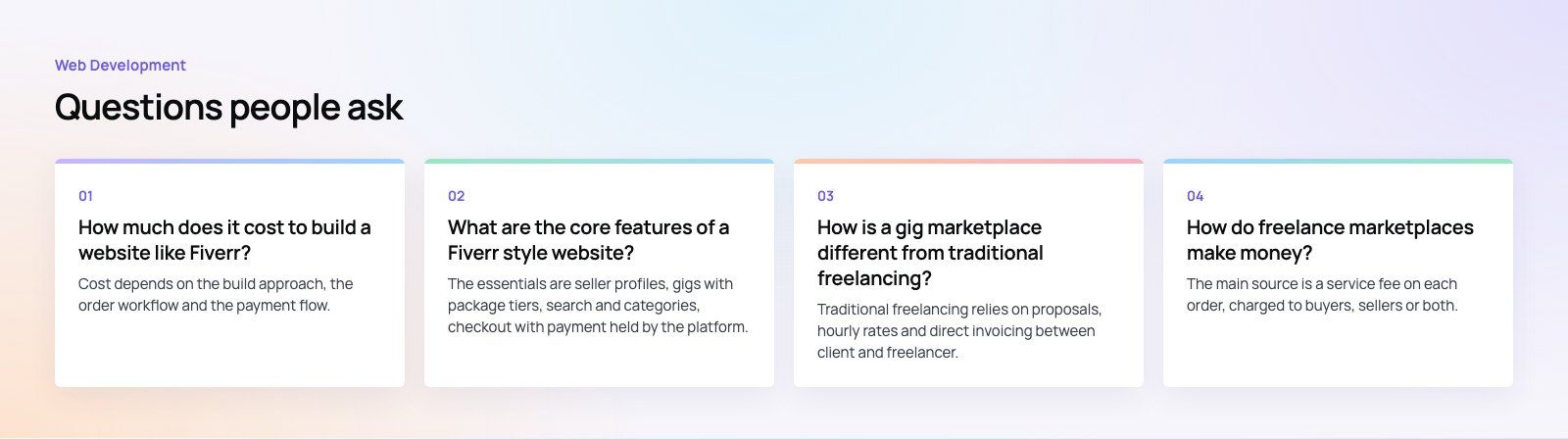
Cost depends on the build approach, the order workflow and the payment flow.
Marketplace software has the lowest upfront cost but limits gig packages and revisions. A custom build costs more initially and gives full control. Budget separately for running costs such as hosting, payment fees and support, and for recruiting sellers and buyers, which is often as large as the build.
Web DevelopmentWordPress vs Drupal: Which CMS Is Right for Your Business?WordPress vs Drupal compared on ease of use, content modeling, security, performance, ecommerce and cost drivers, with five questions to help you choose. Web DevelopmentCustom Website Development vs Website Builders: Pros and ConsAn honest comparison of custom website development and website builders: control, cost over time, SEO, integrations, and how to decide which fits your business.
 Web DevelopmentWeb Development Consultant: What They Do and When to Hire OneWhat a web development consultant does, how the role differs from a developer or agency, when hiring one pays off and how to choose the right one.
Tell us what the business needs. We will tell you what to build first.
Schedule a free consultation and get a written recommendation, with costs, before you commit to anything.
Get in touchPROVEN RESULTS
4.7 / 5verified reviews on Google