 E-CommerceGenerative AI in Online Retail: Uses That Pay BackGenerative AI ecommerce uses ranked by payback and risk: product descriptions, AI search and support assistants, plus Arabic quality checks for UAE stores.
Ecommerce Website Management Services: What They Cover
What ecommerce website management covers: performance, product data, fulfillment, support and security, plus when to outsource and how to choose a partner.
Ecommerce website management services keep an online store fast, secure, accurate and selling after launch. They usually cover performance and SEO, product information, order fulfillment support, customer service processes, and security and compliance. A store that nobody manages slowly loses speed, ranking and customer trust; a well managed one turns those same areas into steady improvements in conversion and repeat orders.
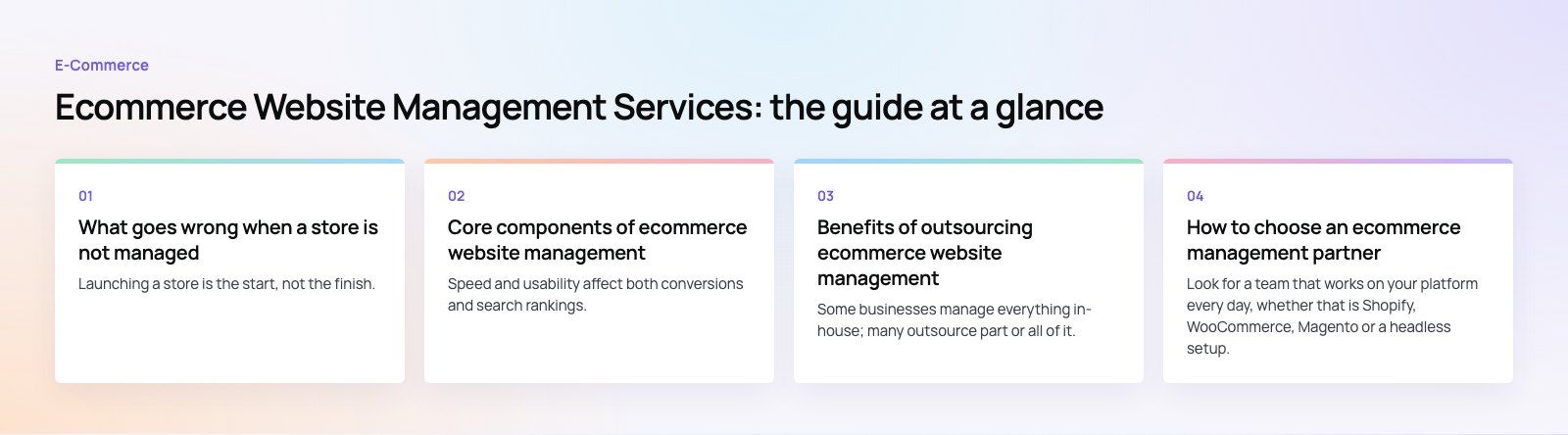
This guide breaks down what management covers, what goes wrong without it, the benefits of outsourcing some or all of the work, and how to choose a partner.
What goes wrong when a store is not managed
Launching a store is the start, not the finish. Plugins go out of date, product data drifts, page speed slips as new apps and scripts are added, and small checkout problems go unnoticed for weeks. The table below shows how common problems turn into lost revenue.
| Problem | Typical impact |
|---|---|
| Slow page loading | Higher bounce rates and abandoned sessions |
| Inaccurate product information | Returns, complaints and lost trust |
| Inefficient order fulfillment | Late deliveries and support tickets |
| Poor customer support | Negative reviews and fewer repeat customers |
| Outdated software | Security holes and broken features |
Core components of ecommerce website management
1. Website performance optimization
Speed and usability affect both conversions and search rankings. Ongoing performance work typically includes:
- Speed optimization: image compression, caching, code minification, removing unused apps and scripts, and monitoring Core Web Vitals. Our Core Web Vitals service focuses on exactly this.
- Mobile optimization: checking that every template, filter and checkout step works on small screens, where a large share of shopping now happens.
- Search engine optimization: clean category structures, unique product copy, structured data and fixing crawl errors so products can be found.
- Conversion rate optimization: studying analytics and session data to find where shoppers drop off, then testing changes to product pages, carts and checkout. A checkout teardown is a quick way to find the biggest leaks.
2. Product information management
Accurate, complete product data builds trust and reduces returns. Management services usually handle:
- Data collection and enrichment: specifications, images, sizes, materials and descriptions gathered from suppliers and improved for shoppers.
- Attribute management: defining attributes such as size, color, brand or compatibility so filters and search work properly.
- Standardization: consistent naming, units and formats across the catalog.
- Content creation: clear product photography and descriptions written for the customer rather than copied from a supplier sheet.
- Stock accuracy: keeping online stock levels in line with the warehouse to prevent overselling.
Good attribute work pays off most in large catalogs. On the Ghezlan store, for example, products can be found by animal, product type or brand, which depends entirely on well structured product data.
3. Order fulfillment and shipping support
The website is where fulfillment problems first become visible to customers. Management covers the digital side of the process:
- Order processing: making sure orders flow correctly from checkout into the systems that pick, pack and ship them.
- Shipping options: configuring carriers, delivery zones, delivery dates and time windows at checkout.
- Order tracking: sending clear status updates and tracking links.
- Returns management: a simple returns flow with clear rules, so returns are handled without endless email.
- Inventory sync: connecting the store with stock and ERP systems so availability is always current.
Delivery details at checkout can matter as much as the products. The Gorgeous Flower Co store, for instance, lets customers choose delivery dates and windows at checkout, because timing is part of what they are buying.
4. Customer support and service
Fast, helpful support keeps customers coming back. Management services can set up and maintain:
- Multi-channel support: email, live chat, WhatsApp and phone, connected so agents see the full history.
- Order and product inquiries: help center content and saved replies for the questions that come up every day.
- Returns and refunds: clear processes so refunds are fast and consistent.
- Feedback management: collecting reviews and survey results and feeding them back into product and site improvements.
5. Security and compliance
An online store holds customer data and takes payments, so security is not optional:
- Website security: regular updates to the platform, themes and plugins, vulnerability monitoring, strong access controls and backups.
- Payment security: using trusted payment gateways and following the PCI Data Security Standard (PCI SSC, 2026) for any part of the store that touches card data. Hosted checkouts reduce how much of that burden falls on you; our payment integration team can advise on the right setup.
- Data protection: encrypting sensitive data, limiting who can access it and following the privacy laws in the markets you sell to, such as the EU data protection rules (European Commission, 2026) or the CCPA in California.
Benefits of outsourcing ecommerce website management
Some businesses manage everything in-house; many outsource part or all of it. The main reasons are:
- Access to specialists: performance, SEO, security and platform development are separate skills that are hard to hire for one by one.
- Focus on the core business: your team can spend its time on buying, marketing and customers instead of plugin updates.
- Scalability: support can increase before a big sale or season and scale back afterwards.
- Lower risk: regular updates, backups and monitoring reduce the chance of downtime or a breach.
- Better decisions: regular reporting turns store data into a clear list of what to fix next.
- Predictable effort: a defined scope replaces the cycle of ignoring the site until something breaks.
What to keep in-house
Outsourcing works best when you keep ownership of strategy, brand and customer relationships. Product decisions, pricing, promotions and tone of voice should stay with your team. A management partner should make those decisions easier to carry out, not make them for you.
How to choose an ecommerce management partner
Platform experience
Look for a team that works on your platform every day, whether that is Shopify, WooCommerce, Magento or a headless setup. Ask to see stores they have built or managed. Codeeo has Shopify developers and WooCommerce developers for exactly this reason: each platform has its own strengths and quirks.
Clear scope and reporting
Agree in writing what is included: updates, monitoring, content changes, performance work, support hours. Ask how they report results and how often. Monthly reporting on speed, uptime, conversion and open issues is a reasonable minimum.
Response times and communication
Find out how quickly they respond to urgent problems such as a broken checkout, and who you actually speak to. A named contact who knows your store is worth more than a ticket queue.
Security practices
Ask how they handle backups, updates, access control and incident response. A partner who cannot explain this clearly is a risk to your store.
What drives the cost
The effort involved depends on catalog size, the number of integrations, how often content changes, traffic levels, the platform and how much support you need. A small store with a stable catalog needs far less ongoing work than a multi-market store with daily promotions and several connected systems.
Keeping your store in shape
An online store is a living system. Managing performance, product data, fulfillment, support and security as one ongoing program is what keeps it converting. Codeeo has delivered 200+ projects across the UAE and the US and is rated 4.7 from 23 Google reviews. If you want help running or improving your store, explore our web development services or get in touch with our team.
Frequently asked questions
They usually include performance and speed optimization, SEO, product information management, support for order processing and shipping settings, customer service processes, and security and compliance work such as updates, backups and payment security. The exact scope varies by provider, so agree in writing which tasks are covered, how often they happen and how results are reported.
E-CommerceGenerative AI in Online Retail: Uses That Pay BackGenerative AI ecommerce uses ranked by payback and risk: product descriptions, AI search and support assistants, plus Arabic quality checks for UAE stores.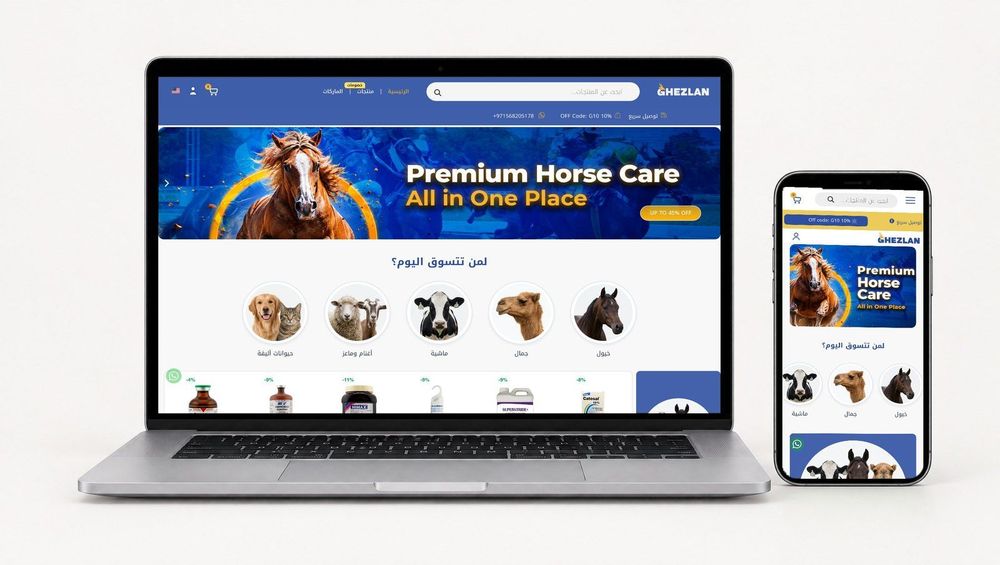 E-CommerceConnecting WooCommerce to ERP, CRM and Shipping Without DuplicatesPlan a WooCommerce ERP integration that avoids duplicates: data ownership rules, idempotent order sync, CRM matching and UAE shipping, with Odoo and Dynamics.
 E-CommerceEnterprise Ecommerce Platform Selection: Requirements Before DemosChoose an enterprise ecommerce platform by setting integration, multi entity, data residency and order management requirements before any vendor demo starts.
Tell us what the business needs. We will tell you what to build first.
Schedule a free consultation and get a written recommendation, with costs, before you commit to anything.
Get in touchPROVEN RESULTS
4.7 / 5verified reviews on Google