 Web DevelopmentWordPress vs Drupal: Which CMS Is Right for Your Business?WordPress vs Drupal compared on ease of use, content modeling, security, performance, ecommerce and cost drivers, with five questions to help you choose.
How Technology Improves User Experience: What Actually Helps
How performance, simpler flows, accessibility, AI, cloud and immersive tech improve user experience, where each gets misused and what to invest in first.
Technology improves user experience when it removes effort for the user: pages that load instantly, flows with fewer steps, content that adapts to the person and their device, and products that work for people with disabilities. The technology itself is never the point. AI, cloud infrastructure, connected devices or immersive media only help when they solve a real friction that users already feel.
This guide looks at the technologies that most often improve UX, where each one genuinely helps, where it gets misused, and how to decide what to invest in first.
What user experience actually covers
User experience is the whole impression someone forms while using a website, app or service. It includes how easy it is to find things, how fast it responds, whether it works on their device, whether they can use it with a screen reader or keyboard, and whether it remembers what matters to them. Visual design is part of it, but most UX problems are about effort, speed and confusion rather than looks.
A useful way to judge any technology investment is to ask one question: does this reduce the time, steps or uncertainty for the user? If the answer is unclear, the feature is probably decoration.
Performance: the technology users notice first
Speed is the most universal UX improvement. Slow pages and laggy interactions frustrate every user, on every device. Google's Core Web Vitals give a practical target: the main content should appear within 2.5 seconds, interactions should respond within 200 milliseconds, and the layout should stay stable with a layout shift score of 0.1 or less, measured across real visits.
Technologies that help
- Content delivery networks serve files from locations near the user.
- Modern image formats and responsive images send smaller files to smaller screens.
- Server rendering and caching deliver usable pages before scripts finish loading.
- Cloud hosting that scales with demand keeps response times steady during traffic spikes.
Common misuse
Heavy animation libraries, autoplay video and a long list of third party scripts often undo all of the above. One issue we often see is a fast site slowed down by chat widgets, trackers and plugins added one at a time. Our Core Web Vitals service usually starts by removing what is not earning its place.
Artificial intelligence: useful when it saves effort
AI can improve UX in specific, measurable ways:
- Search that understands intent, so users find the right product or article even when they use different words.
- Recommendations based on what a person viewed or bought, shown where they help rather than everywhere.
- Support assistants that answer common questions from your own documentation and hand over to a person when they cannot help.
- Automation behind the scenes, such as sorting enquiries or extracting data from documents, which makes the service faster even if users never see the AI.
The risks are well known: confident wrong answers, chatbots that trap users with no way to reach a human, and personalization that feels intrusive. Ground AI features in your own data, test them with real questions and always offer an exit.
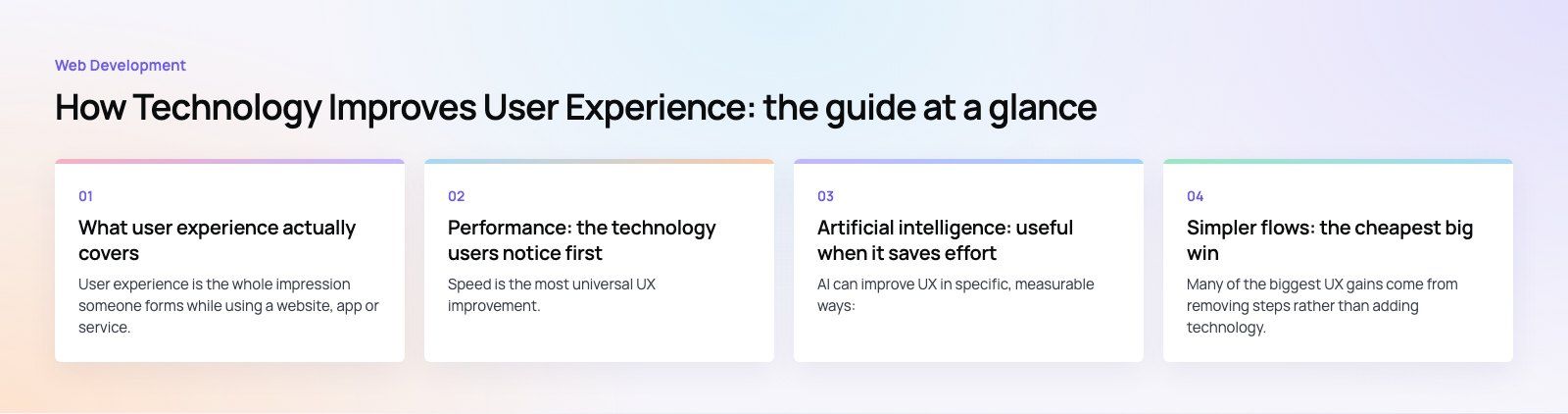
Simpler flows: the cheapest big win
Many of the biggest UX gains come from removing steps rather than adding technology. Guest checkout, saved details, autofill, sign in with a one time code, and showing value before asking for commitment all cut effort. The Star Cinemas case study starts from exactly this kind of problem: the old flow asked for a cinema, a film, a date and a time before it would show a single seat.
How to find friction
- Watch a few real users try your key tasks and note where they hesitate.
- Review analytics for pages where people drop out of a funnel.
- Read support messages; repeated questions point to unclear design.
- Count the taps or clicks needed for your most common task, then try to halve them.
Accessibility: technology that widens your audience
Accessible design lets people with visual, motor, hearing or cognitive impairments use your product, and it usually makes the experience better for everyone. The reference standard is the W3C's Web Content Accessibility Guidelines 2.2.
Practical steps include proper heading structure, text alternatives for images, sufficient color contrast, full keyboard support, visible focus states, clear form labels and error messages, and testing with a screen reader. Building these in from the start costs far less than retrofitting them.
Cloud and connected devices
Cloud services make UX more reliable and consistent. Users expect their data, settings and progress to follow them between phone, tablet and desktop, and cloud sync makes that possible. Managed cloud platforms also provide backups, encryption and monitoring that protect users' data and keep services available.
Connected devices, from wearables to smart home equipment and vehicles, extend the experience beyond the screen. The UX challenge there is reliability and clarity: users need to know what a device is doing, control it easily from an app, and trust that it will work when the connection is poor. Our Runvse case study is one example of an app, an API and device firmware designed to work together.
Augmented and virtual reality: valuable in narrow cases
AR and VR can improve UX where seeing something in context changes a decision: placing furniture in a room, trying on glasses, previewing a property, or training staff on equipment. Outside those cases, immersive features often add load time and complexity without helping the user finish a task. Treat them as targeted tools, not a default.
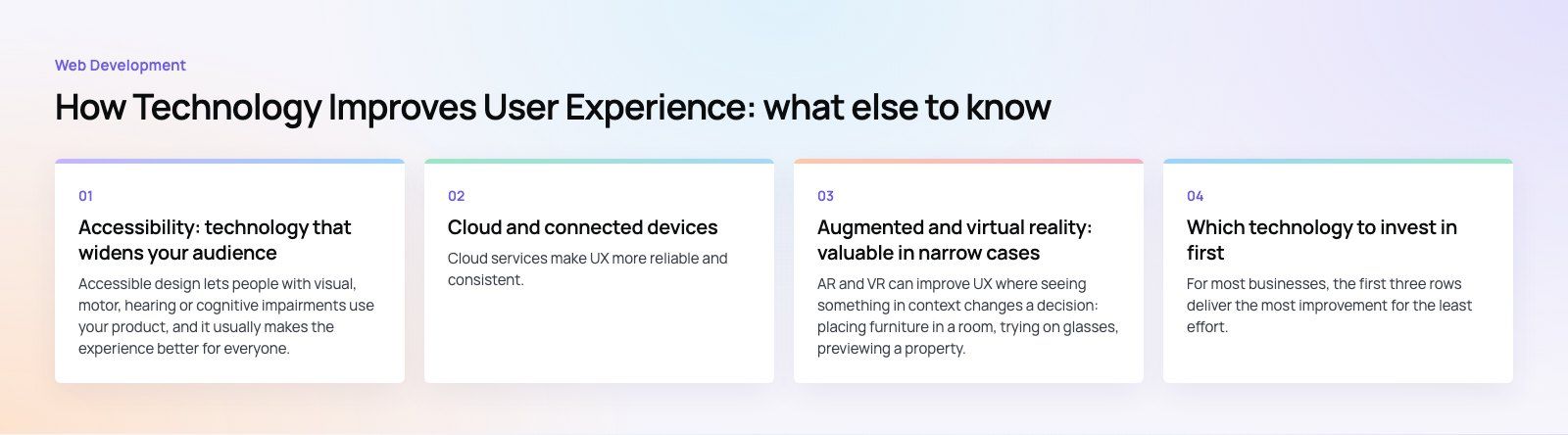
Which technology to invest in first
| Technology | UX benefit | Typical effort | Best for |
|---|---|---|---|
| Performance work | Faster pages and interactions for everyone | Low to medium | Every website and app |
| Flow simplification | Fewer steps, fewer drop offs | Low to medium | Checkouts, bookings, sign ups |
| Accessibility | Usable by more people, clearer for all | Medium | Every public product |
| AI search and support | Faster answers, better discovery | Medium to high | Large catalogs and help centers |
| Cloud sync | Consistent experience across devices | Medium | Apps with accounts |
| Connected devices | Control and feedback beyond the screen | High | Hardware led products |
| AR and VR | Better decisions on physical products | High | Furniture, fashion, property, training |
For most businesses, the first three rows deliver the most improvement for the least effort. Add the others when user research shows a clear need.
Measuring whether it worked
Decide how you will measure success before you build. Useful measures include task completion rate, time to complete key tasks, funnel drop off, Core Web Vitals from real users, support contact volume and satisfaction scores. Measure before and after each change, so you know which investments actually helped.
Improving your product's UX
Good UX comes from research, design and engineering working together. Codeeo's team of 80+ across Dubai, Riyadh and Karachi has delivered 200+ projects across the UAE and the US. If you want to find where your users struggle, start with a website audit, or talk to our design team about research and interface work. For apps, see our mobile app development services.
Frequently asked questions
Improve speed and remove unnecessary steps.
Faster pages help every user, and cutting a step from a checkout or booking flow often lifts completion immediately. Start by measuring Core Web Vitals and watching a few people try your most important task. The problems you find there are usually cheaper to fix than adding a new technology.
Web DevelopmentWordPress vs Drupal: Which CMS Is Right for Your Business?WordPress vs Drupal compared on ease of use, content modeling, security, performance, ecommerce and cost drivers, with five questions to help you choose. Web DevelopmentCustom Website Development vs Website Builders: Pros and ConsAn honest comparison of custom website development and website builders: control, cost over time, SEO, integrations, and how to decide which fits your business.
 Web DevelopmentWeb Development Consultant: What They Do and When to Hire OneWhat a web development consultant does, how the role differs from a developer or agency, when hiring one pays off and how to choose the right one.
Tell us what the business needs. We will tell you what to build first.
Schedule a free consultation and get a written recommendation, with costs, before you commit to anything.
Get in touchPROVEN RESULTS
4.7 / 5verified reviews on Google