 Web DevelopmentWordPress vs Drupal: Which CMS Is Right for Your Business?WordPress vs Drupal compared on ease of use, content modeling, security, performance, ecommerce and cost drivers, with five questions to help you choose.
How to Build a Job Board Like Indeed: Steps, Features and Cost
A step by step guide to building a job board like Indeed: niche, tech stack, core features, data protection, launch, cost drivers and mistakes to avoid.
To build a job board like Indeed, you pick a niche, plan the employer and job seeker flows, choose a technology stack that can search large volumes of listings quickly, build the core features (job posting, search and filters, profiles and resumes, applications and alerts), then secure, test, launch and market it to both sides. The cost depends mainly on how many features you launch with, how advanced search and matching need to be, and how much you invest in getting employers and candidates onto the platform.
This guide covers each step, the features that matter, technology choices, cost drivers and the mistakes that sink most new job boards.
Why build your own job board
Indeed and similar sites aggregate a huge volume of listings, which makes them broad but noisy. A focused job board can serve a specific audience better: one industry such as healthcare or construction, one country or city, one type of work such as shifts, freelance or graduate roles, or a company's own careers platform. Owning the platform gives you control over the experience, the data and how you charge.
Like any marketplace, the hard part is supply and demand at the same time. Candidates come for jobs; employers come for candidates. Plan how you will seed both before you build.
Steps to build a job board like Indeed
1. Research and plan
Study the job market you are targeting, the candidates you want to reach and the competitors already serving them. Define your unique selling point, the features for a first version, a budget and a timeline. Interview a few employers: what do they pay for today, and what frustrates them?
2. Choose the technology stack
The stack must handle many listings, fast search and growing traffic. Common choices:
- Frontend: React, Next.js, Vue or Angular for a fast, responsive interface. Our React developers build this layer regularly.
- Backend: Node.js, Python with Django, PHP with Laravel, Ruby on Rails or Java.
- Database: PostgreSQL or MySQL for structured data, sometimes MongoDB for flexible records.
- Search: a dedicated search engine such as Elasticsearch, OpenSearch or a hosted search service for fast filtering by keyword, location, salary and type.
- Hosting: cloud infrastructure that can scale as listings and traffic grow.
3. Design the user experience
Job seekers need a prominent search bar, useful filters, clear listings and a short application flow. Employers need a straightforward way to post jobs and review applicants. Design mobile first, because many candidates search and apply from their phones.
4. Build the core features
See the feature table below. Start with what lets an employer post a job and a candidate apply, then add the rest.
5. Secure the platform and protect data
Job boards hold resumes, contact details and employment history, which is sensitive personal data. Use secure authentication, encryption, role based access and regular security reviews. If you serve users in Europe, the GDPR applies, and other countries have their own data protection laws. Verify employers to keep fake and scam listings off the site.
6. Test thoroughly
Run functional, usability, performance and security testing across browsers and devices. Test search with large data sets, not just a handful of sample jobs, because search speed is what users notice first.
7. Launch and market
Launch with real listings, even if you have to source the first ones yourself. Use SEO, content, social media, partnerships with employers and associations, and paid campaigns. Mark up listings with Google's JobPosting structured data so they can appear in Google's job search experience.
8. Improve continuously
Collect feedback, track searches with no results, application rates and employer renewals, and use that data to decide what to build next.
Core features of a job board
| Feature | Who it serves | Launch or later |
|---|---|---|
| Employer accounts and job posting | Employers | Launch |
| Job search with filters for location, salary, type and experience | Job seekers | Launch |
| Candidate profiles and resume upload | Job seekers | Launch |
| Applications and status tracking | Both | Launch |
| Email job alerts and notifications | Job seekers | Launch |
| Admin for moderation and employer verification | Platform | Launch |
| Applicant tracking tools for employers | Employers | Soon after launch |
| Company reviews and ratings | Job seekers | Later |
| Paid featured listings and employer plans | Platform | Later |
| AI job matching and recommendations | Both | Later |
| Mobile apps | Both | Later |
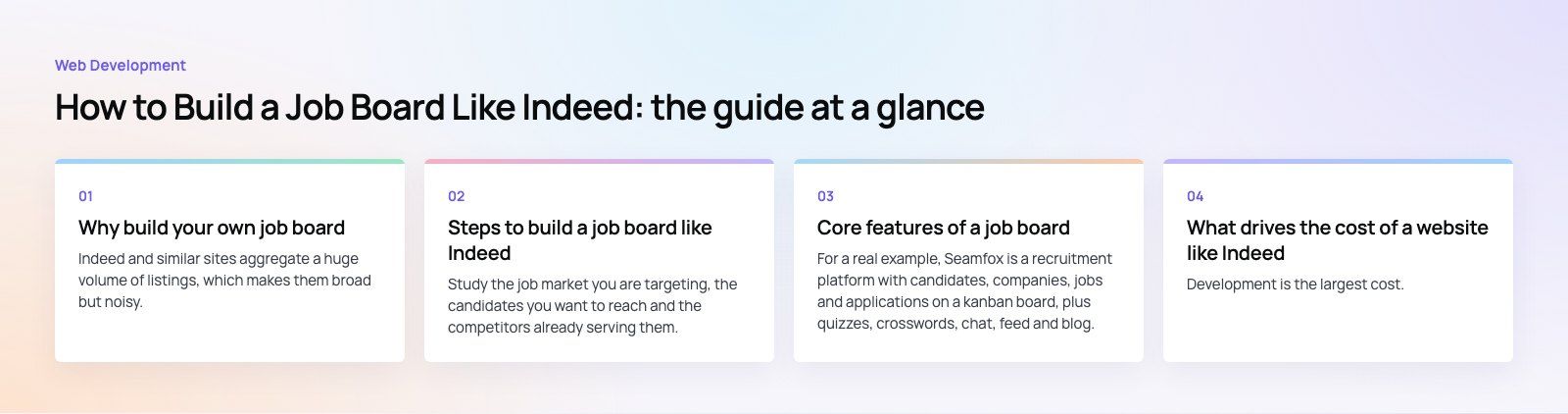
For a real example, Seamfox is a recruitment platform with candidates, companies, jobs and applications on a kanban board, plus quizzes, crosswords, chat, feed and blog. Features like the kanban board help employers manage applicants, which keeps them paying.
What drives the cost of a website like Indeed
Development
Development is the largest cost. A basic job board with posting, search and applications is a modest build. AI recommendations, advanced filtering, applicant tracking, integrations with HR systems and mobile apps each add significant scope.
Design
A clean, professional design builds trust with both employers and candidates. A theme based design costs less; a custom design for job seekers, employers and admins costs more.
Hosting and infrastructure
Costs grow with the number of listings, resumes stored, search traffic and email volume. Cloud hosting lets you start small and scale.
Security and compliance
Encryption, firewalls, audits and data protection compliance are not optional for a site holding personal data.
Marketing
Attracting employers and candidates usually costs more over time than the build itself. Budget for launch campaigns and ongoing SEO, content and advertising.
Maintenance
Bug fixes, updates, new features, moderation and support continue every month after launch.
Niche staffing is often a better business than a general job board. Distinct, for example, is a healthcare workforce platform with a catalogue, shifts, bookings, incident reports, reviews, rewards and a design system shared by web and admin.
Mistakes that sink new job boards
- Launching empty: no listings means no candidates, and no candidates means no employers.
- Going too broad: competing with Indeed on every job type is a losing game.
- Weak search: slow or irrelevant results drive candidates away quickly.
- No moderation: scam listings destroy trust faster than anything else.
- Building every feature first: launch lean and let usage decide what comes next.
Our product scoping quick start helps define a realistic first version before you commit to a build.
Plan your job board with Codeeo
Codeeo has delivered 200+ projects across the UAE and the US, with a team of 80+ across Dubai, Riyadh and Karachi. If you are planning a job board or recruitment platform, our custom software and web development teams can help you scope, design and build it.
Frequently asked questions
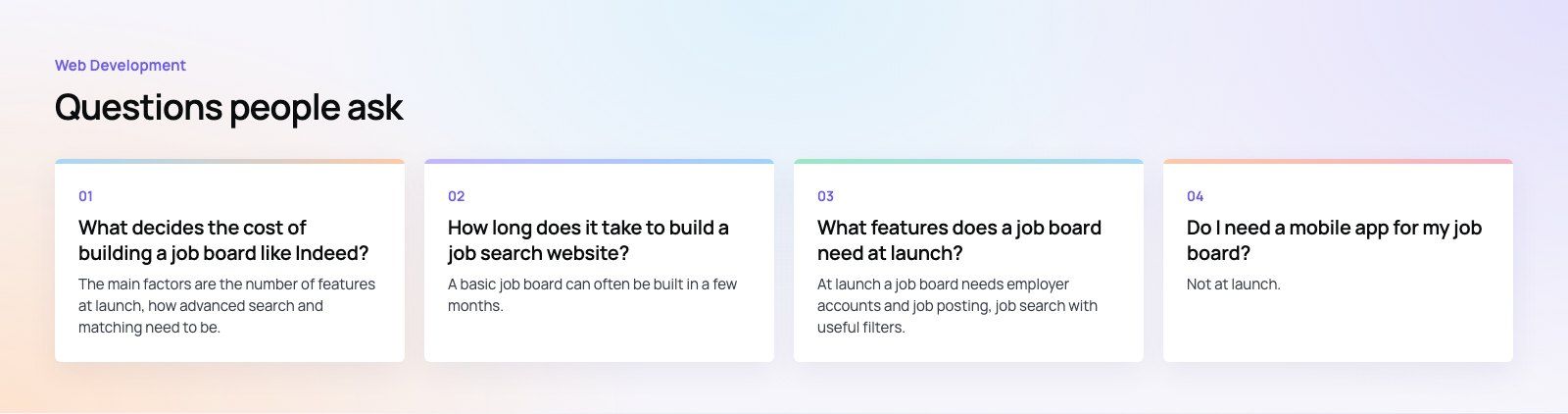
The main factors are the number of features at launch, how advanced search and matching need to be, whether you need mobile apps, the design effort, the development team's experience and location, and ongoing hosting, security and marketing. A lean first version with posting, search and applications costs far less than a platform with AI matching, applicant tracking and native apps from day one.
Web DevelopmentWordPress vs Drupal: Which CMS Is Right for Your Business?WordPress vs Drupal compared on ease of use, content modeling, security, performance, ecommerce and cost drivers, with five questions to help you choose. Web DevelopmentCustom Website Development vs Website Builders: Pros and ConsAn honest comparison of custom website development and website builders: control, cost over time, SEO, integrations, and how to decide which fits your business.
 Web DevelopmentWeb Development Consultant: What They Do and When to Hire OneWhat a web development consultant does, how the role differs from a developer or agency, when hiring one pays off and how to choose the right one.
Tell us what the business needs. We will tell you what to build first.
Schedule a free consultation and get a written recommendation, with costs, before you commit to anything.
Get in touchPROVEN RESULTS
4.7 / 5verified reviews on Google