 Web DevelopmentWordPress vs Drupal: Which CMS Is Right for Your Business?WordPress vs Drupal compared on ease of use, content modeling, security, performance, ecommerce and cost drivers, with five questions to help you choose.
How to Build a Casual Games Website Like Big Fish Games
How to build a casual games portal like Big Fish Games: similar sites to study, must have features, a build plan, tech stack choices and what drives cost.
To build a website like Big Fish Games, you need four things working together: a game catalog that is easy to browse and search, a way for players to try a game before they pay, an account and payment system that handles purchases or memberships, and a steady supply of new titles. The website is the smaller part of the work. Licensing or making games, and keeping the library fresh, is where most of the effort and budget goes.
This guide covers what a casual games portal actually is, which similar sites are worth studying, the features players expect, a step by step build plan, and the factors that decide what the project costs.
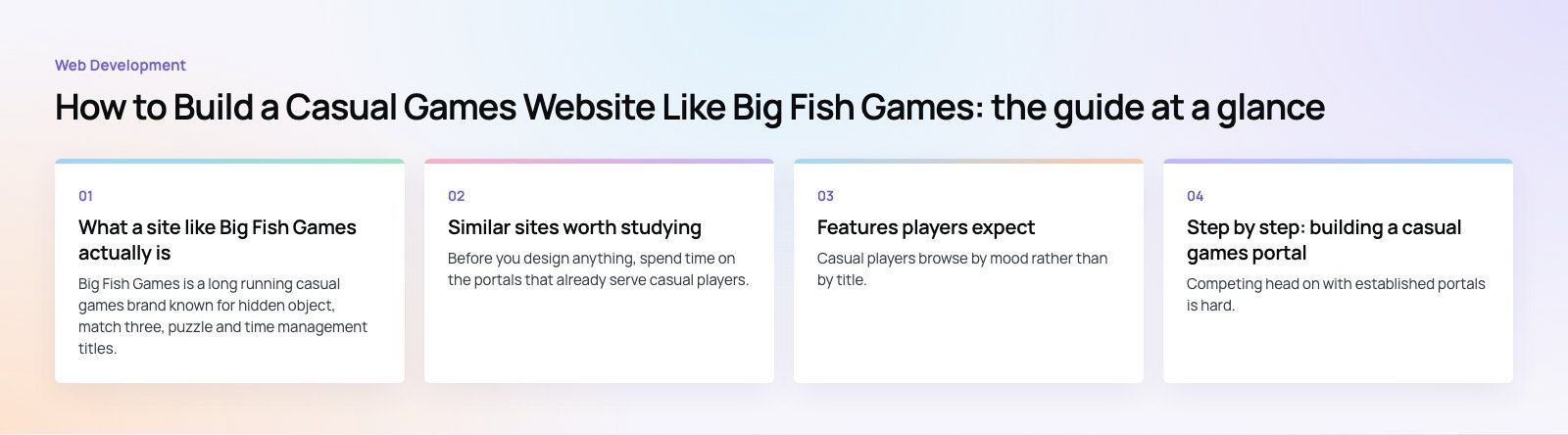
What a site like Big Fish Games actually is
Big Fish Games is a long running casual games brand known for hidden object, match three, puzzle and time management titles. Its model is simple to describe and hard to copy: a large library of short, approachable games aimed at adults who play in short sessions, sold through a storefront that lets people sample before committing.
Under the surface, a portal like this is three products stacked together:
- A storefront. Catalog pages, categories, search, game detail pages, reviews and a checkout.
- A distribution system. Browser play, downloadable installers, or links out to app stores, plus licence checks so paid games stay paid.
- A retention engine. Accounts, wish lists, memberships, email, new release announcements and seasonal events that bring players back.
If you are planning a similar site, decide early which of these you are really building. A free, ad supported browser portal is a very different project from a paid download store with memberships.
Similar sites worth studying
Before you design anything, spend time on the portals that already serve casual players. Each one has chosen a slightly different business model, and those choices shape every page.
| Site | Main model | What to learn from it |
|---|---|---|
| Big Fish Games | Paid casual games with trials | How to present a large catalog by genre and make trying a game feel low risk |
| GameHouse | Casual game library with membership access | How a membership turns many small purchases into one ongoing relationship |
| iWin | Free casual games across match three, hidden object and solitaire | Genre led navigation for a broad audience |
| Pogo | Free card, word and puzzle games with community features | How profiles, badges and chat keep players returning |
| Shockwave | Free online games and downloads | Category depth and daily content for repeat visits |
| Poki | Free browser games, ad supported | Instant play with no install and very fast loading |
Look at how each site handles the first thirty seconds: what a new visitor sees, how many clicks it takes to start playing, and where the site asks for an account or a payment. That sequence matters more than visual style.
Features players expect
A catalog that is easy to browse
Casual players browse by mood rather than by title. Group games by genre, difficulty, length and theme, and add filters for platform. Search should handle typos and partial names. Each game page needs screenshots, a short trailer if you have one, system requirements and honest reviews.
Try before you buy
Free trials, timed demos or a free first chapter lower the barrier to a first purchase. Technically this means time limited licences or a gated build, and the trial must end gracefully with a clear path to buy.
Accounts, purchases and memberships
Players need one account that remembers what they own, their progress and their payment method. If you offer memberships, you also need recurring billing, upgrade and cancellation flows, and member pricing logic. This is where careful payment integration pays for itself, because failed renewals and confusing cancellations generate most support tickets.
Community features
Ratings, reviews, forums, achievements and friend lists give players a reason to come back between purchases. Plan moderation from day one: reporting, filtering and an admin queue.
Play on any device
Many casual players now play on phones and tablets. A responsive site is the minimum. If mobile play is central, you may need native apps alongside the website, which is a separate piece of mobile app development work.
Step by step: building a casual games portal
1. Pick a niche and a business model
Competing head on with established portals is hard. A narrower focus works better: puzzle games for older players, educational games for children, games in Arabic, or titles from independent studios. Then decide how you earn: single purchases, memberships, ads, or a mix. The model decides your feature list.
2. Secure your content
Decide whether you will make games, license them from studios, or run a marketplace where developers publish their own. Licensing needs contracts, revenue sharing and delivery pipelines. A marketplace needs developer accounts, upload tools and review processes. Making games in house is the slowest and most expensive route.
3. Scope the first release
List the minimum a player needs: browse, try, buy, play, and come back. Leave forums, achievements and gifting for later releases. A short product scoping exercise at this point saves months of rework.
4. Design the experience
Wireframe the home page, category pages, game detail pages, checkout and library before any visual design. Test the flow with real players in your niche. Make sure the design meets WCAG accessibility guidelines, since casual audiences often include older players who rely on larger text and clear contrast.
5. Build the platform
Build the storefront, account system, licensing, payments and admin together, because they depend on each other. Plan for spikes when a popular title launches.
6. Test thoroughly
Test every game on every supported platform, every payment path including refunds and failed cards, and every trial expiry. Load test the catalog and checkout.
7. Launch and keep the library moving
A games portal is never finished. Plan a release calendar, seasonal events and regular promotions before launch, and give your team an admin panel that makes publishing a new game quick.
Choosing a technology stack
There is no single right stack, but the choices fall into a few patterns.
| Layer | Common options | When it fits |
|---|---|---|
| Front end | React or Next.js | Fast catalog pages, good search visibility, rich interactions |
| Back end | Node.js, Laravel or Django | Accounts, licences, orders and admin APIs |
| Database | PostgreSQL or MySQL, plus a search engine | Structured catalog data with fast filtering |
| Game delivery | HTML5 builds on a CDN, or downloadable installers | Browser play needs a CDN; downloads need licence keys |
| Payments | A payment provider with subscription support | Single purchases, memberships and refunds |
| Hosting | Cloud hosting with autoscaling | Traffic spikes on launches and promotions |
For browser games, page speed is part of the product. Track the Core Web Vitals from the first build, and treat performance work as ongoing rather than a launch task.
What drives the cost
Prices for a project like this vary too widely for a single figure to be useful. What you can control is scope. These are the factors that move the budget most:
- Content source. Making your own games costs far more than licensing, and licensing costs more than an open marketplace.
- Business model. Memberships, trials and licence management add more back end work than simple free play.
- Platforms. A browser only portal is cheaper than a website plus native iOS and Android apps.
- Custom design. A distinctive interface with animation costs more than a clean template, but casual players do judge quality quickly.
- Community and moderation. Forums, chat and reviews need moderation tools and staff time.
- Running costs. Hosting, CDN bandwidth for game files, payment processing fees, support and marketing continue every month after launch.
The practical way to control spend is to launch a focused first version, measure what players actually use, and add features based on evidence. Open source tools, managed hosting and a proven payment provider all reduce early cost without boxing you in later.
Mistakes to avoid
- Launching with a thin library. A portal with a few dozen games feels empty. Secure enough content before launch to fill every category.
- Forcing sign up too early. Let people play or try first, then ask for an account.
- Ignoring licence security. Weak licence checks let paid games circulate for free.
- No plan for marketing. Players will not find a new portal by chance. Budget for search, social and email from the start, ideally with a digital marketing plan built alongside the site.
- Treating launch as the finish line. The library, events and promotions need a team after launch.
Is a Big Fish style website right for you?
It suits founders who have access to games, through a studio, licensing deals or a developer community, and who can commit to running the portal as an ongoing business. If you only have the website idea and no content plan, start with the content. The platform can be built in months; a library and an audience take longer.
If you are planning a games portal, a marketplace or any content heavy platform, Codeeo's team of 80+ across Dubai, Riyadh and Karachi has delivered 200+ projects across the UAE and the US. Our web development team can help you scope a first release, choose a stack and build it to scale.
Frequently asked questions
Well known casual game portals include GameHouse, iWin, Pogo, Shockwave and Poki.
They differ mainly in business model. Some sell games or memberships, others are free and supported by ads, and some focus on community features such as profiles and chat. Studying how each one handles a new visitor's first few minutes is the most useful research for anyone planning a similar site.
Web DevelopmentWordPress vs Drupal: Which CMS Is Right for Your Business?WordPress vs Drupal compared on ease of use, content modeling, security, performance, ecommerce and cost drivers, with five questions to help you choose. Web DevelopmentCustom Website Development vs Website Builders: Pros and ConsAn honest comparison of custom website development and website builders: control, cost over time, SEO, integrations, and how to decide which fits your business.
 Web DevelopmentWeb Development Consultant: What They Do and When to Hire OneWhat a web development consultant does, how the role differs from a developer or agency, when hiring one pays off and how to choose the right one.
Tell us what the business needs. We will tell you what to build first.
Schedule a free consultation and get a written recommendation, with costs, before you commit to anything.
Get in touchPROVEN RESULTS
4.7 / 5verified reviews on Google