 Web DevelopmentWordPress vs Drupal: Which CMS Is Right for Your Business?WordPress vs Drupal compared on ease of use, content modeling, security, performance, ecommerce and cost drivers, with five questions to help you choose.
How to Choose a Web Development Company: 16 Practical Checks
Sixteen practical checks for choosing a web development company, from defining scope and shortlisting to comparing proposals, contracts and support.
To choose a web development company, define what you need first, then shortlist firms that have built similar projects, check how they work as well as what they have shipped, and compare proposals on scope rather than on the headline number. The right company is the one whose process, team and support plan fit your project, not the one with the slickest pitch. The sixteen checks below walk through that decision in order.
Before you contact anyone
1. Write down what the website must do
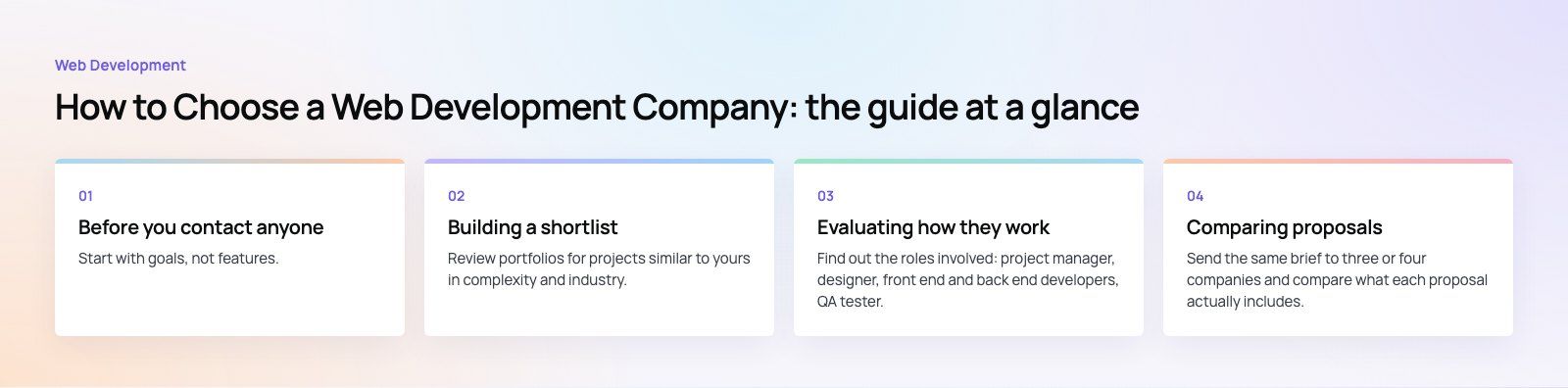
Start with goals, not features. Is the site there to generate leads, sell products, publish content, serve logged in customers or replace an internal tool? A marketing site, an online store and a custom web application are different projects that need different skills. A one page summary of goals, audiences and must have functions will save you weeks of vague conversations.
2. Decide what type of development you need
Some projects are mostly front end work: design, layout, content management and speed. Others are back end heavy: integrations, user accounts, payments, dashboards and business logic. Many need both. Knowing the balance helps you avoid a design studio for a complex platform, or a software house for a simple brochure site. If the site needs strong visual work as well, check that the company has its own design team rather than outsourcing it.
3. Set a realistic budget range and timeline
You do not need an exact figure, but you need a range you are comfortable with and a launch date that is tied to something real, such as a product release or a season. Share both with shortlisted companies. A good firm will tell you what is achievable within them and what has to wait for a later phase.
4. Decide who owns the project on your side
Name one person who can answer questions, gather content and make decisions. Projects slow down most often because the client side has no clear owner, not because the developers are slow. That person should also be the single point of contact for the agency.
Building a shortlist
5. Look for relevant work, not just good looking work
Review portfolios for projects similar to yours in complexity and industry. A beautiful brochure site says little about a firm's ability to build a booking platform. Ask to see live sites, and check them on your own phone.
6. Read case studies for how problems were solved
A useful case study explains the problem, the decisions made and what was built. It tells you how the team thinks. Be wary of case studies that are only screenshots and adjectives.
7. Check reviews and talk to past clients
Read reviews on independent platforms such as Google, and ask for one or two client references you can speak to. Ask those clients what went wrong during the project and how the company handled it. Every project has problems; how they are handled is what matters.
8. Look at the services around development
A website rarely lives alone. You may later need a mobile app, SEO, paid campaigns or integrations with a CRM or ERP. A company that can cover adjacent work, or that partners well with those who do, reduces hand offs. It is not essential, but it is worth knowing early.
Evaluating how they work
9. Ask who will actually work on your project
Find out the roles involved: project manager, designer, front end and back end developers, QA tester. Ask whether the people in the sales meeting are the people who will build the site, and whether any part of the work is subcontracted. A clear team structure is a strong predictor of a smooth project.
10. Understand their process and communication
Ask how the project is broken into phases, how often you will see progress, what tools they use for tasks and feedback, and how change requests are handled. Weekly demos of working software are better than a big reveal at the end.
11. Check their approach to security and privacy
If the site handles logins, payments or personal data, ask how they handle hosting, updates, backups, access control and data protection. Ask what happens when a plugin or library has a security vulnerability after launch. The OWASP Top 10 is a reasonable reference to discuss; a competent team will know it.
12. Ask about performance and SEO from day one
Speed, mobile usability and technical SEO are much cheaper to build in than to fix later. Ask how they measure page speed, how they handle redirects if you are replacing an old site, and who sets up analytics. If they treat these as optional extras, keep looking.
Comparing proposals
13. Compare scope, not just price
Send the same brief to three or four companies and compare what each proposal actually includes. Lower quotes often leave out content entry, testing, training, or integrations that another firm has included. Cost is driven by the number of templates and features, custom design versus a theme, integrations, content migration, and the level of testing and support. If you are replacing an existing site, ask how each firm will handle the site migration, because that work is often missing from cheaper quotes.
| Check | Strong proposal | Weak proposal |
|---|---|---|
| Scope | Lists pages, features and integrations | Says "complete website" |
| Process | Phases, milestones and review points | A single delivery date |
| Team | Named roles and responsibilities | No mention of who does the work |
| Testing | Devices, browsers and acceptance criteria | Not mentioned |
| Ownership | You own code, design files and accounts | Unclear or retained by the agency |
| After launch | Support period and maintenance options | Ends at launch |
14. Agree the timeline in detail
Ask for a schedule with milestones and the inputs needed from you at each one, such as content, approvals and access to third party accounts. Most delays come from missing inputs, so knowing them early protects your launch date.
15. Clarify support and maintenance after launch
Ask what is included after go live: a warranty period for bugs, ongoing updates, monitoring, backups and small changes. Find out how support requests are raised and how quickly they are answered. A site without maintenance gradually becomes slower and less secure.
16. Read the contract carefully
The contract should state the scope, deliverables, milestones, payment schedule, change request process and who owns the code, designs, domain and hosting accounts. Make sure you will have admin access to everything. If something you discussed is not in writing, it is not part of the project.
Red flags to watch for
- A fixed quote given before anyone has asked about your goals or integrations
- Promises of top rankings or fixed traffic numbers
- No access to your own hosting, domain or code
- A portfolio that cannot be checked live
- Reluctance to put the scope in writing
- No testing phase in the plan
- Pressure to sign quickly with a discount that expires
Questions to ask in the first call
- What similar projects have you built, and can I see them live?
- Who will work on my project, and what does each person do?
- How will I see progress and give feedback?
- What do you need from me, and when?
- How do you handle changes to the scope?
- What happens after launch?
- Will I own the code, design files and accounts?
Next steps
A careful selection process takes a few weeks, and it is time well spent compared with rebuilding a site that missed the brief. Codeeo has delivered 200+ projects across the UAE and the US with a team of 80+ across Dubai, Riyadh and Karachi, and is rated 4.7 from 23 Google reviews. You can browse our case studies, learn about our web development services, or start with a product scoping session to turn your goals into a clear brief.
Frequently asked questions
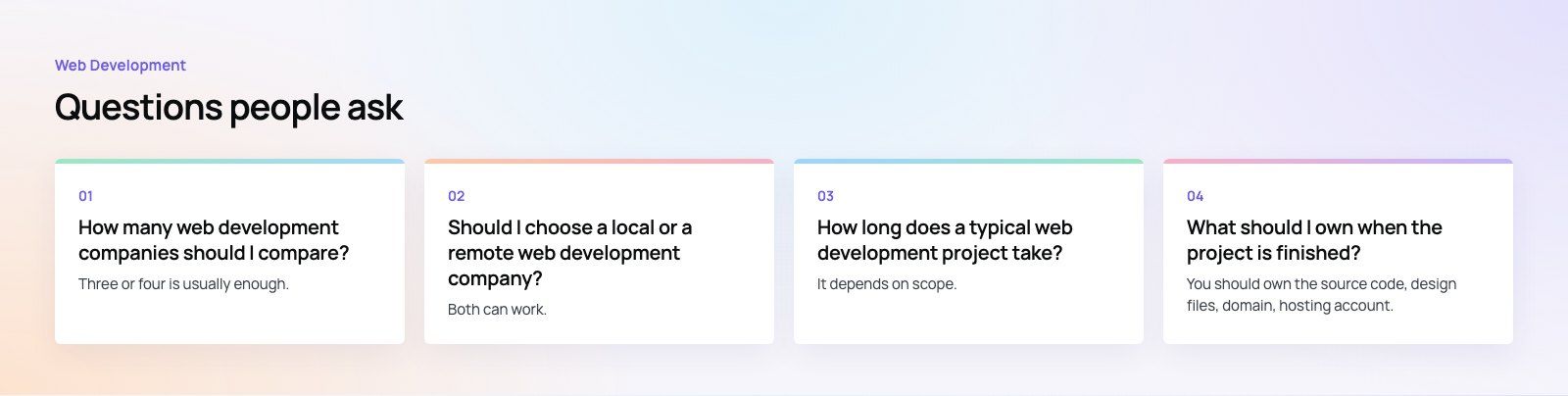
Three or four is usually enough.
Fewer gives you little to compare; more makes it hard to give each proposal proper attention. Send every company the same written brief so the proposals are comparable, and arrange a call with each so you can judge how they ask questions and explain their process, not just what they quote.
Web DevelopmentWordPress vs Drupal: Which CMS Is Right for Your Business?WordPress vs Drupal compared on ease of use, content modeling, security, performance, ecommerce and cost drivers, with five questions to help you choose. Web DevelopmentCustom Website Development vs Website Builders: Pros and ConsAn honest comparison of custom website development and website builders: control, cost over time, SEO, integrations, and how to decide which fits your business.
 Web DevelopmentWeb Development Consultant: What They Do and When to Hire OneWhat a web development consultant does, how the role differs from a developer or agency, when hiring one pays off and how to choose the right one.
Tell us what the business needs. We will tell you what to build first.
Schedule a free consultation and get a written recommendation, with costs, before you commit to anything.
Get in touchPROVEN RESULTS
4.7 / 5verified reviews on Google