 Web DevelopmentWordPress vs Drupal: Which CMS Is Right for Your Business?WordPress vs Drupal compared on ease of use, content modeling, security, performance, ecommerce and cost drivers, with five questions to help you choose.
JavaScript Dependency Injection: Best Practices That Work
How to use dependency injection in JavaScript and TypeScript: constructor injection, composition roots, lifetimes, containers and testing.
Dependency injection in JavaScript means a module or class receives the things it depends on, such as a database client, logger or API wrapper, instead of creating or importing them itself. The best practices are simple: inject through constructors or function parameters, wire everything together in one place, depend on small contracts rather than concrete implementations, and add a container only when manual wiring gets painful. Done well, it makes code easier to test, swap and reason about.
This guide explains what dependency injection is, the patterns that work in modern JavaScript and TypeScript, when a DI container helps, and the security issues that often get confused with it.
What is dependency injection?
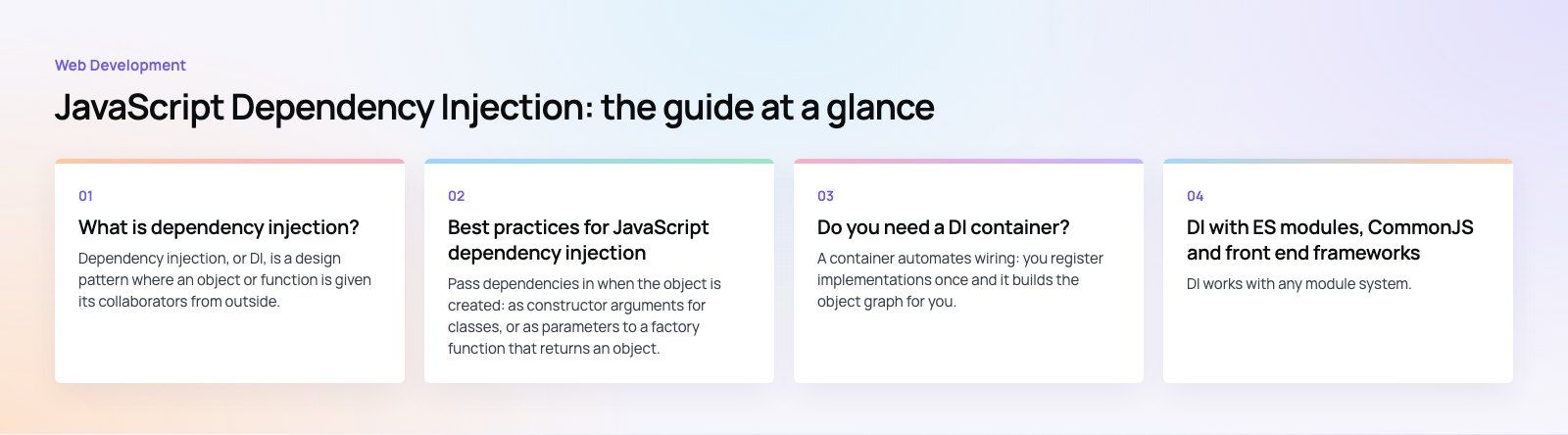
Dependency injection, or DI, is a design pattern where an object or function is given its collaborators from outside. Something else, often called the composition root, injector or container, decides which concrete implementations to use and passes them in.
A games console is a useful picture. The console does not contain any game; you insert the cartridge you want and it plays. The console only needs to know the shape of a cartridge, not how each game was built. In the same way, an order service that is handed a payment gateway does not care whether it is the real provider, a sandbox or a test fake. It only cares that the object has the methods it calls.
The opposite is hard wiring: a module that imports a specific database client at the top of the file and calls it directly. That works until you need to test the module without a database, run it against a different provider, or reuse it in another app.
Why it matters in JavaScript
JavaScript's module system makes it tempting to import everything directly. Frameworks like Angular and NestJS have DI built in, but plain Node.js, React and Next.js codebases do not, so teams often skip it. The cost shows up later as tests that need heavy module mocking, services that cannot run without a live network, and features that are hard to move between projects.
Best practices for JavaScript dependency injection
1. Prefer constructor or parameter injection
Pass dependencies in when the object is created: as constructor arguments for classes, or as parameters to a factory function that returns an object. This makes every dependency visible in one place, so reading the signature tells you what the code needs. Avoid setting dependencies through properties after creation, which leaves objects half built and easy to misuse.
2. Use factory functions when classes are not needed
Many JavaScript teams prefer functions to classes. A factory such as a function that takes a database client and a logger and returns an object of user service methods gives you all the benefits of DI with closures instead of constructors. It is idiomatic, needs no library and works the same in Node.js and the browser.
3. Wire everything in a composition root
Create concrete implementations and connect them in one place near the application's entry point, such as the server start file or the app bootstrap. Business modules should never decide which implementation they get. When you need a different setup for tests, staging or a worker process, you write a different composition root rather than editing business code.
4. Depend on contracts, not implementations
Design each dependency as a small contract: the handful of methods the consumer actually calls. In TypeScript, express it as an interface or type. In plain JavaScript, document it and keep it narrow. A notification service that only needs a send method should not receive a whole email SDK with dozens of methods.
5. Avoid the service locator pattern
A service locator is a global registry that code reaches into to fetch what it needs. It looks like DI but hides dependencies inside function bodies, so you cannot see them from the outside and tests have to configure global state. Pass dependencies in explicitly instead.
6. Keep the number of dependencies small
If a constructor takes eight or ten dependencies, the class is probably doing too much. DI makes this visible, which is a benefit. Split the responsibility into smaller services rather than hiding the dependencies behind a container.
7. Watch for circular dependencies
When service A needs B and B needs A, wiring fails or produces half initialized objects. Treat a cycle as a design problem: extract the shared logic into a third service, or use events to decouple the two. Lazy injection tricks that hide the cycle usually make it harder to understand later.
8. Choose lifetimes deliberately
Most DI setups, manual or container based, use three lifetimes:
| Lifetime | What it means | Typical use |
|---|---|---|
| Singleton | One instance for the whole application | Configuration, connection pools, loggers |
| Scoped | One instance per scope, usually per request | Request context, unit of work, current user |
| Transient | A new instance every time it is requested | Lightweight, stateless helpers |
The common bug is a singleton that holds a scoped dependency, such as a service created once at startup that keeps a reference to the first request's user. Make sure longer lived objects never capture shorter lived ones.
9. Use DI to make testing simple
The payoff of DI is in tests. Pass in-memory fakes or simple stubs instead of real clients, and you can test business logic quickly without a network, database or module mocking framework. If a test needs complex setup to replace a dependency, that dependency is probably not injected.
Do you need a DI container?
A container automates wiring: you register implementations once and it builds the object graph for you. Options in the JavaScript world include the built in systems in Angular and NestJS, and libraries such as InversifyJS, tsyringe and Awilix for other codebases.
| Approach | Strengths | Trade offs |
|---|---|---|
| Manual wiring in a composition root | No library, fully explicit, easy to read | Becomes long in large applications |
| Framework DI (Angular, NestJS) | Integrated with the framework, standard across the team | Tied to the framework's conventions and decorators |
| Standalone container library | Automates wiring and lifetimes in any codebase | Extra dependency, some magic, decorators or registration to learn |
Start with manual wiring. Move to a container when the composition root grows hard to maintain or you need per request scopes across many services. If you use a framework that has DI built in, use its system rather than adding a second one.
DI with ES modules, CommonJS and front end frameworks
DI works with any module system. Modules still import contracts and factories; they just do not import concrete singletons and call them directly. In React, context and props already act as a form of injection: a provider near the root can supply an API client, and components receive it without importing a specific implementation. In Next.js and other server rendered apps, keep server only dependencies such as database clients in server code and inject them into route handlers or server functions.
Dependency injection is not code injection
Articles on this topic often mix up dependency injection, which is a design pattern, with injection attacks and risky third party dependencies, which are security problems. DI does not make an app less secure. But JavaScript apps do pull in many packages and scripts, and those carry real risk. Keep these practices alongside good design:
- Lock dependency versions. Commit your lockfile, such as npm's package-lock.json, and install from it in CI so builds use exactly the versions you reviewed.
- Guard against dependency confusion. Use scoped package names and configure your registry so private package names cannot be satisfied by a public package with a higher version number.
- Audit and update regularly. Run vulnerability scans, remove unused packages, and patch libraries with known issues.
- Use a Content Security Policy. A CSP restricts which scripts and resources the browser loads, which limits cross site scripting.
- Pin third party scripts. Use Subresource Integrity for scripts loaded from CDNs so a tampered file is rejected.
- Validate input on the server. Client side checks help users; server side validation and output encoding protect the app.
- Protect state changing requests. Use same site cookies and anti forgery tokens against cross site request forgery.
Common mistakes
- Adding a container to a small project that manual wiring would handle in a few lines.
- Injecting a whole SDK when the consumer needs one method.
- Letting modules fetch their own dependencies from a global registry.
- Singletons capturing request scoped data.
- Using DI only in new code, so tests still rely on module mocking everywhere else.
Codeeo's web development team builds JavaScript and TypeScript applications with React, Next.js and Node.js, structured so they stay testable as they grow. You can see a shared design system across web and admin in the Distinct case study. If an existing app has become hard to test or change, a codebase review will show where better structure would help most.
Frequently asked questions
Dependency injection means giving a piece of code the things it needs instead of letting it create them.
A service that sends emails receives an email client as a parameter rather than importing one directly. This keeps the service independent of any particular implementation, so you can swap the real client for a test fake or a different provider without changing the service itself.
Web DevelopmentWordPress vs Drupal: Which CMS Is Right for Your Business?WordPress vs Drupal compared on ease of use, content modeling, security, performance, ecommerce and cost drivers, with five questions to help you choose. Web DevelopmentCustom Website Development vs Website Builders: Pros and ConsAn honest comparison of custom website development and website builders: control, cost over time, SEO, integrations, and how to decide which fits your business.
 Web DevelopmentWeb Development Consultant: What They Do and When to Hire OneWhat a web development consultant does, how the role differs from a developer or agency, when hiring one pays off and how to choose the right one.
Tell us what the business needs. We will tell you what to build first.
Schedule a free consultation and get a written recommendation, with costs, before you commit to anything.
Get in touchPROVEN RESULTS
4.7 / 5verified reviews on Google