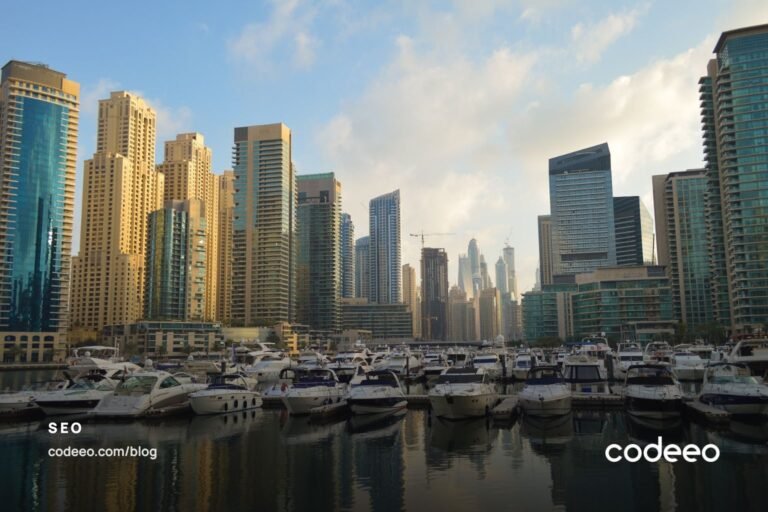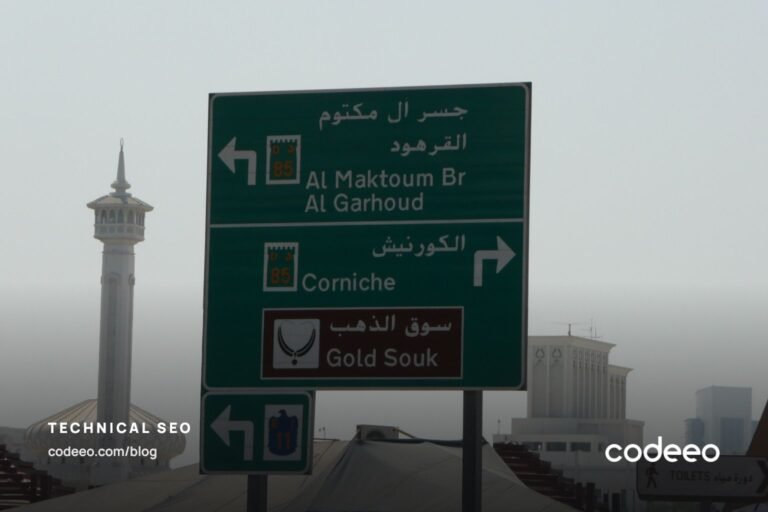


Local SEO in Dubai is decided on an asset you do not own: the Google Business Profile that shows in Maps and in the three-result local pack sitting above the organic listings. Google ranks those results on relevance, distance and prominence, and only two of the three respond to work you do. This guide covers what to fix on the profile, what to fix on the website behind it, and how to check whether either changed anything for searches made from Deira, Business Bay, JLT and Dubai Marina.
Key takeaways
- Google states that local results are based mainly on relevance, distance and prominence, and that there is no way to request or pay for a better local ranking.
- Adding keywords or a city to the business name breaks Google’s naming rule and is the fastest route to a suspended profile in the UAE market.
- Service-area businesses can list up to 20 areas, and the overall area should stay within roughly two hours of driving time from the base location.
- Verification review can take up to five business days, and a video call asks you to show signage, branded equipment and access to staff-only areas.
- Because distance is a ranking input, a single position number for “Dubai” is meaningless; check the same query from several points across the city.
What Google actually ranks in the local pack
Google’s own guidance on improving local ranking names three inputs. Relevance is how well a profile matches the search. Distance is how far the business sits from the person searching, or from the area Google infers if no location is shared. Prominence is how well known the business is, which Google says is informed by things like how many websites link to the business and how many reviews it has.
Distance is the input people argue with and cannot change. A fit-out contractor in Al Quoz will show for someone standing in Al Barsha and disappear for the same query typed in Mirdif. That is expected behaviour, not a penalty. The same page states plainly that there is no way to request or pay for a better local ranking, which rules out any pitch that promises a fixed map position.
Relevance and prominence are the two levers: category choice, services, description and hours on one side, reviews and links on the other.
Verification is the gate, and video is the common route
An unverified profile cannot be edited properly and reports no performance data. Google lists verification by phone or text, email, live video call, postcard, Search Console for sites already verified there, and bulk verification for chains. Its help page says verification review can take up to five business days, that most postcard codes arrive within 14 days, and that codes expire after 30 days.
The live video call is where UAE applications stall. Google asks you to show outside signs, nearby businesses or a street sign that confirms the location, then branded equipment or marketing material, then access to an employee-only area such as a stock room or a till. A company working from a flexi-desk inside a free zone business centre has none of that on hand by default. Before booking the call, have the trade licence, the signage on or beside the unit door, branded stationery and the tenancy document ready, and make sure the name on the licence matches the name you typed into the profile character for character. If the call fails, fix the mismatch that caused it before trying again, because repeated attempts with the same evidence tend to end the same way.
The name field suspends more Dubai profiles than anything else
Google’s guidelines for representing your business put it in one line: “Your name should reflect your business’s real-world name, as used consistently on your storefront, website, stationery, and as known to customers.” The list of things you may not add includes marketing taglines, phone numbers, URLs, store codes, fully capitalised words, service or product descriptions, and location details.
So “Al Quoz Movers” is fine. “Al Quoz Movers | Best Movers in Dubai, Cheap Rates” is a guideline breach, and Google says it reserves the right to suspend access to profiles for businesses that break these rules. Competitors in crowded UAE categories such as moving, cleaning, visa services and car rental report each other’s names routinely, so a keyword-stuffed name that ranked for eight months can vanish in a day. Use the trade name on the licence and put the keywords where they belong, in the description, the services list and the website.
Categories and service areas set what you are eligible for
The primary category carries the most weight and also controls which profile features appear, from booking buttons to menus. Google’s advice is to use as few categories as possible to describe the core business, pick the more specific option, and choose what the business is rather than what it has.
The practical difference in Dubai is large. A studio that picks “Marketing agency” competes against every agency in the emirate. The same studio under “Website designer” competes against a much shorter list and matches a buyer who already knows what they want. Check what the top three profiles in your area use as their primary category, then choose deliberately rather than adding nine categories and hoping. Categories describing work you do not sell dilute relevance and invite edits from users.
Businesses with no walk-in office
Consultants, contractors, home-service companies and most free zone entities have no counter for customers to visit. Google’s service-area documentation allows up to 20 areas defined by city, postal code or region, and says the overall boundary should not extend more than about two hours of driving time from where the business is based. Approved edits can take up to 48 hours to appear.
Two hours from Deira covers every emirate and reaches Abu Dhabi, which tempts owners to list the whole country. It rarely pays. Distance still applies to the searcher, so listing Fujairah does nothing for a Dubai team that never works there. List the areas where you genuinely take jobs, and hide the address if customers never visit, which Google requires for businesses without a storefront.
A field by field checklist
| Profile element | What to put in it | Review cadence |
|---|---|---|
| Business name | The trade name on the licence, nothing appended | Check monthly for user edits |
| Primary category | The single closest match to what you sell | Twice a year |
| Additional categories | Only services you actually deliver and can prove | Twice a year |
| Address or service area | The licensed premises, or up to 20 real service areas | On any office move, same week |
| Hours and special hours | Customer-facing hours plus Eid and public holiday closures | Before every UAE holiday |
| Phone | A local number answered at the business, not a call centre | Test the number monthly |
| Website link | The page that matches the search intent, tagged with UTM parameters | Quarterly |
| Description | What you do, who you serve and which areas, in plain sentences | Quarterly |
| Services and products | Each service named the way clients ask for it | Quarterly |
| Photos | Office, team and completed work, shot on site rather than stock | A few every month |
| Reviews | A reply on every one, in the language it was written in | Within 48 hours |
| Questions and answers | Your own answers to the five questions clients keep asking | Monthly |
The first 30 days in order
- Claim and verify the profile, with the licence, signage and tenancy paperwork ready for a video call.
- Correct the name to the licensed trade name and remove every appended keyword.
- Set the primary category after checking what the top three profiles in your area use.
- Complete the address or service areas, hours, holiday hours, phone and website link.
- Write the description and list every service using the words clients say on the phone.
- Upload 10 to 15 real photos, then add a few each month rather than 60 in one sitting.
- Ask the last 10 satisfied clients for a review, with no incentive attached, and reply to each one.
- Record a baseline geo-grid and a performance export, then repeat both on the same date monthly.
Reviews, replies and the line you cannot cross
Reviews feed prominence, and Dubai buyers read them closely because so many suppliers here are new. The rule that catches businesses out sits in Google’s Maps content policy, which prohibits offering incentives such as payment, discounts, free goods or services in exchange for posting a review, revising one, or removing a negative one. The discount-for-a-review card printed for the reception desk is a policy breach, and so is the WhatsApp message offering AED 50 off the next service.
What works instead is timing. Ask when the job is signed off and the client is happy, in person or in the handover message, and send the short review link rather than instructions. A steady flow of four or five reviews a month reads better than 40 in one week from accounts with no other activity. Reply to every review, including the difficult ones, and keep the reply factual. Google also says not to report a review simply because you disagree with it, and it does not step into disputes between a business and its customer, so a reply is usually your only public answer.
Reviews in the UAE arrive in English, Arabic, Hindi, Russian and Tagalog. Answer in the language used; it signals to the next reader that someone is paying attention.
The website still carries prominence
Google names links to the business among the prominence signals, and that work happens on your site rather than inside the profile. Give every area you seriously serve its own page with real detail, such as projects delivered, travel time and local references, rather than one template with the district name swapped in. Thin location pages are easy to spot and rarely rank.
Add LocalBusiness structured data while you are there. Google’s documentation requires only name and address, and recommends geo coordinates with at least five decimal places, openingHoursSpecification, telephone, url and priceRange. Keep the name, address and phone identical to the trade licence and to the profile. If the underlying site needs clearing first, our technical SEO checklist covers crawling, indexing and speed.
Arabic and English on the same site
Dubai’s resident population passed 4.74 million on 30 July 2026 according to the Dubai Population Now platform, and average daytime presence in the emirate is around 6.39 million once commuters and visitors are counted. DataReportal’s Digital 2026 report for the UAE puts internet users at 11.3 million at the end of 2025, a penetration rate of 99.0 percent, against 23.0 million active mobile connections. Almost everyone searching for you is on a phone, and a real share of them search in Arabic.
The profile carries one name and one description, so the bilingual work sits on the website: Arabic pages with correct right-to-left layout, hreflang tags pointing each version at the other, and Arabic service names that match how people type them. If the Arabic page is a machine translation of the English one, it reads that way to a Gulf national, and the bounce back to the search results tells Google what it needs to know.
Measuring it without guessing
The profile reports its own numbers under Performance: views, searches, interactions, calls, directions, website clicks, messages, bookings and, depending on category, products, menus and offers. One quirk matters for reporting. Google updates the searches metric at the start of each month and says it can take up to five days to appear, so a report pulled on the second of the month will look wrong.
For position tracking, one number is not enough. Because distance is a ranking factor, the honest method is a geo-grid: run the same query from a set of points across the city, for example Deira, Business Bay, JLT, Dubai Marina, Al Quoz and Dubai Silicon Oasis, and record the position at each. A profile that sits third in Business Bay and eleventh in Marina tells you where to put content and links next. Tag the website link on the profile with UTM parameters so Maps traffic separates cleanly from organic search in analytics, and read calls and direction requests alongside form fills rather than on their own. Our marketing analytics team usually sets this up once and then leaves it running.