 Web DevelopmentWordPress vs Drupal: Which CMS Is Right for Your Business?WordPress vs Drupal compared on ease of use, content modeling, security, performance, ecommerce and cost drivers, with five questions to help you choose.
Manufacturing Web Design: Features That Win Buyers and Save Time
Manufacturing web design that works: specs, quote tools, order portals and downloads that serve engineers and buyers while cutting routine sales work.
Good manufacturing web design does two jobs at once: it helps buyers and engineers find specifications, request quotes and track orders without calling anyone, and it takes repetitive work off your sales and support teams. That means clear product data, downloadable technical files, quote and order tools, and pages built separately for each type of visitor. A manufacturer's website should work like a sales engineer that is available all day, not a digital brochure.
This guide covers why many manufacturing sites underperform, which features remove manual work, how to design for different audiences, and how to plan a redesign.
Why many manufacturing websites need a rebuild
Manual processes that a website could handle
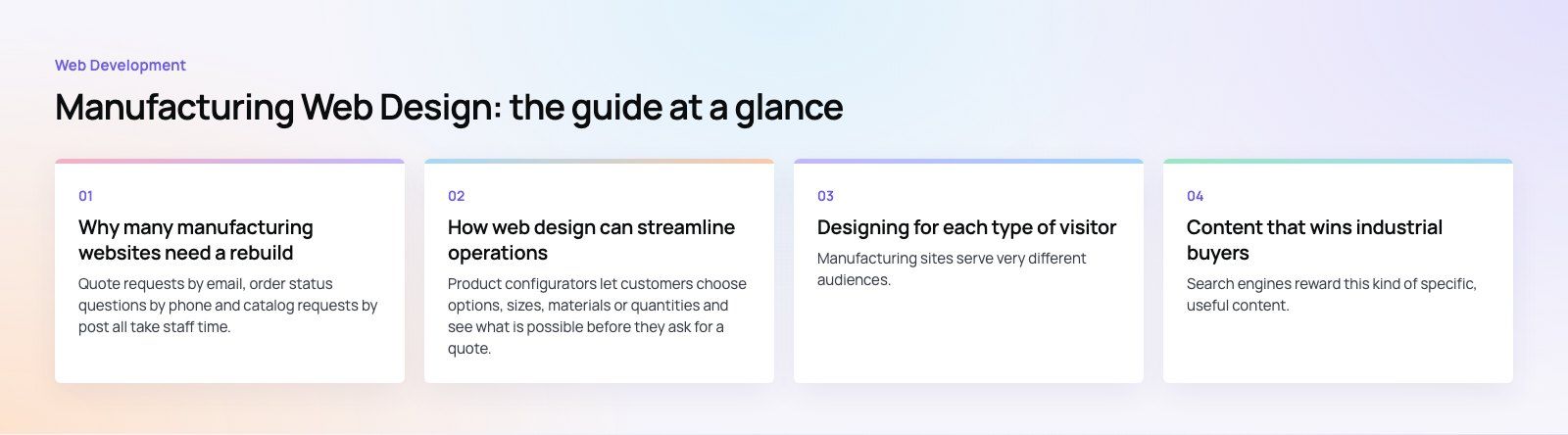
Quote requests by email, order status questions by phone and catalog requests by post all take staff time. Each of these can be handled, at least partly, by a well built website with forms, portals and downloads connected to your back office systems.
Missed leads
Buyers research suppliers online long before they contact anyone. If they cannot find a specification, a certification or a clear way to request a quote, they move on to a competitor whose site makes it easy.
A dated brand image
A slow, old looking site suggests old processes. For a manufacturer selling precision, reliability or innovation, the website is often the first evidence a buyer sees.
How web design can streamline operations
Self service quotes and product configuration
Product configurators let customers choose options, sizes, materials or quantities and see what is possible before they ask for a quote. Even when final pricing needs human review, a structured quote form that captures every required detail saves several rounds of email.
Order tracking portals
A secure customer portal that shows order status, delivery dates, invoices and past orders removes a large share of routine support calls. It works best when connected directly to your ERP or order management system, so the data is always current.
Downloadable technical resources
Datasheets, CAD files, installation guides, safety data sheets, certificates and catalogs should be easy to find and download, ideally from each product page. Gating some files behind a short form can also turn downloads into qualified leads.
Dashboards and data visualization
For internal users and key accounts, a secure area can show live data such as order pipelines, stock levels or production schedules, pulled from your existing systems. Tools like Power BI can be embedded so managers and partners see the same figures without exporting spreadsheets.
Partner and internal collaboration
Distributor portals, dealer resources and internal intranets give partners and staff one place for price lists, marketing materials, training and announcements. Access controls keep sensitive information to the right people.
Designing for each type of visitor
Manufacturing sites serve very different audiences. Trying to address all of them on one page usually satisfies none.
| Visitor | What they need | What to give them |
|---|---|---|
| Engineers and technical buyers | Exact specifications and compatibility | Datasheets, CAD files, tolerances, standards and certifications |
| Procurement teams | Lead times, minimum orders, compliance | Quote forms, supplier documents, clear terms |
| New prospects | Proof you can deliver | Capabilities, industries served, case studies, facility photos |
| Existing customers | Fast reorders and support | Order portal, reorder tools, documentation, support contacts |
| Distributors and partners | Sales and marketing support | Partner portal, price lists, product training |
| Job seekers and investors | Stability and culture | Careers, company news, sustainability information |
Information architecture
Organize products the way buyers think: by application, industry or product family, not by internal part numbers. Add site search that understands part numbers and common synonyms, filters for key specifications, and breadcrumbs so visitors always know where they are.
Plain language
Technical detail belongs on the page, but headings and summaries should be readable by non engineers. Explain what a product does and where it is used before listing the tolerances.
Mobile friendly design
Engineers check specifications on the shop floor and buyers read emails on phones. Product pages, search and downloads must work on small screens, and tables of specifications need a layout that does not break on mobile.
Accessibility
Follow the Web Content Accessibility Guidelines for contrast, keyboard use, form labels and alt text. This helps all users and is required by some public sector buyers.
Content that wins industrial buyers
- Capability pages that describe processes, materials, tolerances and capacity in specific terms.
- Industry pages that explain how your products are used in each sector you serve.
- Case studies that describe a real customer problem and how it was solved, with permission.
- Quality and compliance pages listing standards and certifications you actually hold, with documents to download.
- Professional photography and video of products, facilities and processes.
Search engines reward this kind of specific, useful content. Google's SEO starter guide covers the basics, and well structured product pages often rank for long, specific searches that bring highly qualified buyers.
Business returns from better web design
A better website pays back in several ways, even when exact figures vary by business:
- More qualified quote requests with complete information.
- Fewer routine calls and emails about order status and documents.
- Faster onboarding for new distributors and customers.
- A stronger brand that supports higher value contracts.
- Better data on which products and industries generate interest.
How to plan a manufacturing website redesign
- Set objectives. Decide what the site must achieve, such as more quote requests, fewer support calls or better distributor support, and how you will measure it.
- Audit the current site. Review analytics, broken pages, slow pages and what customers complain about. A website audit gives a structured starting point.
- Map your audiences and their tasks. List what each visitor type needs to do and design around those tasks.
- Organize product data. Clean up specifications, files and images before design starts. This is usually the longest step.
- Plan integrations. Decide which systems the site must connect to, such as ERP, CRM or product information management.
- Choose a partner with integration experience. Manufacturing sites are as much about data and systems as about visuals.
- Launch in phases. Start with the public site and quote flow, then add portals and dashboards.
Common mistakes on manufacturing websites
- Poor visuals. Low resolution product photos undermine trust. Invest in professional photography.
- Jargon everywhere. Lead with plain language, then give technical depth.
- Weak mobile layouts. Specification tables and downloads that break on phones lose engineers.
- Unclear calls to action. Every product page should offer a clear next step, such as Request a quote or Download the datasheet.
- Specifications hidden in PDFs only. Put key data in the page itself so it can be searched and indexed.
Codeeo designs and builds websites and connected systems for businesses across the UAE and the US, with 200+ projects delivered. For manufacturers, that usually combines design, product catalog structure and custom software for portals, quotes and integrations.
Frequently asked questions
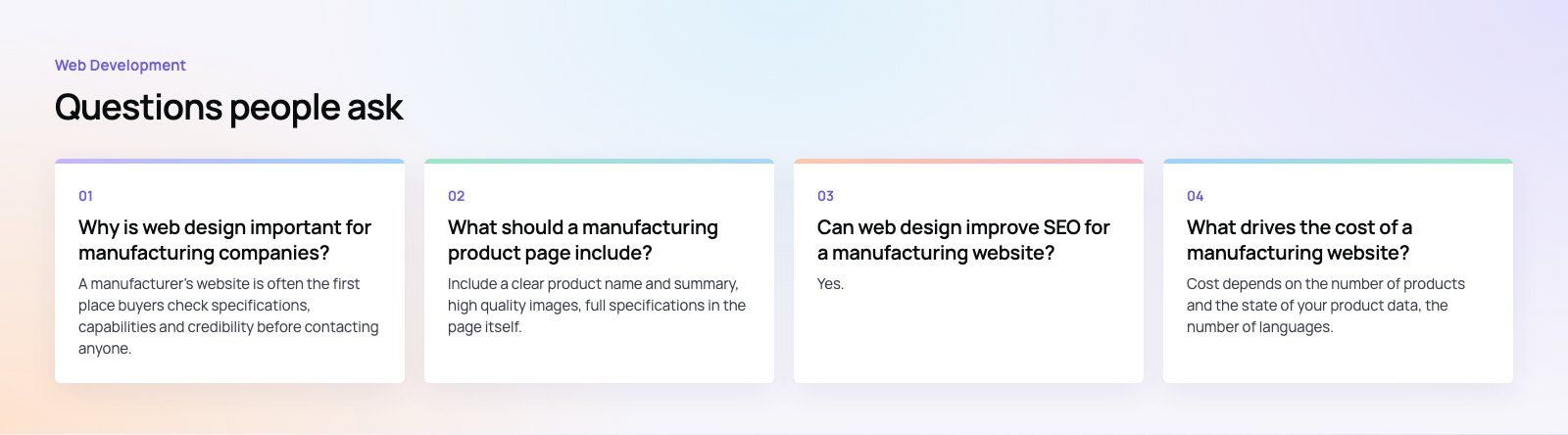
A manufacturer's website is often the first place buyers check specifications, capabilities and credibility before contacting anyone.
Good design makes that information easy to find, captures quote requests with complete details and supports existing customers through portals and downloads. Poor design loses leads to competitors and pushes routine questions back onto your sales and support teams, which adds cost.
Web DevelopmentWordPress vs Drupal: Which CMS Is Right for Your Business?WordPress vs Drupal compared on ease of use, content modeling, security, performance, ecommerce and cost drivers, with five questions to help you choose. Web DevelopmentCustom Website Development vs Website Builders: Pros and ConsAn honest comparison of custom website development and website builders: control, cost over time, SEO, integrations, and how to decide which fits your business.
 Web DevelopmentWeb Development Consultant: What They Do and When to Hire OneWhat a web development consultant does, how the role differs from a developer or agency, when hiring one pays off and how to choose the right one.
Tell us what the business needs. We will tell you what to build first.
Schedule a free consultation and get a written recommendation, with costs, before you commit to anything.
Get in touchPROVEN RESULTS
4.7 / 5verified reviews on Google