 Web DevelopmentWordPress vs Drupal: Which CMS Is Right for Your Business?WordPress vs Drupal compared on ease of use, content modeling, security, performance, ecommerce and cost drivers, with five questions to help you choose.
Outsourcing Website Development: Issues to Watch and How to Avoid Them
The issues to watch when outsourcing website development, from unclear scope and miscommunication to lost code ownership, and how to prevent each one.
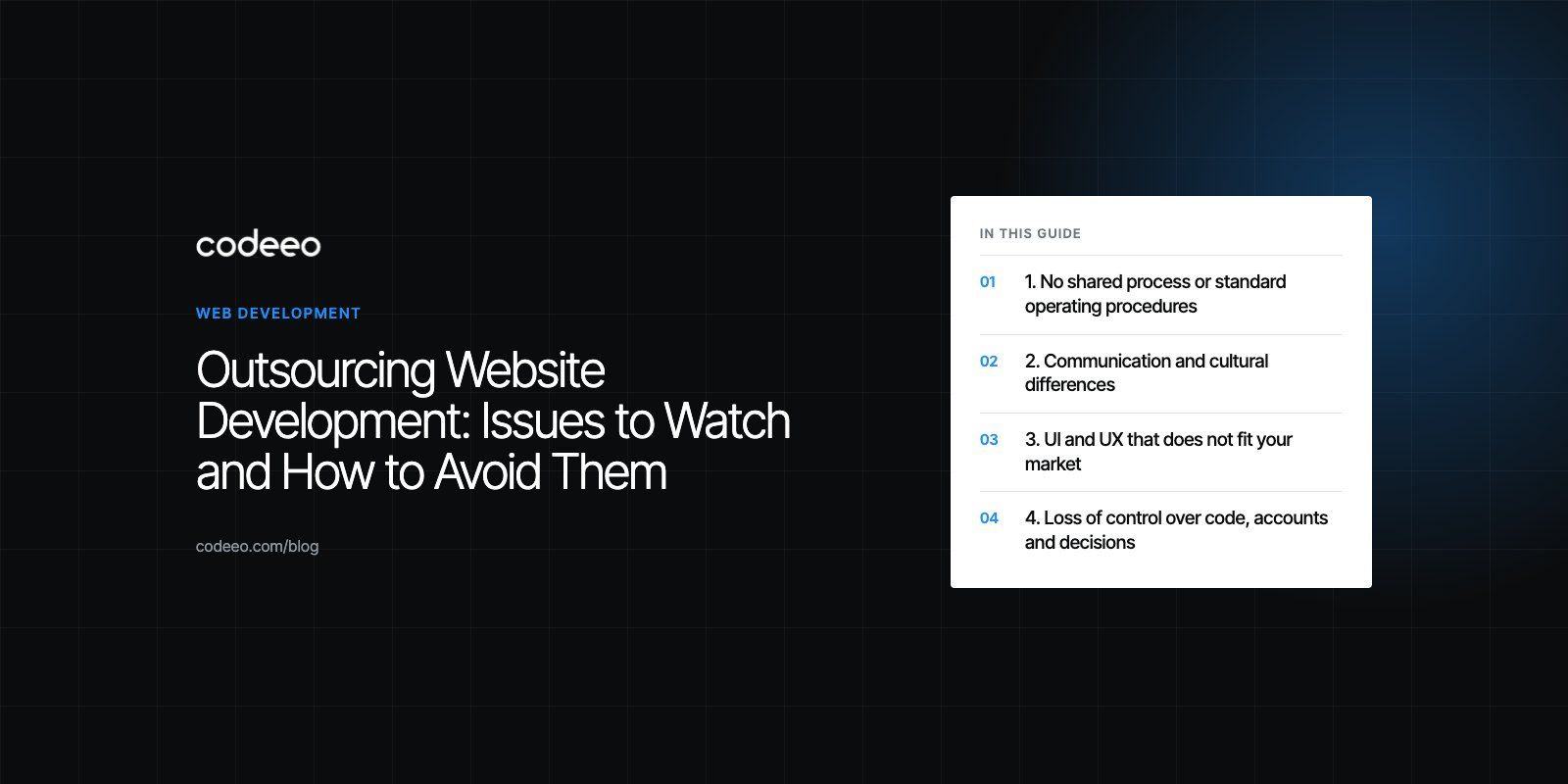
The main issues to watch for when outsourcing website development are unclear scope, weak communication, a design that does not fit your market, loss of control over code and accounts, and inconsistent quality. Almost all of them can be prevented before the project starts, with a tight brief, a clear contract, agreed processes and a small paid trial. The problems that hurt most are the ones nobody wrote down.
This guide goes through each issue, the warning signs to look for, and what to put in place so an outsourced website arrives on time and works as intended.
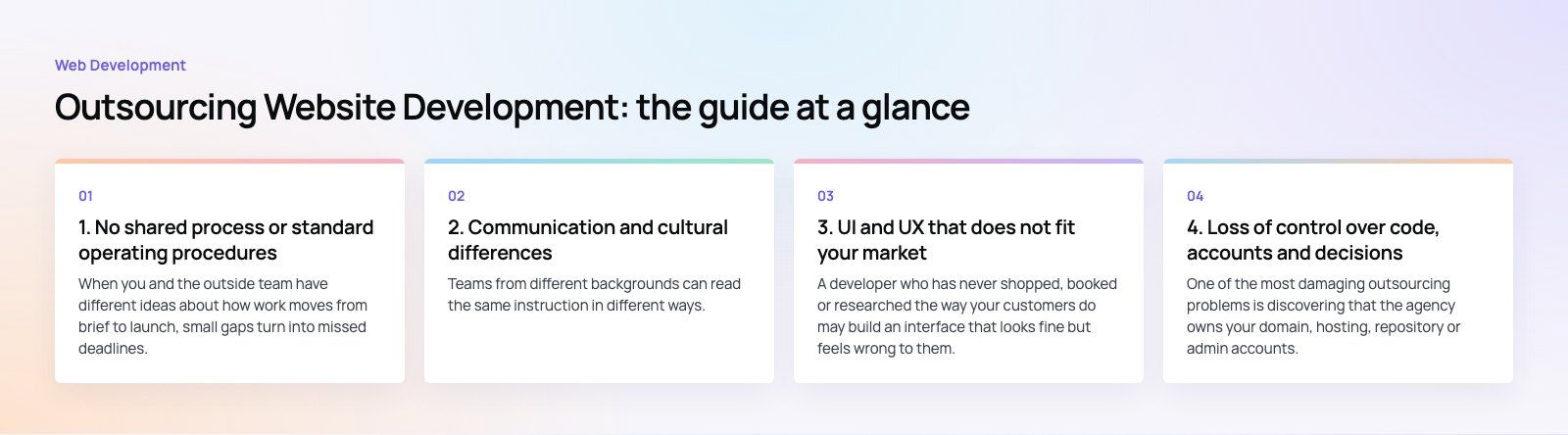
1. No shared process or standard operating procedures
When you and the outside team have different ideas about how work moves from brief to launch, small gaps turn into missed deadlines. You assume a page is finished; they think it is waiting for your content.
How to prevent it
- Agree a written process: how tasks are logged, who approves designs, how changes are requested, and what "done" means for each stage.
- Use one project management tool and one channel for decisions, so nothing important lives only in a call or a private message.
- Set a fixed rhythm: a weekly progress update, a demo of working pages, and a shared list of open questions.
- Start with a small paid task, such as one template or a set of fixes, to see how the team works before committing to the full build.
2. Communication and cultural differences
Teams from different backgrounds can read the same instruction in different ways. A word like "simple" or "premium" means different things to different people, and time zone gaps turn a quick question into a day's delay.
How to prevent it
- Pair written requirements with short screen recordings that walk through what you want and why.
- Share reference sites and say exactly which element you like on each one.
- Agree overlapping working hours for live discussion, even if only an hour or two a day.
- Ask the team to repeat back their understanding of key requirements before they start building.
3. UI and UX that does not fit your market
A developer who has never shopped, booked or researched the way your customers do may build an interface that looks fine but feels wrong to them. Payment options, address formats, date formats, language direction and expected trust signals all vary by market. If you sell in a region with Arabic speaking customers, for example, right to left layout has to be designed in from the start rather than added later.
How to prevent it
- Review the team's past work for clients in your market or industry, not just their most attractive projects.
- Share real customer insight: who your users are, which devices they use, and what they complain about today.
- Test wireframes with a few real customers before visual design and development begin.
4. Loss of control over code, accounts and decisions
One of the most damaging outsourcing problems is discovering that the agency owns your domain, hosting, repository or admin accounts, or has built on a stack nobody else understands. Changing provider later becomes slow and expensive.
How to prevent it
- Register the domain, hosting, analytics, and any app or plugin licenses in your company's name, and give the team access rather than the other way round.
- Keep the code in a repository you own, with the outsourced team added as collaborators.
- Prefer widely used, well documented platforms and frameworks, so another developer can pick up the work if needed.
- Ask for documentation of the setup, deployment steps and any custom code as part of the deliverables.
5. Inconsistent quality standards
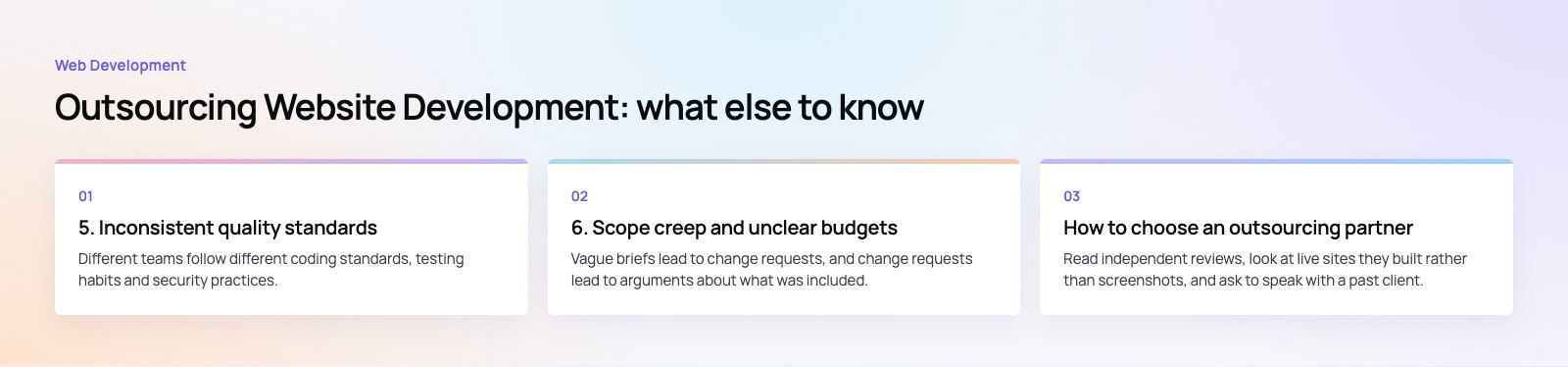
Different teams follow different coding standards, testing habits and security practices. Without agreed standards, you may receive a site that looks right in a demo but is slow, hard to update, inaccessible or insecure, and you pay again for rework.
How to prevent it
- Define quality in the brief: page speed targets, supported browsers and devices, and accessibility in line with WCAG.
- Ask how the team handles security, and check their approach against common risks such as those in the OWASP Top 10.
- Require code reviews, a staging site for testing, and a clear bug fixing period after launch.
- Have an independent developer review the code at a midpoint, before problems are buried under more work. Our codebase review exists for exactly this.
6. Scope creep and unclear budgets
Vague briefs lead to change requests, and change requests lead to arguments about what was included. Both sides end up frustrated, and the launch date slips.
How to prevent it
- Write a brief listing every page type, feature, integration and content responsibility.
- Split the project into milestones with clear deliverables and approval points.
- Agree in advance how changes are estimated, approved and scheduled.
Quick reference: issues, warning signs and fixes
| Issue | Early warning sign | Prevention |
|---|---|---|
| No shared process | You learn about progress only when you ask | Written process, one tool, weekly demos |
| Miscommunication | Work comes back different from what you described | Recordings, references, read back of requirements |
| Poor market fit | Portfolio has no work for your type of customer | Share customer insight, test wireframes |
| Loss of control | Accounts or repository registered to the agency | Own every account and the code from day one |
| Inconsistent quality | No staging site or testing plan offered | Written quality standards, independent code review |
| Scope creep | Estimate given without detailed questions | Detailed brief, milestones, change process |
How to choose an outsourcing partner
Check reviews and real work
Read independent reviews, look at live sites they built rather than screenshots, and ask to speak with a past client. Ask for case studies close to your project in size and industry.
Judge the questions they ask
A good partner asks about your customers, goals, content, integrations and who will maintain the site. A team that gives a fixed estimate after one short call has probably not understood the project.
Meet the people doing the work
Find out who will actually design and develop your site, where they are based, and how much of their time your project gets. Our teams page shows how we structure this.
What the contract should cover
- Project scope: specific pages, features, integrations and deliverables.
- Timeline: milestones, deadlines and what happens if either side causes a delay.
- Payment terms: schedule and method, ideally linked to approved milestones.
- Intellectual property: confirmation that you own the code, designs and content once paid.
- Confidentiality and data protection: how your data and customer data are handled and stored.
- Acceptance and warranty: how work is tested and approved, and the bug fixing period after launch.
- Dispute resolution: the process, such as mediation or arbitration, and the governing law.
- Handover: access, documentation and support if the relationship ends.
Outsourcing that works
Outsourcing website development gives you access to skills and capacity you may not have in house. The issues above are common, but they are predictable, and a good brief, clear ownership and agreed standards prevent most of them. If you are planning a new site, Codeeo's web development team has delivered 200+ projects across the UAE and the US, and you can also add dedicated developers to your own team instead of outsourcing a whole project.
Frequently asked questions
The biggest risks are unclear scope, poor communication, a design that does not suit your customers, losing control of your code or accounts, and inconsistent quality that leads to rework.
Most can be prevented with a detailed brief, a written process, ownership of every account from day one, agreed quality standards and a small paid trial before the main project.
Web DevelopmentWordPress vs Drupal: Which CMS Is Right for Your Business?WordPress vs Drupal compared on ease of use, content modeling, security, performance, ecommerce and cost drivers, with five questions to help you choose. Web DevelopmentCustom Website Development vs Website Builders: Pros and ConsAn honest comparison of custom website development and website builders: control, cost over time, SEO, integrations, and how to decide which fits your business.
 Web DevelopmentWeb Development Consultant: What They Do and When to Hire OneWhat a web development consultant does, how the role differs from a developer or agency, when hiring one pays off and how to choose the right one.
Tell us what the business needs. We will tell you what to build first.
Schedule a free consultation and get a written recommendation, with costs, before you commit to anything.
Get in touchPROVEN RESULTS
4.7 / 5verified reviews on Google