 Web DevelopmentWordPress vs Drupal: Which CMS Is Right for Your Business?WordPress vs Drupal compared on ease of use, content modeling, security, performance, ecommerce and cost drivers, with five questions to help you choose.
PHP Web Development: When to Choose It and How to Plan the Build
When PHP is the right choice, how Laravel, Symfony and CodeIgniter compare, the problems PHP projects hit, and how to plan, build and upgrade one.
PHP is still a sound choice for web development in 2026 when your project is a content site, an online store, a portal or a custom business application that runs on a server and talks to a relational database. It is mature, cheap to host, and backed by frameworks like Laravel and Symfony that handle routing, security and data access for you. The real question is rarely "PHP or not" but how you plan, build and maintain a PHP project so it stays fast and secure for years.
This guide covers when PHP fits, which framework to pick, the problems PHP projects usually run into and how to avoid them, and what a sensible build process looks like from first workshop to launch and beyond.
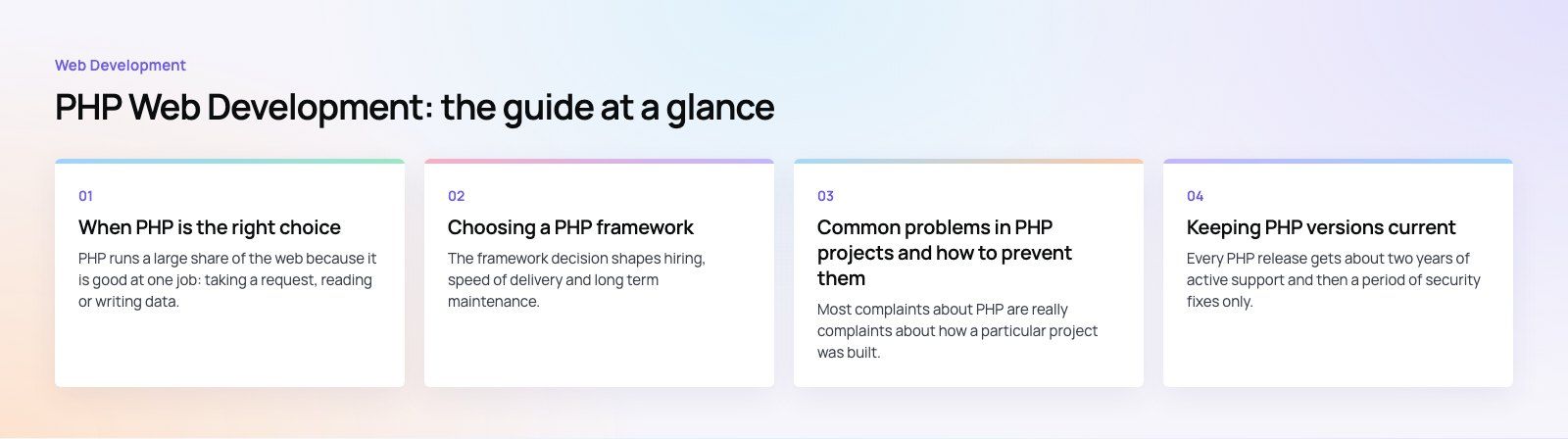
When PHP is the right choice
PHP runs a large share of the web because it is good at one job: taking a request, reading or writing data, and returning a page or an API response. That makes it a natural fit for several kinds of project.
- Content managed websites. WordPress, Drupal and many headless setups are written in PHP, so marketing teams get familiar editing tools.
- Online stores. WooCommerce and Magento are PHP platforms, and both have large plugin and integration ecosystems.
- Custom business applications. Booking systems, client portals, internal dashboards and admin panels are classic Laravel territory.
- APIs for mobile apps. A PHP backend can serve JSON to iOS and Android apps just as well as it serves HTML to browsers.
PHP is a weaker fit when the core of the product is long running real time work, such as live multiplayer games or streaming pipelines, or heavy data science. In those cases Node.js, Go or Python usually suit the workload better, and PHP can still sit alongside them for the admin side.
PHP or Laravel: what is the difference?
PHP is the language. Laravel, Symfony and CodeIgniter are frameworks written in PHP that give you a structure and a set of ready made parts: routing, database access, authentication, queues, email and testing tools. Almost no serious project today is written in plain PHP from scratch, because a framework saves months of work and closes common security gaps by default. If you hear a team say "we build in Laravel", they are building in PHP.
Choosing a PHP framework
The framework decision shapes hiring, speed of delivery and long term maintenance. Here is how the main options compare.
| Framework | Best for | Strengths | Watch out for |
|---|---|---|---|
| Laravel | Custom web apps, SaaS products, APIs, portals | Fast to build with, large community, built in queues, auth and testing | Easy to grow a messy codebase if structure is not agreed early |
| Symfony | Large, long lived enterprise systems | Strict structure, reusable components, strong long term support releases | Steeper learning curve and more setup for small projects |
| CodeIgniter | Small apps and lightweight APIs | Small footprint, simple to learn | Fewer built in features, smaller ecosystem |
| WordPress | Content sites and marketing websites | Familiar editor, huge plugin choice | Plugin sprawl slows sites and widens the attack surface |
For most custom builds we would start with Laravel and only move to Symfony when the system is large enough that its stricter conventions pay for themselves. Our Laravel developers page explains the kind of applications that suit it.
Common problems in PHP projects and how to prevent them
Most complaints about PHP are really complaints about how a particular project was built. The same three issues come up again and again.
Slow page loads
Slow PHP sites usually suffer from too many database queries per page, no caching, or heavy plugins. The fixes are well known:
- Turn on OPcache so compiled code is reused instead of parsed on every request.
- Cache expensive queries and rendered fragments in Redis or a similar store.
- Fix "N plus one" query patterns by loading related records in one go.
- Move slow jobs such as sending email or generating PDFs onto a queue.
- Put static files behind a CDN so the PHP server only handles dynamic work.
If your site already feels slow, a speed optimization review is a practical place to start.
Security gaps
PHP itself is not insecure, but old code and unpatched versions are. The main defences are simple to state and easy to skip under deadline pressure:
- Use prepared statements or the framework's query builder so user input never reaches SQL directly.
- Escape output in templates to block cross site scripting.
- Rely on the framework's CSRF protection, password hashing and session handling rather than writing your own.
- Protect APIs with token based authentication, rate limits and clear permission checks on every endpoint.
- Keep PHP, the framework and every dependency on supported versions.
Code that is hard to scale
Scaling problems in PHP are rarely about the language. They come from business logic scattered across controllers and templates, no automated tests, and sessions or files stored on a single server. Keeping logic in service classes, writing tests for the parts that handle money and data, and storing sessions and uploads outside the web server lets you add servers behind a load balancer when traffic grows.
Keeping PHP versions current
Every PHP release gets about two years of active support and then a period of security fixes only. According to the official PHP supported versions page, checked in October 2026, PHP 8.2 receives security fixes only until 31 December 2026, while 8.4 and 8.5 are the current branches. Any application still on PHP 7 or 8.0 is already running without security patches.
A version upgrade is usually a planned piece of work rather than a one line change. A sensible approach is:
- Audit the codebase and dependencies for deprecated functions and packages that block the upgrade.
- Add automated tests around the most important flows before changing anything.
- Upgrade on a staging server, run the tests and fix what breaks.
- Release, monitor error logs closely for a few days, then schedule the next upgrade before support ends again.
If you have inherited an older PHP application and are not sure what state it is in, a codebase review will show what needs attention first.
A practical PHP development process
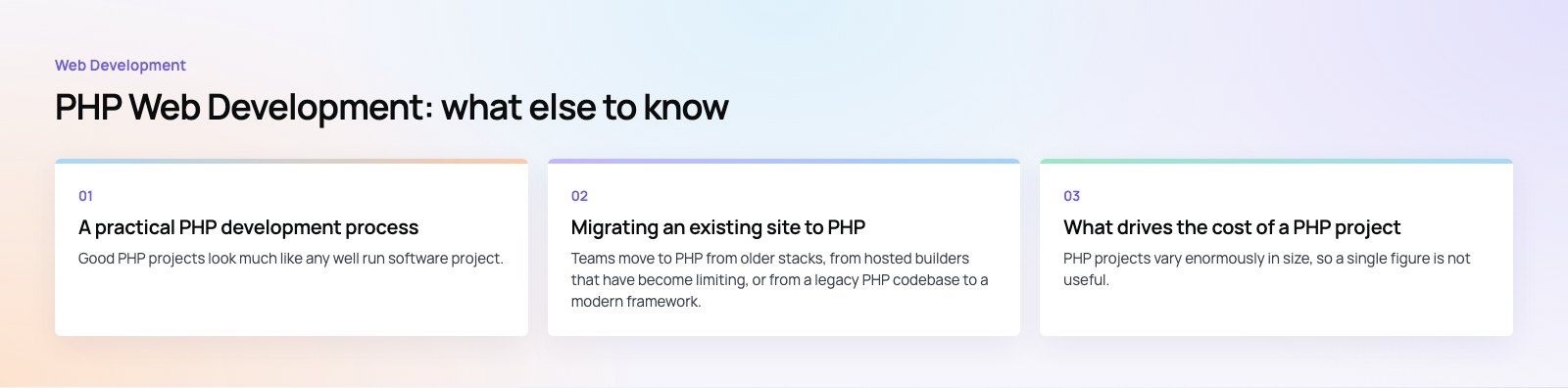
Good PHP projects look much like any well run software project. The stages below are the ones that matter most.
1. Discovery and scoping
Agree what the system must do, who uses it, what data it holds and which other systems it connects to. A short written scope with user roles, key screens and integrations prevents most of the rework that sinks budgets later.
2. Design
Wireframes and then visual designs for the key screens, tested with real users where possible. For admin tools, plain and fast usually beats clever.
3. Build
Work in short cycles with a working version on a staging server that you can click through. Database structure, authentication and permissions should be settled early because they are expensive to change later.
4. Integrations
Most PHP applications talk to something else: payment gateways, CRMs, accounting tools, email platforms, shipping providers. Plan each integration with clear error handling and logging, because these are the parts most likely to fail quietly. Our team covers this under payment integration and wider custom software work.
5. Testing
Automated tests for business rules, plus manual testing across browsers and devices. Load testing is worth doing before any launch that expects a traffic spike.
6. Launch and support
Deploy through a repeatable pipeline, not by copying files to a server. After launch, plan for monitoring, backups, dependency updates and PHP version upgrades as ongoing work, not as surprises.
Migrating an existing site to PHP
Teams move to PHP from older stacks, from hosted builders that have become limiting, or from a legacy PHP codebase to a modern framework. The risks are the same in each case: lost data, broken URLs and lost search rankings. A safe migration maps every old URL to a new one with permanent redirects, moves data with scripts that can be run and checked repeatedly, and runs the old and new systems side by side until the new one is proven. Our site migration service is built around those steps.
What drives the cost of a PHP project
PHP projects vary enormously in size, so a single figure is not useful. These are the factors that move the budget most:
- The number of user roles and the permissions between them.
- The number and complexity of integrations with outside systems.
- Whether you need a mobile app or public API as well as the website.
- The amount of existing data to migrate and clean.
- Design depth, from a standard admin theme to a fully custom interface.
- The level of ongoing support, monitoring and upgrade work after launch.
A clear scope document is the best way to get comparable quotes from different teams.
Getting your PHP project right
PHP rewards teams who choose a modern framework, keep versions current and treat testing and integrations as first class work. Codeeo has delivered 200+ projects across the UAE and the US with a team of 80+ across Dubai, Riyadh and Karachi. If you are planning a new application or rescuing an older one, see how our web development team approaches PHP builds.
Frequently asked questions
PHP is used for content managed websites, online stores, customer portals, booking systems, internal dashboards, SaaS products and APIs that serve mobile apps.
Platforms such as WordPress, WooCommerce, Magento and Drupal are written in PHP, and frameworks like Laravel and Symfony are used to build custom applications. It suits most projects that run on a server and store data in a relational database.
Web DevelopmentWordPress vs Drupal: Which CMS Is Right for Your Business?WordPress vs Drupal compared on ease of use, content modeling, security, performance, ecommerce and cost drivers, with five questions to help you choose. Web DevelopmentCustom Website Development vs Website Builders: Pros and ConsAn honest comparison of custom website development and website builders: control, cost over time, SEO, integrations, and how to decide which fits your business.
 Web DevelopmentWeb Development Consultant: What They Do and When to Hire OneWhat a web development consultant does, how the role differs from a developer or agency, when hiring one pays off and how to choose the right one.
Tell us what the business needs. We will tell you what to build first.
Schedule a free consultation and get a written recommendation, with costs, before you commit to anything.
Get in touchPROVEN RESULTS
4.7 / 5verified reviews on Google