 Web DevelopmentWordPress vs Drupal: Which CMS Is Right for Your Business?WordPress vs Drupal compared on ease of use, content modeling, security, performance, ecommerce and cost drivers, with five questions to help you choose.
13 Popular Web Development Frameworks and When to Use Each
React, Next.js, Angular, Vue, Node.js, Django, Laravel, Rails and more: strengths, weaknesses and use cases for 13 web frameworks, plus how to choose.
The most widely used web development frameworks and tools are React, Next.js, Angular, Vue.js, Node.js with Express, Django, Flask, Laravel, Ruby on Rails, ASP.NET Core, WordPress and, on older sites, jQuery. None of them is the best in every case. The right choice depends on what you are building, the skills your team already has, and how long you expect to maintain the product.
Below is a plain overview of each option, its strengths and weaknesses, typical use cases, and a short method for choosing.
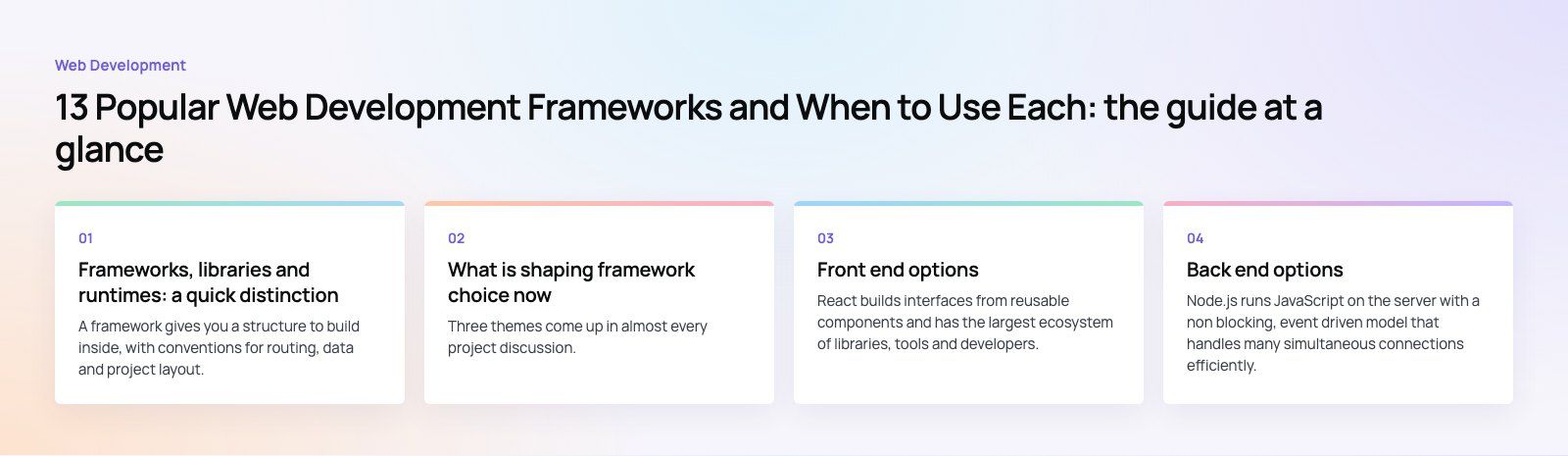
Frameworks, libraries and runtimes: a quick distinction
A framework gives you a structure to build inside, with conventions for routing, data and project layout. A library is a set of tools you call when you need them. A runtime is the environment your code runs in. React is technically a library, Node.js is a runtime and WordPress is a CMS, yet all three are routinely compared with frameworks because teams choose between them at the same stage of a project. This list keeps them together for that reason.
It also helps to group them by layer:
- Front end handles what users see and interact with in the browser: React, Angular, Vue.js, jQuery.
- Back end handles server logic, databases, authentication and APIs: Node.js, Express, Django, Flask, Laravel, Ruby on Rails, ASP.NET Core.
- Full stack or meta frameworks combine both, often with server rendering built in: Next.js, and in practice Laravel, Rails and Django when they render pages themselves.
What is shaping framework choice now
Three themes come up in almost every project discussion. First, speed and search visibility, which pushes teams toward server side rendering (SSR) and static site generation (SSG) so pages arrive ready to read rather than built in the browser. Second, developer experience, meaning good tooling, TypeScript support and clear documentation. Third, deployment flexibility, with more apps running as small services or serverless functions rather than one large server.
The 13 frameworks at a glance
| Name | Layer | Language | Good fit for |
|---|---|---|---|
| React | Front end | JavaScript or TypeScript | Interactive interfaces and single page apps |
| Next.js | Full stack | JavaScript or TypeScript | Fast, search friendly sites and web apps |
| Angular | Front end | TypeScript | Large enterprise apps with big teams |
| Vue.js | Front end | JavaScript or TypeScript | Gradual adoption and small to mid sized apps |
| jQuery | Front end library | JavaScript | Maintaining older sites |
| Node.js | Back end runtime | JavaScript or TypeScript | APIs and real time apps |
| Express | Back end | JavaScript or TypeScript | Lightweight APIs and microservices |
| Django | Back end or full stack | Python | Data heavy apps with admin needs |
| Flask | Back end | Python | Small APIs and prototypes |
| Laravel | Back end or full stack | PHP | Business apps, portals and ecommerce |
| Ruby on Rails | Back end or full stack | Ruby | MVPs and database driven products |
| ASP.NET Core | Back end | C# | Enterprise systems on Microsoft stacks |
| WordPress | CMS | PHP | Content sites, blogs and smaller stores |
Front end options
React
React builds interfaces from reusable components and has the largest ecosystem of libraries, tools and developers. Strengths: flexibility, a huge talent pool, and a path to mobile through React Native. Weaknesses: it is unopinionated, so teams must choose their own routing, data fetching and state tools, and JSX takes some getting used to. Use it for dashboards, single page apps and complex interactive products. See our React development service.
Angular
Angular is a complete, opinionated framework maintained by Google, written in TypeScript, with routing, forms, dependency injection and testing built in. Strengths: consistency across large teams and long lived codebases. Weaknesses: a steeper learning curve and more structure than a small project needs. Use it for enterprise portals and internal tools with many developers.
Vue.js
Vue.js is a progressive framework you can add to one part of a page or use for a full application. Strengths: gentle learning curve, clear documentation and good performance. Weaknesses: a smaller hiring pool than React in many markets, and it is community funded rather than backed by one large company. Use it for small to mid sized apps and for modernizing existing pages step by step.
jQuery
jQuery simplified DOM manipulation and cross browser quirks for years. Modern browsers now handle most of what it was created for, so new projects rarely need it. Strengths: simple syntax and a large plugin library. Weaknesses: code becomes hard to maintain as interactivity grows. Use it mainly to maintain existing sites that already depend on it.
Back end options
Node.js
Node.js runs JavaScript on the server with a non blocking, event driven model that handles many simultaneous connections efficiently. Strengths: one language across front and back end, and excellent fit for APIs and real time features such as chat. Weaknesses: CPU heavy work can block the event loop unless it is moved to worker threads. Check the Node.js release schedule and stay on a long term support version.
Express
Express is a minimal web framework for Node.js. Strengths: simple, flexible and supported by a large middleware ecosystem. Weaknesses: few built in features, so structure depends on the team's discipline. Use it for APIs, microservices and back ends for single page apps.
Django
Django is a Python framework that follows a batteries included approach, with an ORM, authentication, security protections and an automatic admin panel. Strengths: fast development and sensible security defaults. Weaknesses: more than you need for a tiny service. Use it for data driven platforms, internal tools and apps that sit close to Python data or AI work.
Flask
Flask is a lightweight Python framework that gives you routing and little else, letting you add only the pieces you need. Strengths: simplicity and flexibility. Weaknesses: larger apps need careful structure because there are fewer conventions. Use it for small APIs, prototypes and model serving.
Laravel
Laravel is a PHP framework with expressive syntax and built in tools for routing, queues, authentication, testing and database migrations. Strengths: very productive, with a mature ecosystem. Weaknesses: performance needs attention at very high scale, as with most frameworks. Use it for business applications, customer portals and custom ecommerce. See our Laravel developers.
Ruby on Rails
Rails follows convention over configuration, which lets small teams build database backed products quickly. Strengths: speed of development and a mature community. Weaknesses: a smaller hiring pool than JavaScript or Python, and CPU intensive tasks need care. Use it for MVPs, SaaS products and marketplaces.
ASP.NET Core
ASP.NET Core is Microsoft's cross platform framework for web apps and APIs in C#. Strengths: strong performance, security features and deep integration with Azure and the wider Microsoft stack. Weaknesses: more complex for teams new to .NET. Use it for enterprise systems and APIs inside Microsoft focused organizations.
Full stack and CMS options
Next.js
Next.js builds on React and adds routing, server rendering, static generation and API routes, as described in the Next.js documentation. Strengths: fast pages, strong search performance and one codebase for front end and light back end work. Weaknesses: more setup than a plain static site needs, and hosting choices affect some features. Use it for marketing sites, headless commerce and web apps. See our Next.js development service.
WordPress
WordPress is a CMS rather than a framework, but it powers a large share of content sites and is often the right answer. Strengths: easy editing, a huge plugin library and a large community. Weaknesses: too many plugins slow sites down and add security maintenance. Use it for blogs, company websites and smaller stores. See our WordPress development service.
How to choose the right framework
- Start with the product. A content site, a real time app and an internal admin tool point to different tools.
- Match your team's skills. A team fluent in Python will deliver faster with Django than with an unfamiliar stack.
- Check the community. Active maintenance, documentation and a hiring pool matter more than benchmarks.
- Think about search and speed. If organic traffic matters, favor server rendering or static generation.
- Plan for maintenance. Look at release cycles and how painful upgrades are, because you will live with the choice for years.
If you already have a product and are unsure the stack still fits, a platform fit review can tell you whether to keep, extend or migrate.
Codeeo has delivered 200+ projects across the UAE and the US on many of the stacks above. If you want help matching a framework to your product, start with our web development services.
Frequently asked questions
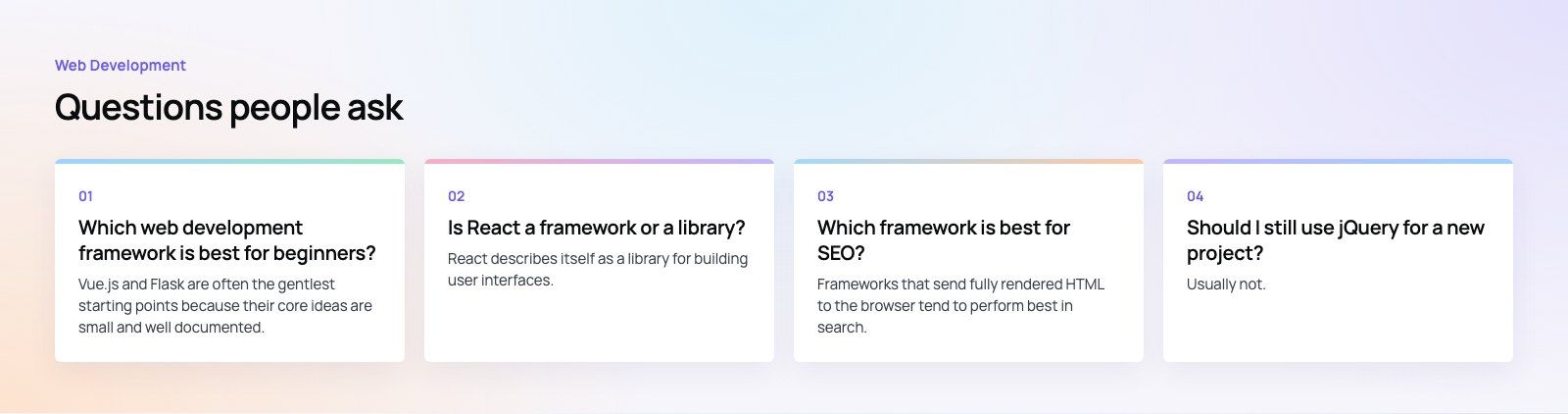
Vue.js and Flask are often the gentlest starting points because their core ideas are small and well documented.
Many beginners also start with React because of the volume of tutorials and jobs. The best first choice is usually the one that matches the language you already know, since learning a language and a framework at the same time slows progress.
Web DevelopmentWordPress vs Drupal: Which CMS Is Right for Your Business?WordPress vs Drupal compared on ease of use, content modeling, security, performance, ecommerce and cost drivers, with five questions to help you choose. Web DevelopmentCustom Website Development vs Website Builders: Pros and ConsAn honest comparison of custom website development and website builders: control, cost over time, SEO, integrations, and how to decide which fits your business.
 Web DevelopmentWeb Development Consultant: What They Do and When to Hire OneWhat a web development consultant does, how the role differs from a developer or agency, when hiring one pays off and how to choose the right one.
Tell us what the business needs. We will tell you what to build first.
Schedule a free consultation and get a written recommendation, with costs, before you commit to anything.
Get in touchPROVEN RESULTS
4.7 / 5verified reviews on Google