 Web DevelopmentWordPress vs Drupal: Which CMS Is Right for Your Business?WordPress vs Drupal compared on ease of use, content modeling, security, performance, ecommerce and cost drivers, with five questions to help you choose.
Real Estate Website Design: Key Features and Trends
The features every real estate website needs, from search and listing feeds to tours and enquiries, plus the design trends worth investing in.
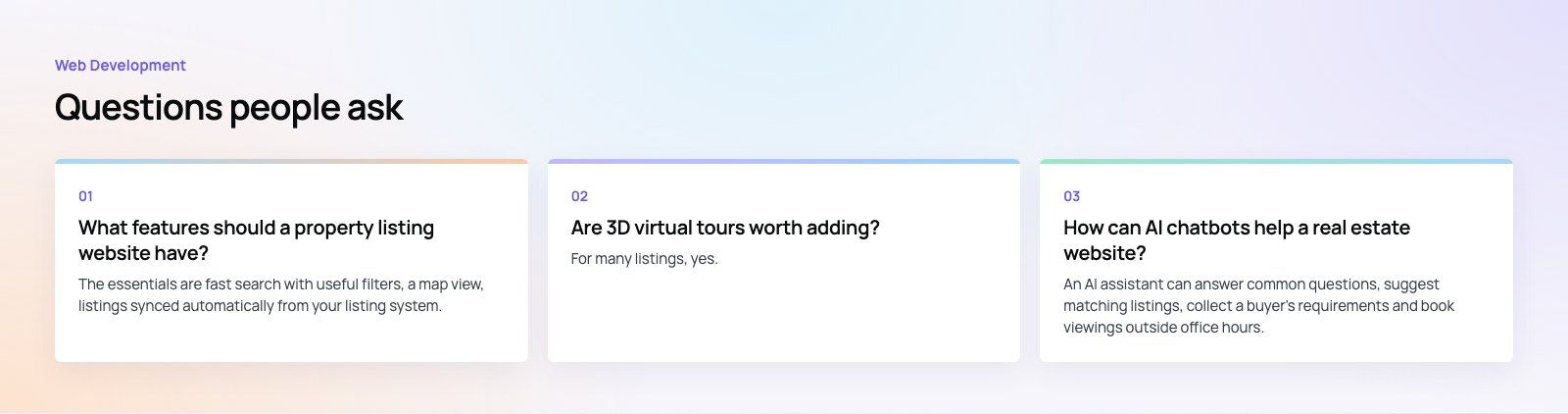
A good real estate website helps buyers and tenants find the right property quickly and makes it easy to contact an agent at the moment they are interested. The features that matter most are fast property search with useful filters, accurate listings synced from your listing system, high quality photos and video, mobile friendly design and clear ways to enquire. Trends such as 3D tours, AI assistants and map based search build on that foundation; they do not replace it.
This guide covers the main types of real estate website, the core features every listing site needs, the trends worth investing in, and how to plan the build.
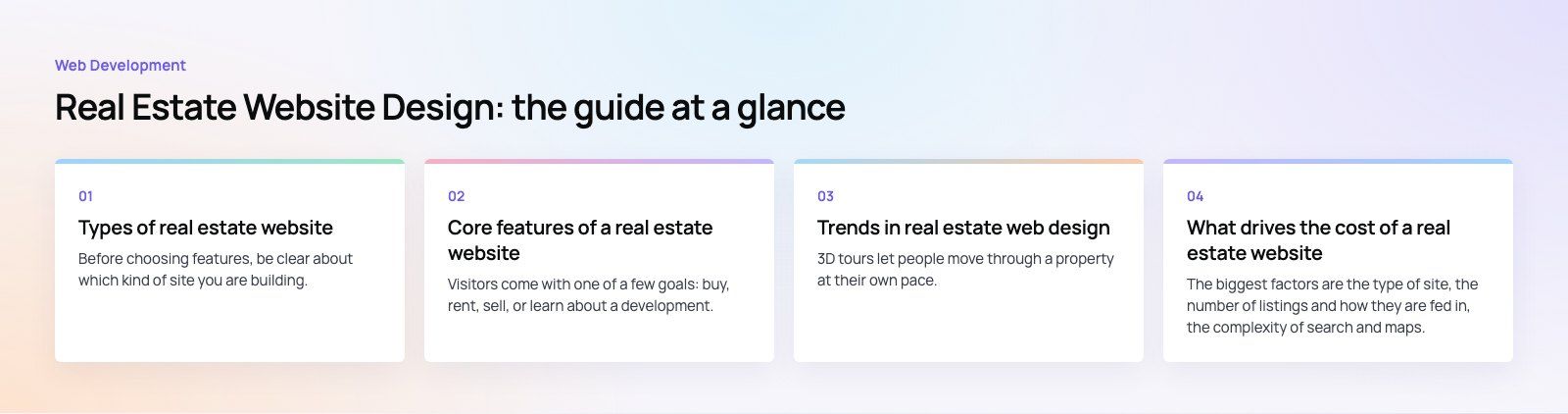
Types of real estate website
Before choosing features, be clear about which kind of site you are building. Each type has a different business model and a different set of users.
| Type | Who uses it | Main job | Typical extras |
|---|---|---|---|
| Agency or developer website | Buyers, tenants, sellers, investors | Show your own listings or projects and capture leads | Project pages, brochures, valuation requests |
| Listing portal | Many agencies and the public | List properties from many sources in one place | Agent accounts, featured listings, alerts |
| Marketplace | Owners, buyers, tenants | Connect parties and handle part of the transaction | Messaging, booking, payments, reviews |
| Aggregator | Property seekers | Pull offers from other sites and let users compare | Data feeds, deduplication, price history |
| Property management platform | Landlords, tenants, managers | Run occupancy, maintenance and payments | Tenant portal, rent collection, service requests |
Most businesses start with an agency or developer website. Portals and marketplaces are software products in their own right, closer to custom software than a marketing site.
Core features of a real estate website
Clear navigation
Visitors come with one of a few goals: buy, rent, sell, or learn about a development. Put those paths in the main menu and make each one reachable in a single click. Keep agent contact details and the enquiry button visible on every listing page, not hidden in the footer.
Mobile friendly design
Most property browsing happens on phones, often in short sessions. Design for the small screen first: large photos that swipe easily, filters that open in a simple panel, and a call or WhatsApp button within thumb reach. Google also indexes the mobile version of your site, so mobile quality affects search visibility directly.
Powerful search and filters
Search is the heart of a listing site. Offer the filters people actually use: location or community, property type, bedrooms, budget range, size, furnishing, completion status and key amenities. Save the user's filters when they go back, show the number of results as they adjust, and let them sort by newest or price.
Map based search
Many buyers think in areas rather than addresses. A map view with clustered pins, the ability to draw or select a neighborhood, and nearby schools, transport and shops helps them narrow down quickly.
Listing feed integration
Manually updating listings leads to sold or rented properties staying online, which damages trust. Connect the website to the system where your listings live, whether that is a CRM, a property management tool or a multiple listing service. In the US, MLS data commonly follows the RESO Data Dictionary standard, which makes feeds easier to integrate. Other markets use portal feeds or CRM exports; the principle is the same: one source of truth that updates the site automatically.
High quality photos
Photos are the first thing visitors judge. Show a full set for every listing, starting with the strongest image, and include floor plans where possible. Serve images in modern formats and sized for the screen so galleries load quickly even with dozens of photos.
Video and virtual tours
Walkthrough videos and virtual tours let people shortlist properties before visiting. They are especially valuable for off plan developments, overseas buyers and investors who cannot easily view in person.
Messaging and enquiries
Make it effortless to ask a question. Offer a short enquiry form, click to call, WhatsApp or live chat, and a way to book a viewing. Route each enquiry to the right agent with the listing reference attached, and send it straight into your CRM so nothing is lost.
Security and trust
Real estate sites collect names, phone numbers and sometimes financial details. Use HTTPS everywhere, keep the platform and plugins updated, protect forms against spam and store personal data responsibly under the privacy laws that apply where you operate. Show license details, office address and real agent profiles to build confidence.
Content and guides
Area guides, buying and renting guides, and market commentary help people at the research stage and give search engines more reasons to rank your site. Write about the specific communities you serve rather than generic advice, and update the guides when the facts change.
Trends in real estate web design
Interactive 3D tours
3D tours let people move through a property at their own pace. They reduce wasted viewings because buyers who book a visit have already seen the layout. For new developments, interactive floor plans and show unit tours do a similar job before construction is finished.
Mobile first experiences
Beyond responsive layouts, mobile first means fast loading on a mobile connection, saved searches, push or email alerts for new matches, and favorites that sync between devices. Some agencies add a progressive web app or a native app for their most active users.
AI assistants and chat
AI chat assistants can answer common questions about listings, qualify leads with a few questions and book viewings outside office hours. They work best when connected to live listing data and handing over to a human agent quickly. Review what the assistant says regularly, because a wrong answer about price or availability costs trust.
Smarter recommendations
Machine learning can suggest similar properties, rank listings by how well they match a user's behavior, and score leads so agents call the most serious buyers first. Start simple: "similar properties" and saved search alerts deliver most of the value.
Clean, minimal design
Simple layouts with plenty of space, readable type and a restrained color palette let the property photos do the work. Minimal design also tends to load faster, which helps both users and search rankings.
Conversational search
More people search in natural language, typed or spoken, such as "two bedroom apartment near the metro with a balcony". Pages that answer specific questions clearly and use structured data for listings and the business are better placed for these queries and for AI generated answers.
Lighter, efficient sites
Efficient code, optimized media and good hosting reduce page weight and energy use. The practical benefit is speed, which every visitor notices.
Augmented reality
AR features that place furniture in a room or overlay information on a building through the phone camera are still a niche. They suit premium developments and furnishing services more than everyday listings.
How to plan a real estate website
- Define the audience and goal. Buyers, tenants, sellers, investors or all four. Pick the main action you want each to take.
- Map your data. Decide where listings come from, how often they update and who owns each field.
- Plan the search experience. List the filters, sorting options and map behavior before design starts.
- Connect the CRM. Make sure every enquiry, call and chat lands in one place with the source recorded.
- Design mobile first. Test listing pages and the enquiry flow on a phone at every stage.
- Prepare content. Area guides, agent profiles and project pages take longer to write than most teams expect.
- Launch with tracking. Measure enquiries by listing, area and channel, then improve the pages that underperform.
What drives the cost of a real estate website
The biggest factors are the type of site, the number of listings and how they are fed in, the complexity of search and maps, integrations with CRM and portals, multilingual requirements and whether users need accounts. A focused agency site with a listing feed is a very different project from a portal with agent dashboards and payments. A scoping exercise before design avoids paying for features no one uses.
Building your real estate website
Start with fast search, accurate listings, strong photos and easy enquiries, then add 3D tours, AI chat and recommendations where they serve your buyers. Codeeo has delivered 200+ projects across the UAE and the US with a team of 80+ across Dubai, Riyadh and Karachi. Read how we approach the real estate industry, explore our web development services and sales automation for connecting enquiries to your CRM, or start with a website audit of your current site.
Frequently asked questions
A professional website shows your listings in full detail, works around the clock and captures enquiries straight into your sales process.
Portals bring traffic but also show competitors next to you. Your own site builds your brand, ranks for the areas you specialize in, and gives you control over how properties are presented and how leads are followed up.
Web DevelopmentWordPress vs Drupal: Which CMS Is Right for Your Business?WordPress vs Drupal compared on ease of use, content modeling, security, performance, ecommerce and cost drivers, with five questions to help you choose. Web DevelopmentCustom Website Development vs Website Builders: Pros and ConsAn honest comparison of custom website development and website builders: control, cost over time, SEO, integrations, and how to decide which fits your business.
 Web DevelopmentWeb Development Consultant: What They Do and When to Hire OneWhat a web development consultant does, how the role differs from a developer or agency, when hiring one pays off and how to choose the right one.
Tell us what the business needs. We will tell you what to build first.
Schedule a free consultation and get a written recommendation, with costs, before you commit to anything.
Get in touchPROVEN RESULTS
4.7 / 5verified reviews on Google