 Web DevelopmentWordPress vs Drupal: Which CMS Is Right for Your Business?WordPress vs Drupal compared on ease of use, content modeling, security, performance, ecommerce and cost drivers, with five questions to help you choose.
Why RESTful APIs Matter in Modern Web and App Development
How RESTful APIs connect websites, mobile apps and third party services, and what to get right on methods, JSON, security, rate limits and testing.

RESTful APIs matter because they let separate pieces of software talk to each other over plain HTTP in a predictable way. That lets one back end serve a website, a mobile app and partner systems at the same time, lets front end and back end teams work independently, and lets you plug in payments, maps or login services instead of building them yourself.
REST is not new, and newer styles such as GraphQL and gRPC have their place. REST remains the default for most web and mobile products because it is simple, widely understood and supported by every language and platform. This guide explains how it works, where it fits in a modern stack and what to get right when you build or consume one.
What a RESTful API is
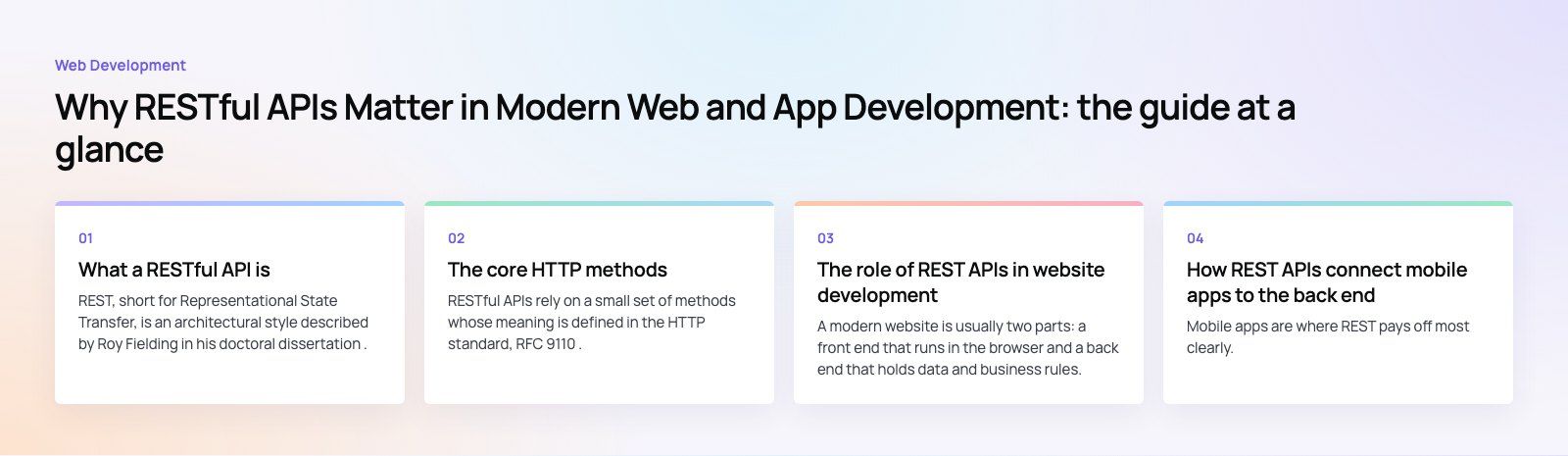
REST, short for Representational State Transfer, is an architectural style described by Roy Fielding in his doctoral dissertation. An API is called RESTful when it follows that style. In practice, that means:
- Resources with addresses. Everything is a resource, such as an order, a user or a product, with its own URL.
- Standard HTTP methods. You act on resources with the methods HTTP already defines.
- Statelessness. Each request carries everything the server needs, so any server can answer it. This is what makes REST APIs easy to scale horizontally.
- Representations. The server sends a representation of the resource, almost always JSON today.
- Cacheability. Responses say whether they can be cached, which cuts load and speeds things up.
The core HTTP methods
RESTful APIs rely on a small set of methods whose meaning is defined in the HTTP standard, RFC 9110.
| Method | What it does | Example |
|---|---|---|
| GET | Reads a resource or a list | Fetch a product's details |
| POST | Creates a new resource | Place an order |
| PUT | Replaces a resource | Save an updated profile in full |
| PATCH | Changes part of a resource | Update only a delivery address |
| DELETE | Removes a resource | Cancel a saved item |
Because every developer already knows these verbs, a well designed REST API is close to self explanatory. Combined with clear status codes, such as 200 for success, 201 for created, 404 for not found and 422 for invalid input, clients can react correctly without special cases.
The role of REST APIs in website development
A modern website is usually two parts: a front end that runs in the browser and a back end that holds data and business rules. The REST API is the contract between them.
- Independent teams. Once the API contract is agreed, front end and back end developers can build in parallel.
- Reuse. The same endpoints that power the website can power a mobile app, an admin panel or a partner integration.
- Third party services. Payments, maps, email, search and authentication arrive as APIs, so you integrate rather than rebuild.
- Safer changes. You can rework the back end, change the database or split a service in two without touching the front end, as long as the contract holds.
Frameworks such as Next.js, React and Laravel are all comfortable on either side of a REST API, which is one reason the pattern has lasted.
How REST APIs connect mobile apps to the back end
Mobile apps are where REST pays off most clearly. iOS, Android and cross platform apps built with Flutter or React Native all speak HTTP and JSON, so one API serves every platform.
Flutter, for example, makes this straightforward: its official guide to fetching data from the internet shows how an app calls an endpoint, decodes the JSON and displays it. The same pattern pulls user profiles, product lists, order status or chat history from the server.
Mobile adds a few concerns a website can sometimes ignore:
- Unreliable networks. Design for slow and dropped connections with timeouts, retries and offline caching.
- Payload size. Return only the fields the screen needs, and paginate long lists.
- Old app versions. Users do not always update, so the API must keep supporting older clients. Versioning is essential.
JSON: the format REST APIs speak
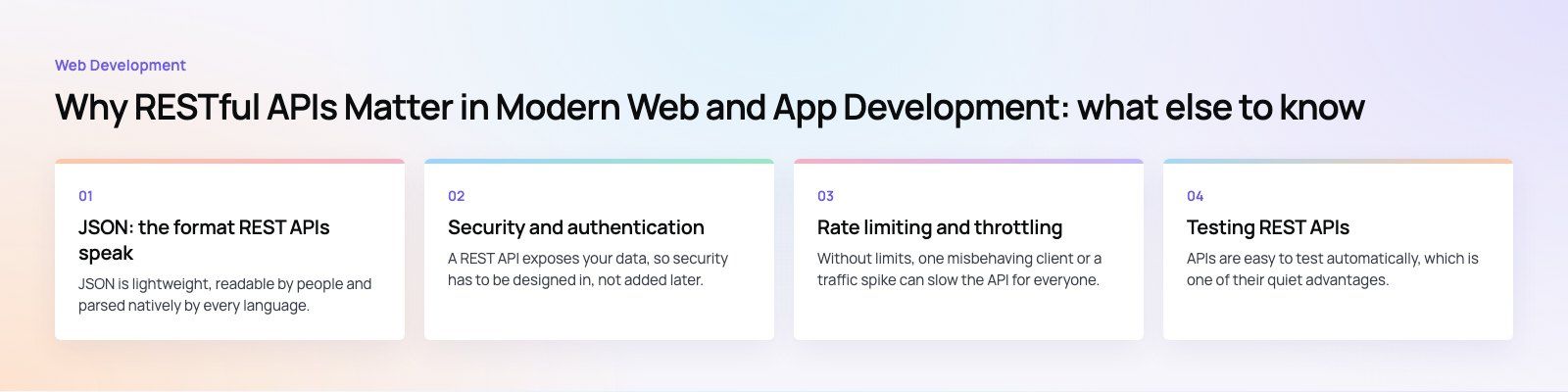
JSON is lightweight, readable by people and parsed natively by every language. A typical response is a simple object with named fields, nested objects for related data and arrays for lists. Keep your JSON consistent: the same naming style everywhere, the same date format, the same error shape and the same pagination pattern on every list endpoint.
Security and authentication
A REST API exposes your data, so security has to be designed in, not added later.
- HTTPS everywhere. No exceptions, including internal environments.
- OAuth 2.0 for delegated access. Defined in RFC 6749, it lets an app act for a user through tokens without ever handling the user's password.
- Short lived tokens. Access tokens should expire, with refresh tokens to renew them.
- Authorization checks on every request. Confirm the caller is allowed to see or change this specific resource, not just that they are logged in.
- Input validation. Treat every field as untrusted.
Rate limiting and throttling
Without limits, one misbehaving client or a traffic spike can slow the API for everyone. Rate limiting caps how many requests a client can make in a time window and returns a clear error when the cap is reached. Throttling slows or queues excess requests rather than rejecting them. Publish your limits, return them in response headers and tell clients how long to wait before retrying.
Testing REST APIs
APIs are easy to test automatically, which is one of their quiet advantages. Common tools include Postman for exploratory and collection based testing, SoapUI for functional and load testing, and REST Assured for tests written in Java.
What to test
- Each endpoint returns the right data and status codes.
- Invalid input is rejected with useful errors.
- Authorization rules hold: one user cannot read another user's data.
- Performance under realistic load.
Testing in continuous integration
Run API tests on every pull request in your CI pipeline. When a change breaks an endpoint, the build fails before the change reaches users. Contract tests, which compare responses against the documented schema, catch the subtle breaks that unit tests miss.
Documentation keeps everyone aligned
An API is only as useful as its documentation. Describe each endpoint, its methods, parameters, example requests and responses, and every error it can return. Writing the API in a specification format such as OpenAPI lets you generate reference pages, mock servers and client libraries from the same file, so the docs never drift from the code.
Common mistakes when building REST APIs
- Putting verbs in URLs, such as /getOrders, instead of using HTTP methods on resources.
- Returning 200 for every response, including errors.
- Shipping without versioning, then breaking mobile users on the first change.
- Returning entire database records, including fields the client should never see.
- Checking that a user is logged in but not that they own the resource.
REST, GraphQL or gRPC?
REST is the safe default for public APIs and most web and mobile products. GraphQL suits front ends that need to combine data from many sources in flexible shapes. gRPC suits high volume communication between internal services. Many systems use REST at the edge and something else inside.
If you are planning a product that needs a web front end, a mobile app and integrations from one back end, our web development and mobile app development teams design the API first so every client builds on the same contract. We work across Next.js and Laravel stacks, and a product scoping session is a good place to map the endpoints before code starts. The Teachers Lunch case study shows three apps working from one platform.
Frequently asked questions
REST APIs are simple, widely understood, stateless and easy to scale, and they work with every language through standard HTTP and JSON.
Their weaknesses are over fetching or under fetching data on complex screens, several round trips for related resources, and no built in standard for real time updates. Security is not automatic and must be designed in.
Web DevelopmentWordPress vs Drupal: Which CMS Is Right for Your Business?WordPress vs Drupal compared on ease of use, content modeling, security, performance, ecommerce and cost drivers, with five questions to help you choose. Web DevelopmentCustom Website Development vs Website Builders: Pros and ConsAn honest comparison of custom website development and website builders: control, cost over time, SEO, integrations, and how to decide which fits your business.
 Web DevelopmentWeb Development Consultant: What They Do and When to Hire OneWhat a web development consultant does, how the role differs from a developer or agency, when hiring one pays off and how to choose the right one.
Tell us what the business needs. We will tell you what to build first.
Schedule a free consultation and get a written recommendation, with costs, before you commit to anything.
Get in touchPROVEN RESULTS
4.7 / 5verified reviews on Google