 Software DevelopmentAPI Integration for Saudi Business Websites: ERP, CRM and Payment GatewaysHow Saudi websites connect to ERP, CRM, payment gateways like mada and Tabby, ZATCA e-invoicing, logistics and WhatsApp through APIs.
CodeeoInsightsSoftware Development
Software Development Best Practices That Keep Code Easy to Change
The software development best practices that matter: version control, readable code, testing, code review, staging, CI/CD, security and documentation.
Software development best practices are the habits that keep a codebase easy to change: version control for every change, readable code with clear names, automated tests, small reviewed pull requests, a staging environment, and an automated pipeline that builds, tests and deploys. Add security checks and living documentation, and most projects avoid the expensive rework that comes from shortcuts taken early.
None of these practices is new. What separates teams that ship reliably from teams that firefight is consistency: applying the basics on every change, not just when there is time. This guide covers the practices that matter most, why each one exists, and how to introduce them without slowing a team down.
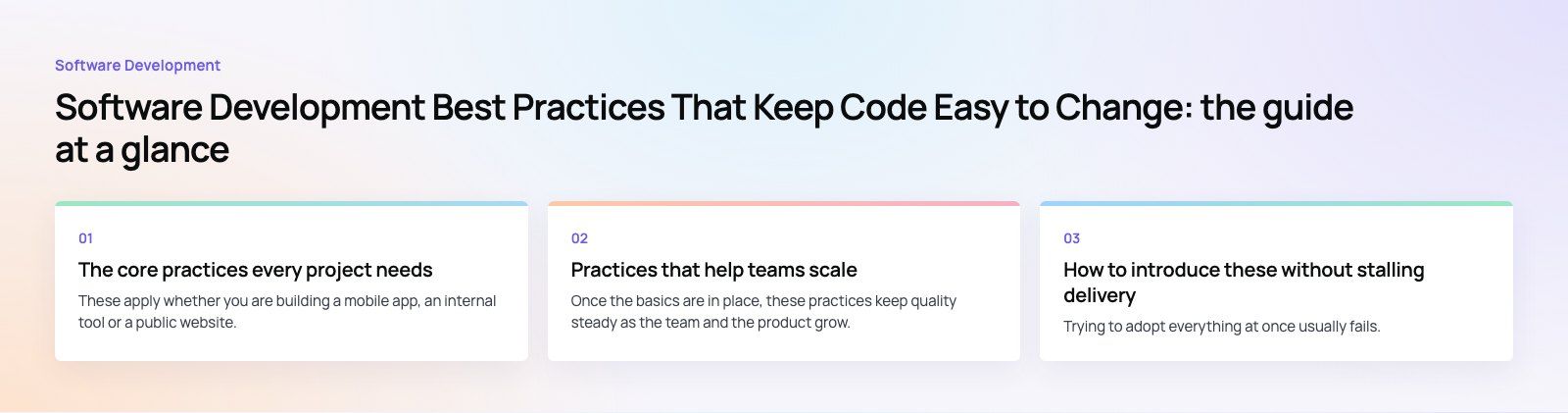
The core practices every project needs
These apply whether you are building a mobile app, an internal tool or a public website. Skip any of them and the cost shows up later as bugs, slow releases or code nobody wants to touch.
Put everything under version control
Version control records every change to the code, who made it and why. Git is the default choice, and the free Pro Git book remains the clearest reference for how it works. The practice goes beyond simply using Git:
- Keep the main branch deployable at all times.
- Work in short lived branches and merge often, so changes stay small and conflicts stay rare.
- Write commit messages that explain the reason for a change, not just what changed.
- Version infrastructure, configuration and database migrations too, not only application code.
With that discipline, rolling back a bad release takes minutes, and anyone can trace when and why a behavior changed.
Write code for the next reader
Code is read far more often than it is written. Readable code uses consistent formatting, small functions that do one thing, and names that explain purpose. An automatic formatter and a linter settle style arguments for good, so reviews can focus on logic.
Naming is where readability is won or lost. Compare a function called process_data with one called calculate_customer_lifetime_value. The first tells a reader nothing about its input, its output or its side effects. The second tells them what it does before they open it. The same goes for variables: lifetime_value beats lv or result2 every time.
Don't repeat yourself, within reason
The DRY principle says each piece of knowledge should live in one place. If the same tax rule or validation logic is copied into five files, a change means finding all five, and someone will miss one. Extract shared logic into a function or module.
The caution is premature abstraction. Two blocks of code that look alike today may need to change for different reasons tomorrow. A common rule of thumb is to tolerate duplication until the third copy, then extract it once the shared shape is clear.
Test automatically, at the right levels
Automated tests are what let a team change code with confidence. A balanced suite usually has three layers:
- Unit tests check small pieces of logic in isolation and run in seconds.
- Integration tests check that components work together, such as the API talking to the database.
- Browser tests drive the real interface through the few flows that must never break, like sign in and checkout.
Most tests should sit at the unit level because they are fast and precise. Keep the slower browser tests for critical paths only, or the suite becomes too slow for anyone to run. When a bug reaches production, write a test that reproduces it before fixing it, so it cannot quietly return.
Design before you build
An hour of planning saves days of rework. Before writing code for a feature, agree on what it must do, how data flows, which edge cases matter and how you will know it works. For larger pieces, a short design note covering the approach, the alternatives considered and the risks is enough. It does not need to be a formal document; it needs to exist before the code does.
If you are starting a new product, a structured product scoping exercise does this work at project level, turning ideas into a defined first release.
Review every change
Code review catches bugs, spreads knowledge across the team and keeps standards consistent. It works best when pull requests are small enough to review properly, ideally a few hundred lines at most. Reviewers should look at correctness, readability, tests and security first, and leave formatting to the tools.
Refactor continuously
Requirements shift, libraries age and early decisions stop fitting. Left alone, these mismatches pile up as technical debt, and every new feature takes longer than the last. Refactoring means restructuring code without changing what it does: simplifying a tangled function, removing dead code, splitting a module that has grown too large.
The sustainable approach is to refactor as part of normal work, leaving each area slightly cleaner than you found it, rather than waiting for a large cleanup project that never gets scheduled. If a codebase has already drifted, an outside codebase review can show where the debt is costing most.
Use a staging environment
A staging environment mirrors production as closely as possible: same infrastructure, same configuration, realistic data. New features are tested there before real users see them. It catches the problems that only appear outside a developer's laptop, such as missing environment variables, slow queries against real data volumes, or third party services that behave differently.
Practices that help teams scale
Once the basics are in place, these practices keep quality steady as the team and the product grow.
Work in short iterations
Agile methods such as Scrum and Kanban break work into small increments that can be shipped and tested with real users. Scrum uses fixed length sprints with planning and review meetings; Kanban limits work in progress and lets tasks flow continuously. Either works. What matters is a short feedback loop, so the team learns early when something is wrong.
Automate the pipeline with CI/CD
Continuous integration runs the build and tests automatically on every change, so problems surface within minutes of being introduced. Continuous delivery takes the next step and makes every passing build ready to release, often with an automated deployment to staging and a single approval for production.
A good pipeline also runs the linter, checks dependencies for known vulnerabilities and builds the same artifact that will be deployed, so what was tested is exactly what ships.
Build security in from the start
Security added at the end is expensive and incomplete. Build it in from the first commit:
- Validate all input and encode output to block injection attacks.
- Keep secrets out of the repository and in a proper secrets manager.
- Apply least privilege to users, services and database accounts.
- Scan dependencies automatically and patch them on a schedule.
- Use the OWASP Top 10 as a checklist of common web application risks.
Keep documentation alive
Useful documentation is short and close to the code: a README that explains how to run the project locally, architecture notes for the big decisions, an API reference generated from the code where possible, and a runbook for common operational tasks. Documentation that lives in the repository gets updated in the same pull request as the code it describes, which keeps it accurate.
Track work in one place
Tools such as Jira, Linear, Trello or GitHub Issues give the team one view of what is in progress, what is blocked and what is next. The specific tool matters less than the habit: every piece of work has a ticket, every ticket links to the code that resolved it.
Best practices at a glance
| Practice | What it prevents | Where to start |
|---|---|---|
| Version control | Lost work, untraceable changes | Git with a protected main branch |
| Readable code and naming | Slow onboarding, hidden bugs | Formatter and linter in the pipeline |
| DRY | Rules that drift apart across files | Extract logic on the third copy |
| Automated testing | Regressions after every release | Unit tests for core logic first |
| Design first | Rewrites of poorly planned features | A one page design note per feature |
| Code review | Bugs and knowledge silos | Small pull requests, one reviewer minimum |
| Refactoring | Growing technical debt | Clean as you go |
| Staging | Surprises in production | Mirror production configuration |
| CI/CD | Manual, error prone releases | Build and test on every push |
| Security by default | Breaches and leaked secrets | Dependency scanning and a secrets manager |
| Documentation | Knowledge leaving with people | README and runbook in the repository |
How to introduce these without stalling delivery
Trying to adopt everything at once usually fails. A steadier order looks like this:
- Get all code into Git with a protected main branch and required reviews.
- Add a formatter, a linter and a basic CI build that runs on every pull request.
- Write tests for the most important business logic and for every new bug fixed.
- Set up a staging environment and deploy to it automatically.
- Add dependency scanning and move secrets out of the code.
- Agree on a lightweight design note and a definition of done for features.
One issue we often see is a team that writes a long standards document and then never enforces it. Automation beats policy: if the pipeline blocks an unformatted or untested change, the standard holds without anyone having to police it.
These are the same habits behind the 200+ projects Codeeo has delivered across the UAE and the US. If you need a team that brings them to your product from day one, see our custom software development service, or browse our case studies to see the kind of platforms we build.
Frequently asked questions
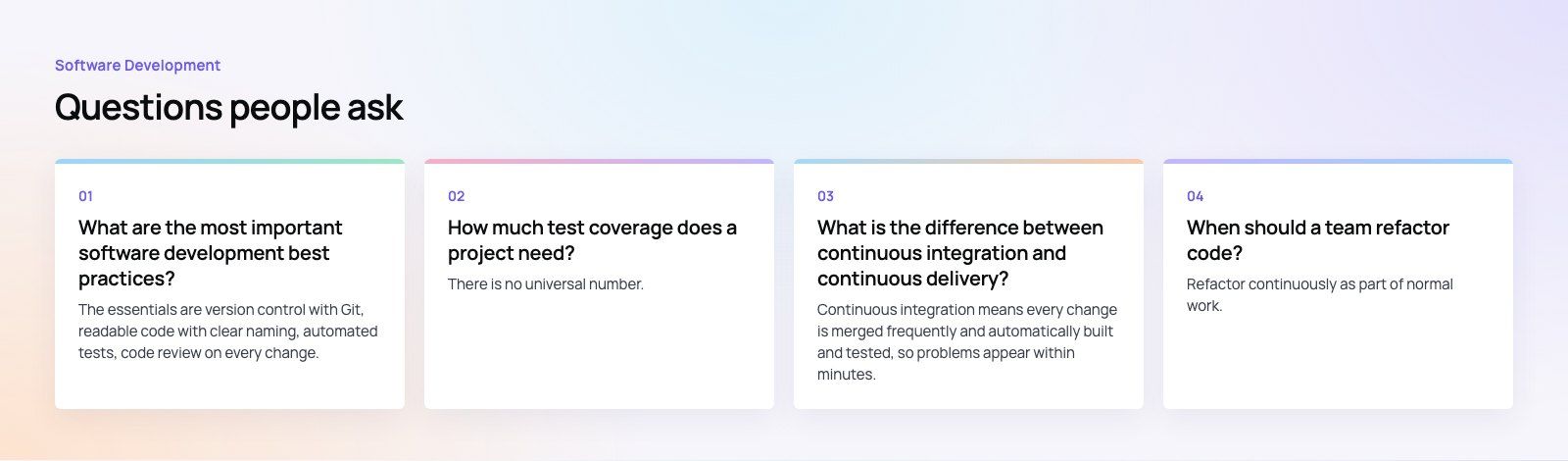
The essentials are version control with Git, readable code with clear naming, automated tests, code review on every change, a staging environment and a CI/CD pipeline.
Together they make changes traceable, catch bugs early and keep releases predictable. Security checks and short, living documentation round out the list. Teams that apply these consistently spend far less time fixing regressions and far more time building features.
Software DevelopmentAPI Integration for Saudi Business Websites: ERP, CRM and Payment GatewaysHow Saudi websites connect to ERP, CRM, payment gateways like mada and Tabby, ZATCA e-invoicing, logistics and WhatsApp through APIs. Software DevelopmentAI Workflow Automation for Case Management: Where AI Saves Case Teams Real TimeHow AI workflow automation fits into case management: practical uses, human review, data security and when to build a custom AI workflow.
 Software DevelopmentLaw Firm Client Portal, Legal CRM and Intake Software: Turning Inquiries into Signed ClientsTurn more legal inquiries into signed clients with intake software, a legal CRM and a secure client portal built around your firm.
Tell us what the business needs. We will tell you what to build first.
Schedule a free consultation and get a written recommendation, with costs, before you commit to anything.
Get in touchPROVEN RESULTS
4.7 / 5verified reviews on Google