 Software DevelopmentAPI Integration for Saudi Business Websites: ERP, CRM and Payment GatewaysHow Saudi websites connect to ERP, CRM, payment gateways like mada and Tabby, ZATCA e-invoicing, logistics and WhatsApp through APIs.
CodeeoInsightsSoftware Development
Software Development Contract: The Clauses That Matter Most
What a software development contract should cover: scope, milestones, acceptance, change control, payment, IP ownership, liability, termination and disputes.
A software development contract is the agreement between a client and a developer that sets out what will be built, by when, for how much, who owns the result and what happens if things go wrong. The clauses that matter most are scope of work, milestones and acceptance, payment terms, intellectual property, confidentiality, warranties and liability, change control, termination and dispute resolution. Getting these right before work starts prevents most of the disputes that derail software projects.
This guide walks through each clause, what it should cover, and the mistakes that cause trouble later. It is written for founders, product owners and developers, and it is not legal advice: always have a qualified lawyer in your jurisdiction review the final document.
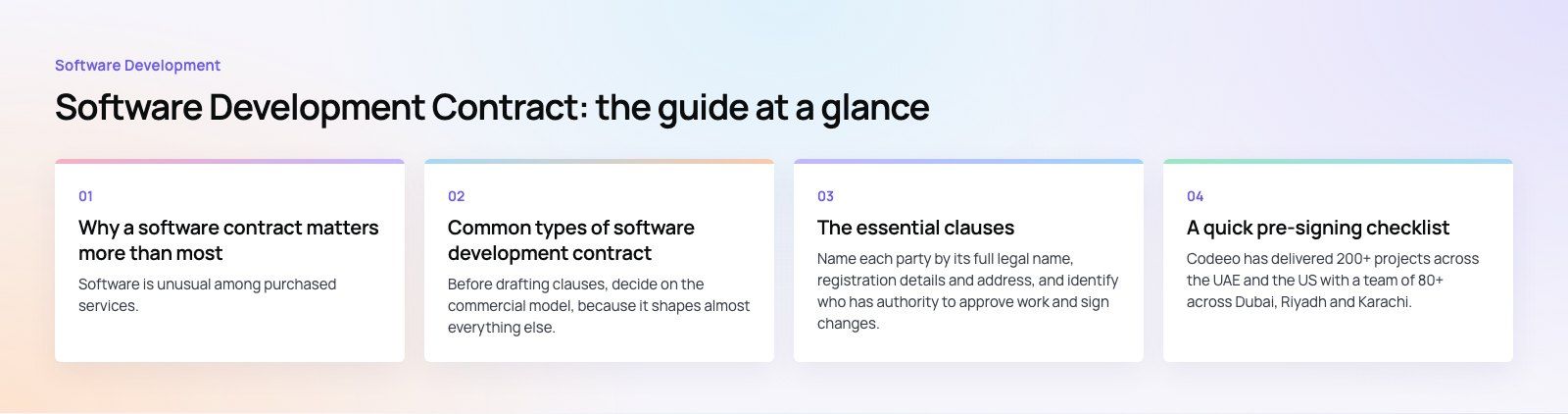
Why a software contract matters more than most
Software is unusual among purchased services. Requirements are often incomplete at the start, the product changes as people see it, and the most valuable output, the source code, is intangible. Without a clear contract, both sides carry risk:
- The client risks paying for software that does not do what they expected, or finding they do not own the code they paid for.
- The developer risks unlimited revisions, late or missing payments, and liability out of proportion to the fee.
A good contract turns assumptions into written commitments. It gives both sides a shared reference when memories differ six months into a build.
Common types of software development contract
Before drafting clauses, decide on the commercial model, because it shapes almost everything else.
| Model | How it works | Best suited to | Main risk |
|---|---|---|---|
| Fixed scope, fixed price | An agreed specification delivered for an agreed total | Well defined projects with stable requirements | Disputes over what counts as in scope |
| Time and materials | The client pays for hours or days actually worked | Evolving products and discovery phases | Budget uncertainty for the client |
| Dedicated team | A team works for the client on an ongoing basis | Long running products with a steady backlog | Weak oversight if goals are not set |
| Hybrid or phased | A paid discovery phase, then a fixed or capped build | New products where scope needs shaping first | Unclear handover between phases |
Many contracts sit inside a two layer structure: a master services agreement with the legal terms, plus a statement of work for each project or phase. That keeps the legal terms stable while scope and timelines change.
The essential clauses
Parties and definitions
Name each party by its full legal name, registration details and address, and identify who has authority to approve work and sign changes. A short definitions section prevents arguments later about what words like "deliverable", "acceptance" or "defect" mean.
Scope of work
This is the clause most disputes trace back to. It should describe:
- What the software must do, ideally as features or user stories with clear outcomes.
- The platforms, technologies and integrations involved.
- What is explicitly out of scope, such as content entry, hosting or third party licenses.
- The deliverables: source code, builds, documentation, design files and credentials.
If the scope is not yet clear enough to write down, that is a signal to run a paid discovery or product scoping phase first, and contract the build once the specification exists.
Milestones, timeline and acceptance
Break the work into milestones, each with a deliverable and a target date. For each milestone, define acceptance criteria and an acceptance window: how long the client has to test and either approve or report defects. A common approach is that a deliverable is deemed accepted if no material defects are reported within that window, which stops projects stalling in endless review.
The timeline should also say what happens to dates when the client is late supplying content, access or feedback, because client side delays are one of the most common reasons projects run over.
Change control
Requirements will change. The contract should set out how: a written change request, an impact assessment covering time and cost, and approval by a named person before work begins. Without this clause, small requests accumulate into a large, unpaid expansion of scope, and goodwill on both sides erodes.
Payment terms
Payment terms should state the pricing model, the schedule (often tied to milestones), invoicing and due dates, accepted payment methods, and what happens on late payment, such as interest or a right to pause work. Rather than one large payment at the end, staged payments linked to accepted milestones keep risk balanced for both sides.
Intellectual property
This clause decides who owns the code. Clients usually expect full ownership of everything written for them on payment, but the detail matters:
- Custom code written for the project typically transfers to the client, often on full payment.
- Pre-existing code, such as the developer's internal libraries or frameworks, usually stays with the developer, with the client receiving a perpetual license to use it within the product.
- Open source components remain under their own licenses, and the contract should require the developer to disclose them and avoid licenses that conflict with how the client plans to use the software.
- Third party services, such as paid APIs or plugins, need their own accounts and licenses, ideally in the client's name.
Copyright law differs between countries, and in some jurisdictions code written by a contractor does not automatically belong to the client without a written assignment. The WIPO copyright pages give a useful overview of how copyright applies to software, but your lawyer should confirm the position where you operate.
Confidentiality and data protection
Define what counts as confidential, such as business plans, user data, designs and source code, and how long the obligation lasts after the contract ends. If the developer will handle personal data, add data processing terms that reflect the privacy laws that apply to your users, covering security measures, breach notification and deletion at the end of the project.
Warranties and liability
A warranty clause sets out what the developer promises about the software, for example that it will materially conform to the specification for a defined period after launch, and how defects found in that period will be fixed. It should be clear what is excluded, such as problems caused by client changes or third party services.
The limitation of liability clause caps how much each party can be liable for, often linked to the fees paid, and usually excludes indirect losses such as lost profits. Both sides should read this carefully, because it decides who carries the risk if something serious goes wrong.
Support and maintenance
Launch is not the end of software. Either include post launch support in the contract or reference a separate maintenance agreement covering bug fixes, security updates, response times and how new work is requested.
Termination
Set out how either party can end the contract: for convenience with notice, or for cause such as material breach or insolvency. Most importantly, define what happens on termination, including payment for work completed, handover of code and credentials, and the return or deletion of confidential information.
Dispute resolution and governing law
Choose the law that governs the contract and the forum for disputes. Many software contracts set an escalation path: negotiation between project leads, then senior management, then mediation, and finally arbitration or court. Cross border projects especially need this clause, since the client and the developer may sit in different countries.
General provisions
The standard closing clauses still matter: force majeure, assignment, entire agreement, severability, notices, and whether the developer can subcontract work or name the client in its portfolio.
Mistakes to avoid
- Vague scope. Phrases like "a modern ecommerce platform" invite disagreement. Describe features and outcomes.
- No acceptance process. Without criteria and a time window, milestones never formally close.
- Ownership left implied. Write down who owns the code, designs and accounts, and when ownership passes.
- Credentials in the developer's name. Domains, app store accounts, hosting and repositories should belong to the client.
- No exit plan. Agree handover obligations before you need them.
- Using a generic template unchanged. Templates are a starting point; every project has specific risks.
A quick pre-signing checklist
- Is the scope specific enough that a third party could judge whether it was delivered?
- Does every milestone have acceptance criteria and a review window?
- Is there a written change request process?
- Are payments tied to accepted milestones?
- Is IP ownership explicit, including pre-existing and open source code?
- Are confidentiality and data protection covered?
- Is liability capped in a way both sides accept?
- Are support, termination and handover defined?
- Has a lawyer in the relevant jurisdiction reviewed it?
Codeeo has delivered 200+ projects across the UAE and the US with a team of 80+ across Dubai, Riyadh and Karachi, and every one starts with an agreed scope. If you are planning a build, see how our custom software development and mobile app development teams work, or explore dedicated developers for ongoing product work. When you are ready, get in touch to talk through your project.
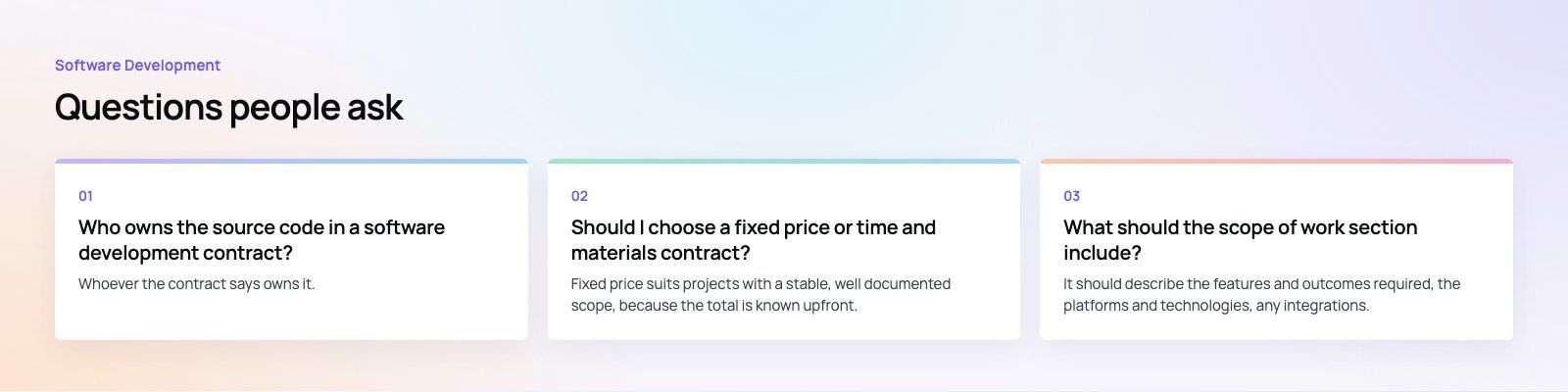
Frequently asked questions
It is a legally binding agreement between a client and a developer or agency that defines the software to be built, the timeline, payment, ownership of the code, confidentiality, warranties, liability and how disputes are handled. Its purpose is to turn expectations into written commitments, so both sides have a clear reference point when questions or disagreements arise during or after the project.
Software DevelopmentAPI Integration for Saudi Business Websites: ERP, CRM and Payment GatewaysHow Saudi websites connect to ERP, CRM, payment gateways like mada and Tabby, ZATCA e-invoicing, logistics and WhatsApp through APIs. Software DevelopmentAI Workflow Automation for Case Management: Where AI Saves Case Teams Real TimeHow AI workflow automation fits into case management: practical uses, human review, data security and when to build a custom AI workflow.
 Software DevelopmentLaw Firm Client Portal, Legal CRM and Intake Software: Turning Inquiries into Signed ClientsTurn more legal inquiries into signed clients with intake software, a legal CRM and a secure client portal built around your firm.
Tell us what the business needs. We will tell you what to build first.
Schedule a free consultation and get a written recommendation, with costs, before you commit to anything.
Get in touchPROVEN RESULTS
4.7 / 5verified reviews on Google