 Software DevelopmentAPI Integration for Saudi Business Websites: ERP, CRM and Payment GatewaysHow Saudi websites connect to ERP, CRM, payment gateways like mada and Tabby, ZATCA e-invoicing, logistics and WhatsApp through APIs.
CodeeoInsightsSoftware Development
Software Development Principles That Keep Projects on Track
The software development principles that matter: user focus, short iterations, SOLID, DRY and KISS, TDD, CI/CD, code review and version control.
The software development principles that matter most are simple: understand the user's problem before writing code, deliver in small iterations with frequent feedback, keep code modular and readable using ideas like SOLID, DRY and KISS, automate testing and releases with CI/CD, and track every change in version control. Teams that follow these consistently ship fewer bugs, change direction more cheaply and keep projects on schedule.
This guide explains each principle, why it matters and how to apply it, from planning through to release.
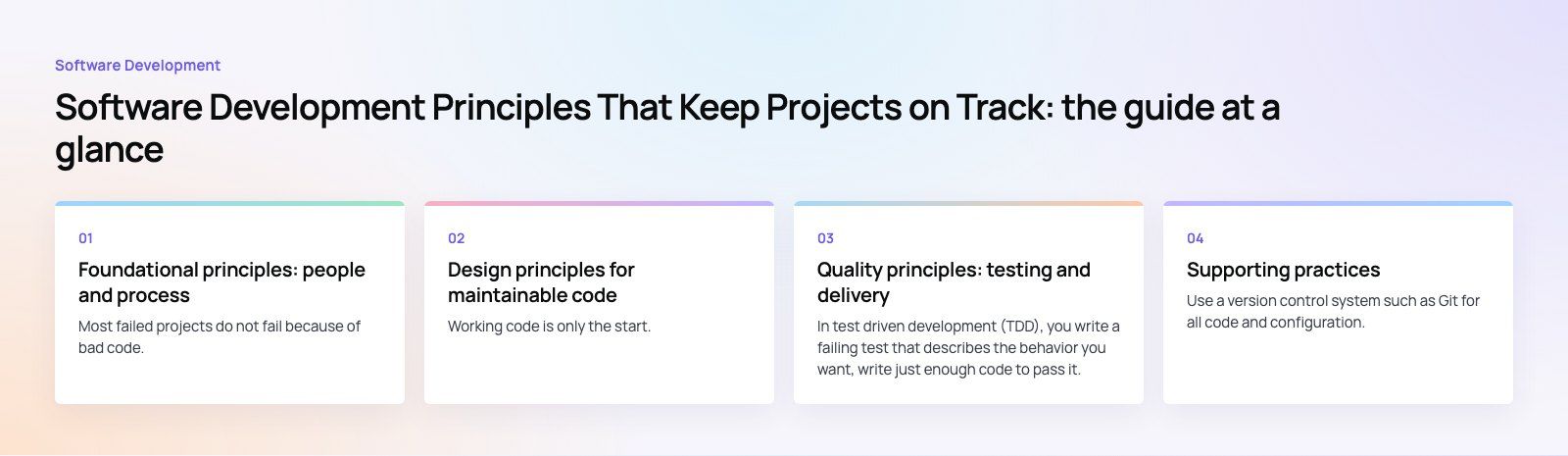
Foundational principles: people and process
Start with the user's problem
Most failed projects do not fail because of bad code. They fail because the team built the wrong thing. Before design starts, write down who the users are, what problem they have and how they solve it today. Interviews, observation and usability tests on rough prototypes cost little and prevent expensive rework.
Turn that research into a prioritized list. Not every feature is equally valuable, and not every user carries the same weight for the business. A clear priority order lets the team cut scope sensibly when time runs short. A product scoping session is one structured way to reach that list.
Work in short iterations
Long, fixed plans assume requirements will not change. They always do. Iterative methods such as Scrum and Kanban break work into short cycles, each ending with something working that users or stakeholders can see. The values behind this approach are set out in the Manifesto for Agile Software Development, which favors working software and responding to change over following a fixed plan.
Short sprints give fast feedback. If a feature misses the mark, you lose days, not months.
Build feedback loops into every stage
Feedback should come from users through testing and analytics, from stakeholders through regular demos, and from the code itself through automated tests and monitoring. Each loop catches a different kind of mistake. Retrospectives at the end of each cycle apply the same idea to the team's own process.
Communicate clearly and write things down
Software is a team effort, and most delays come from misunderstandings rather than technical problems. Everyone should know the goal, the timeline and who owns what. Short daily check ins, a shared task board and a single place for decisions keep people aligned.
Documentation does not need to be long. Record why key decisions were made, how to run the project locally, how to deploy and what the main parts of the system do. New team members and future maintainers will rely on it.
Design principles for maintainable code
Working code is only the start. Good code is also easy to read, change and extend, because most of a system's life is spent being modified.
SOLID
SOLID is a set of five object oriented design principles:
- Single responsibility: each class or module should have one reason to change.
- Open and closed: code should be open to extension but closed to modification, so new behavior is added without rewriting what works.
- Liskov substitution: a subtype should work anywhere its parent type is expected.
- Interface segregation: prefer small, focused interfaces over large general ones.
- Dependency inversion: depend on abstractions rather than concrete implementations, which makes testing and swapping components easier.
DRY, KISS and YAGNI
DRY (don't repeat yourself) means each piece of knowledge should live in one place, so a change happens once. KISS (keep it simple) means choosing the simplest solution that works. YAGNI (you aren't gonna need it) means not building features for imagined future needs. Together they keep code small and understandable.
Apply them with judgment. Forcing DRY on two pieces of code that only look similar can create a tangled abstraction that is harder to change than the duplication was.
Separation of concerns and modularity
Split the system into parts with clear boundaries: user interface, business logic, data access, integrations. Each part can then be understood, tested and replaced on its own. This is what makes a system scale, not just in traffic but in the number of developers who can work on it at once.
Design for change
Expect requirements, traffic and technology to change. That does not mean building for every possibility. It means keeping boundaries clean, avoiding hard coded assumptions and choosing well supported tools so that change is affordable when it comes.
Quality principles: testing and delivery
Test driven development
In test driven development (TDD), you write a failing test that describes the behavior you want, write just enough code to pass it, then clean up the code. The cycle forces clear thinking about requirements before implementation and leaves behind a suite of tests that protect against regressions, where a later change breaks something that used to work.
TDD is not mandatory for every line of code, but some form of automated testing is. Unit tests cover logic, integration tests cover how parts work together, and browser or device tests cover the key user flows.
Continuous integration and continuous delivery
Continuous integration means every change is merged often and automatically built and tested. Continuous delivery extends this so that every passing build can be released with little manual work. Together, CI/CD reduce integration problems, catch errors within minutes and make releases routine rather than risky events.
Code review
Every change should be read by at least one other developer before it merges. Reviews catch bugs, spread knowledge across the team and keep style consistent. Keep pull requests small so reviews are fast and thorough.
Supporting practices
Version control
Use a version control system such as Git for all code and configuration. It records every change, who made it and why, lets you roll back safely and lets many developers work in parallel on branches. Agree on a branching strategy and clear commit messages early.
Change management
Define how changes are requested, approved and released, and how conflicts are resolved when several developers touch the same code. Feature flags let you ship code switched off and turn it on gradually, which lowers release risk.
Prioritization and resource management
Projects run late when everything is urgent. Keep a single ordered backlog, finish the most valuable work first and protect the team from constant interruption. Estimate in ranges, review progress every cycle and adjust scope openly rather than hoping to catch up.
Choose tools to fit the problem
Pick languages, frameworks and services that suit the project and that the team can support for years. Fashionable tools with small communities can become a maintenance burden. Proven, well documented options are usually the better default.
Principles and their benefits at a glance
| Principle | Main benefit |
|---|---|
| User research and clear requirements | Builds the right thing and reduces rework |
| Short iterations | Faster feedback and cheaper changes of direction |
| SOLID and modular design | Code that is easier to change, test and reuse |
| DRY, KISS, YAGNI | Smaller, simpler codebase |
| Automated testing and TDD | Earlier bug detection and fewer regressions |
| CI/CD | Reliable, frequent releases |
| Code review | Fewer defects and shared knowledge |
| Version control | Safe collaboration and easy rollback |
Common mistakes
- Skipping discovery and starting with a long feature list nobody has tested with users.
- Treating testing as a final phase instead of part of every task.
- Large, infrequent releases that bundle many risky changes together.
- Over engineering for scale the product may never need.
- No documentation, so knowledge leaves when a developer does.
If you are planning a new product or inheriting a codebase that has drifted from these principles, Codeeo offers custom software development, dedicated developers and a codebase review, backed by a team of 80+ across Dubai, Riyadh and Karachi. The Runvse project shows the kind of multi part product where these practices matter most.
Frequently asked questions
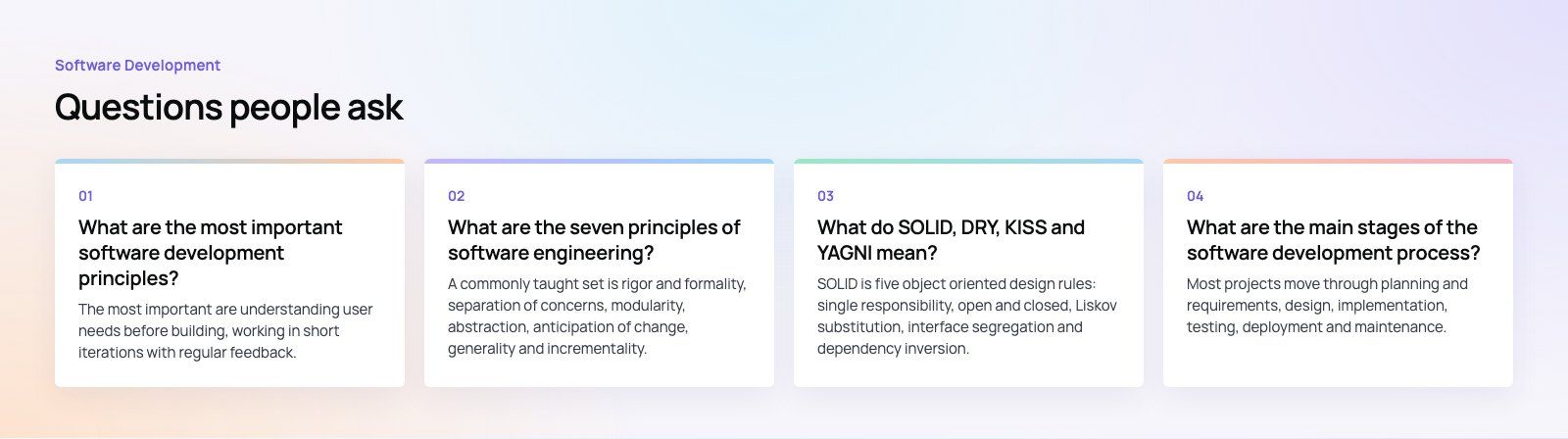
The most important are understanding user needs before building, working in short iterations with regular feedback, writing modular code that follows SOLID, DRY and KISS, automating testing and releases with CI/CD, reviewing code before it merges, and using version control for every change. Together they reduce rework and bugs, and they make software cheaper to change as requirements evolve over time.
Software DevelopmentAPI Integration for Saudi Business Websites: ERP, CRM and Payment GatewaysHow Saudi websites connect to ERP, CRM, payment gateways like mada and Tabby, ZATCA e-invoicing, logistics and WhatsApp through APIs. Software DevelopmentAI Workflow Automation for Case Management: Where AI Saves Case Teams Real TimeHow AI workflow automation fits into case management: practical uses, human review, data security and when to build a custom AI workflow.
 Software DevelopmentLaw Firm Client Portal, Legal CRM and Intake Software: Turning Inquiries into Signed ClientsTurn more legal inquiries into signed clients with intake software, a legal CRM and a secure client portal built around your firm.
Tell us what the business needs. We will tell you what to build first.
Schedule a free consultation and get a written recommendation, with costs, before you commit to anything.
Get in touchPROVEN RESULTS
4.7 / 5verified reviews on Google