 Software DevelopmentAPI Integration for Saudi Business Websites: ERP, CRM and Payment GatewaysHow Saudi websites connect to ERP, CRM, payment gateways like mada and Tabby, ZATCA e-invoicing, logistics and WhatsApp through APIs.
CodeeoInsightsSoftware Development
Software Development Team Structure: Which Model Works Best?
How to choose a software development team structure: generalist, specialist and hybrid teams, core and supporting roles, Agile vs traditional, remote vs co-located.
There is no single best software development team structure. Small, well defined projects usually work best with a compact generalist team, large and technically complex products need specialists, and most growing products end up with a hybrid: cross-functional teams built around a feature or product area, with specialists added where depth matters. The right choice depends on project size, complexity, delivery method and how your organization communicates.
This guide compares the main structures, explains the core and supporting roles, covers remote versus co-located teams, and gives a simple way to match a structure to your project.
Why team structure matters
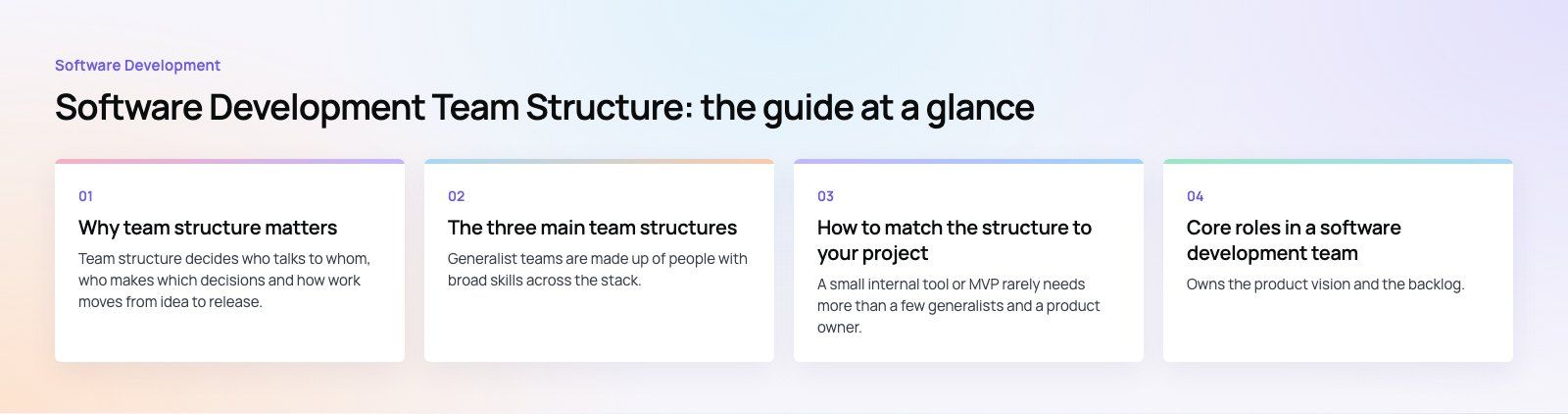
Team structure decides who talks to whom, who makes which decisions and how work moves from idea to release. A good structure keeps communication short, makes ownership clear and lets the team deliver steadily. A poor one creates handoff delays, duplicated work, unclear responsibility and, eventually, missed deadlines and budget overruns.
A common mistake is copying the structure of a large tech company, or keeping the same structure as a project grows. What works for a four person MVP team breaks at thirty people, and what works for a stable enterprise system can slow down a new product.
The three main team structures
Generalist teams
Generalist teams are made up of people with broad skills across the stack. A full-stack developer can build the interface, write the API, set up the database and handle basic testing and deployment.
- Strengths: fast decisions, few handoffs, easy to adapt when priorities change. Ideal for prototypes, MVPs and small, well defined projects.
- Weaknesses: limited depth in areas such as security, performance, complex UI or data engineering. Specialist problems may need outside help.
Specialist teams
Specialist teams bring together people with deep expertise in one area: front-end developers, back-end developers, mobile developers, UI and UX designers, QA engineers, DevOps engineers and data specialists.
- Strengths: high quality in each area, better handling of complex technical challenges, clear ownership of each layer.
- Weaknesses: more handoffs between groups, risk of silos where each group optimizes its own part, and slower iteration if coordination is weak.
Hybrid teams
Hybrid teams combine both approaches. Each team has people with broad core skills plus specialists for the areas the product depends on. For example, a team building a consumer app might include a product owner, two full-stack developers, an iOS developer, an Android developer, a designer and a QA engineer.
- Strengths: flexible enough for changing requirements, deep enough for complex work. Fits most Agile teams and medium to large products.
- Weaknesses: harder to staff well, and the balance of skills needs regular review as the product changes.
| Structure | Best for | Main risk |
|---|---|---|
| Generalist | MVPs, prototypes, small and clear projects | Lack of depth on complex problems |
| Specialist | Large, technically demanding systems | Silos and slow handoffs |
| Hybrid | Growing products and most Agile teams | Hard to staff and keep balanced |
How to match the structure to your project
Project size and complexity
A small internal tool or MVP rarely needs more than a few generalists and a product owner. A platform with web, mobile, payments, integrations and strict security needs specialists in each of those areas, usually organized into hybrid teams.
Delivery method: Agile or Waterfall
Agile methods, such as Scrum, rely on small cross-functional teams that can deliver working software every iteration. The Scrum Guide describes a Scrum team as small and cross-functional, with all the skills needed to create value each sprint. That points naturally to hybrid teams.
Waterfall projects move through fixed stages: requirements, design, build, test and release. Specialist groups for each stage can work well here, as long as the handoff documents are clear and complete.
Platforms involved
A cross-platform mobile app built with a shared codebase needs different skills from two native apps. A web product with heavy content needs CMS skills. List the platforms first, then the skills, then the roles.
Company culture and communication
Organizations with open, frequent communication can run lean generalist or hybrid teams. If departments are used to working separately, specialist teams with clearly defined interfaces and a strong project manager often work better at first.
Budget and timeline
Specialists cost more and take longer to hire, but fixing problems they would have prevented costs more again. A useful compromise is a core hybrid team with specialists brought in for set periods, such as a security review or a performance sprint.
Core roles in a software development team
Product owner
Owns the product vision and the backlog. Turns business goals into prioritized features and decides what the team builds next.
Project manager or delivery lead
Plans the work, manages timelines and resources, tracks progress and removes blockers. In Scrum, the Scrum Master focuses on the process and team health rather than managing tasks.
Software developers
Front-end developers build what users see and interact with. Back-end developers build the server, APIs, business logic and database. Mobile developers build iOS and Android apps. Full-stack developers cover more than one of these.
QA engineers
Test the software manually and through automated tests, find bugs before users do and help the team define what "done" means.
Supporting roles, depending on the project
- UI and UX designer: researches users and designs interfaces that are easy to use and consistent.
- DevOps engineer: builds and maintains deployment pipelines, environments, monitoring and infrastructure.
- Business analyst: translates business needs into clear requirements and acceptance criteria.
- Solution architect: designs the overall system so it can scale, perform and be maintained.
- Data engineer or analyst: builds data pipelines, reporting and analytics for data driven products.
- Security engineer: reviews code and infrastructure for vulnerabilities, especially for payments, health or personal data.
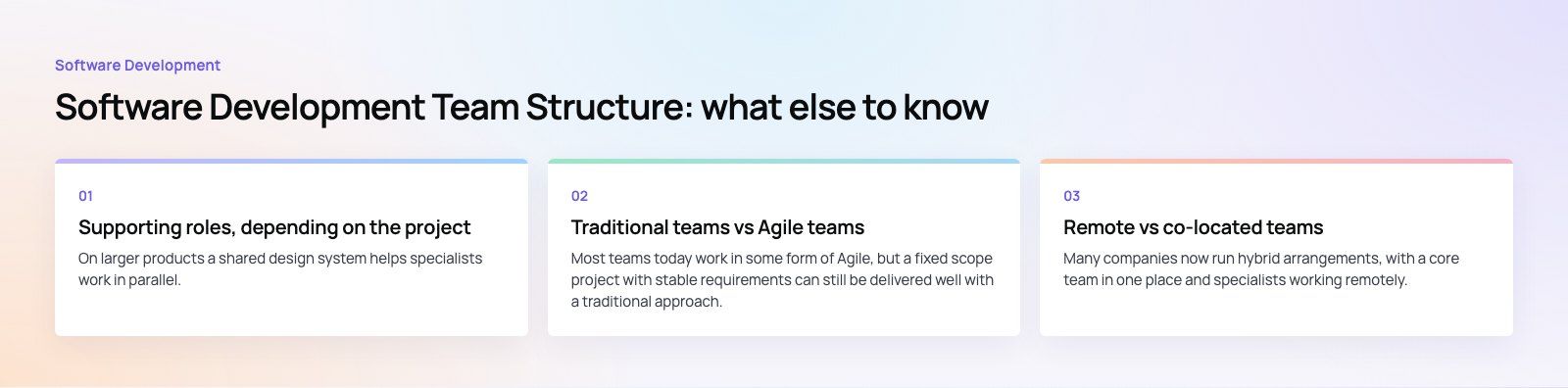
On larger products a shared design system helps specialists work in parallel. Our Distinct case study shows a healthcare workforce platform where one design system is shared by the web app and the admin.
Traditional teams vs Agile teams
| Aspect | Traditional team | Agile team |
|---|---|---|
| Structure | Separate groups for each stage | Cross-functional team owning a product area |
| Communication | Formal, mostly top down | Frequent and direct, with daily check ins |
| Handling change | Changes are costly and disruptive | Changes are expected and planned for |
| Planning | Detailed specification up front | Short iterations with regular feedback |
| Delivery | One large release at the end | Working software every iteration |
Most teams today work in some form of Agile, but a fixed scope project with stable requirements can still be delivered well with a traditional approach. The Agile Manifesto is a short read that explains the values behind the Agile side.
Remote vs co-located teams
Remote teams
- Pros: access to a wider talent pool, flexibility for team members, and the ability to cover more working hours.
- Cons: communication needs more structure, team culture takes more effort, and large time zone gaps can slow decisions.
Co-located teams
- Pros: faster informal communication, easier problem solving at a whiteboard and stronger team bonds.
- Cons: hiring limited to one location, office costs and less flexibility.
Many companies now run hybrid arrangements, with a core team in one place and specialists working remotely. What matters most is not location but clear goals, written decisions, overlapping working hours and agreed ways of working.
Common mistakes to avoid
- Starting a complex product with only generalists and adding specialists after problems appear.
- Splitting teams by technology layer when the product would be better served by teams owning features.
- Having no clear product owner, so priorities are set by whoever asks loudest.
- Treating QA as a final stage rather than part of every iteration.
- Growing a single team past the point where everyone can follow the conversation.
Building the right team for your project
If you are unsure what your project needs, a product scoping session helps define the platforms, roles and seniority before hiring. Codeeo has a team of 80+ across Dubai, Riyadh and Karachi, and you can add individual specialists or a full squad through our dedicated developers and team options, or hand over a complete build through custom software development.
Frequently asked questions
The best structure depends on project size and complexity, the delivery method you use, the platforms involved, your budget and timeline, and how your organization communicates.
Small, clear projects suit generalist teams. Large, technical systems need specialists. Most growing products work best with hybrid cross-functional teams that combine broad core skills with specialists in the areas the product depends on.
Software DevelopmentAPI Integration for Saudi Business Websites: ERP, CRM and Payment GatewaysHow Saudi websites connect to ERP, CRM, payment gateways like mada and Tabby, ZATCA e-invoicing, logistics and WhatsApp through APIs. Software DevelopmentAI Workflow Automation for Case Management: Where AI Saves Case Teams Real TimeHow AI workflow automation fits into case management: practical uses, human review, data security and when to build a custom AI workflow.
 Software DevelopmentLaw Firm Client Portal, Legal CRM and Intake Software: Turning Inquiries into Signed ClientsTurn more legal inquiries into signed clients with intake software, a legal CRM and a secure client portal built around your firm.
Tell us what the business needs. We will tell you what to build first.
Schedule a free consultation and get a written recommendation, with costs, before you commit to anything.
Get in touchPROVEN RESULTS
4.7 / 5verified reviews on Google