 Web DevelopmentWordPress vs Drupal: Which CMS Is Right for Your Business?WordPress vs Drupal compared on ease of use, content modeling, security, performance, ecommerce and cost drivers, with five questions to help you choose.
Web Development Outsourcing: Benefits, Risks and Best Practices
What you gain and what can go wrong when you outsource web development, how the models compare, and the steps that keep an outsourced project on track.
Web development outsourcing means handing the design, build, testing or upkeep of a website or web application to an outside team instead of hiring for it in house. It works well when you need skills you do not have, need to move faster than hiring allows, or only need a team for the length of a project. It goes wrong when scope, ownership, security and communication are left vague, so most of the work is in setting those up before a line of code is written.
This guide covers what you gain, what can go wrong, how the common engagement models compare, and the practical steps that keep an outsourced project on track.
What web development outsourcing covers
Outsourcing is not one thing. Some companies hand over an entire build, from discovery and design through launch. Others keep product ownership and design in house and bring in outside developers for a specific stack, such as a Next.js front end or a Laravel API. Many outsource the ongoing work after launch: updates, security patches, speed fixes and small features.
The work you might outsource usually falls into these buckets:
- Design: research, wireframes, interface design and a design system.
- Front end: the part users see and click, built in HTML, CSS and JavaScript frameworks.
- Back end: servers, databases, APIs and integrations with payment, CRM or ERP systems.
- Quality assurance: manual and automated testing across browsers and devices.
- Maintenance: hosting, monitoring, updates and fixes after launch.
Knowing which buckets you are handing over, and which you keep, is the first decision. It shapes the contract, the team you need and how you will measure the result.
The benefits of outsourcing web development
Access to skills you do not have
A modern website can touch a dozen specialties: interface design, accessibility, front end frameworks, API design, database tuning, search engine optimization, analytics and security. Few companies need all of these full time. An outside team lets you bring in the right people for the stages where they matter, then step back.
Speed to launch
Hiring takes time. Recruiting, onboarding and building a working rhythm inside a new team can delay a project before it starts. An established team that already works together can usually begin with discovery straight away, which shortens the time from idea to a live product.
Flexible capacity
Web projects are lumpy. A redesign needs several people for a few months, then very little. Outsourcing lets you scale the team up for a build and down for maintenance, without hiring and letting people go as the workload changes. A dedicated developer arrangement sits in the middle: an outside team that works only on your product for as long as you need it.
Predictable cost structure
Instead of salaries, equipment, software licenses and training, you pay for agreed scope or agreed time. That does not automatically make outsourcing cheaper. It does make the cost easier to plan, because you can tie spend to milestones and stop when the work is done.
Focus for your own team
When an outside team handles the build, your people can stay on the work only they can do: sales, operations, customer service and product decisions. The key word is focus, not absence. Someone inside your company still needs to own the product and make decisions quickly.
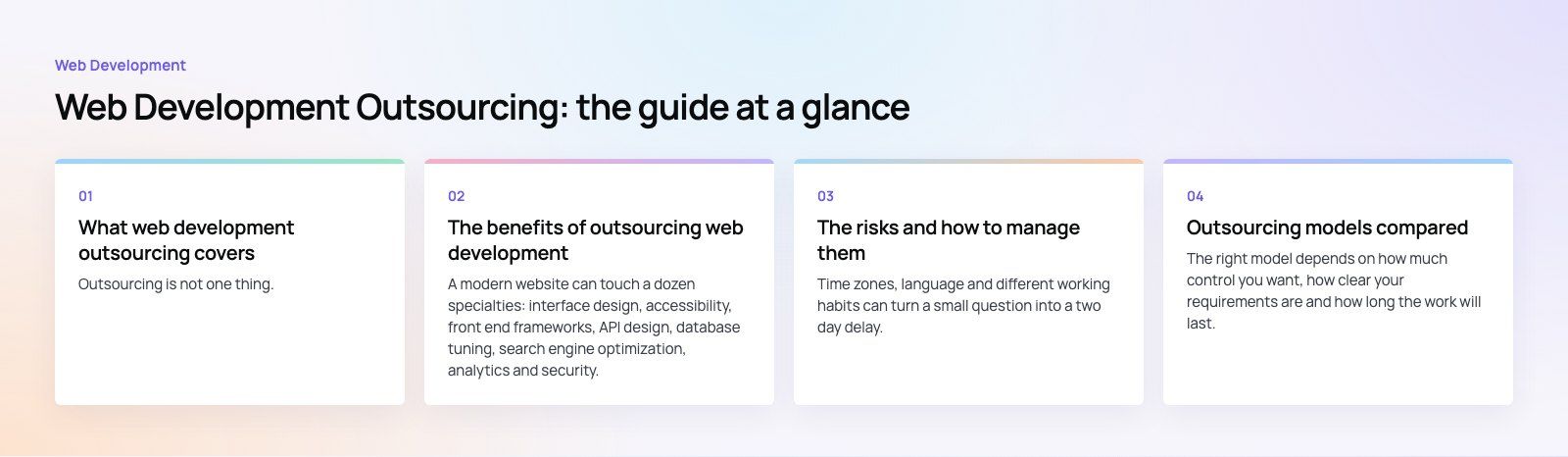
The risks and how to manage them
Communication gaps
Time zones, language and different working habits can turn a small question into a two day delay. The fix is structure: a named contact on each side, a fixed weekly review, a shared project board and written decisions. Agree on overlap hours when both teams are online, and on how quickly messages get answered.
Quality that is hard to see
You cannot judge code quality from a demo. A site can look finished and still be slow, hard to maintain or full of shortcuts. Ask for code in your own repository from day one, a definition of done for each task, automated tests for critical flows and a written handover at the end. If you lack the skills to review code, pay for an independent codebase review at a key milestone.
Data security and access
An outside team often needs access to servers, databases, analytics and sometimes customer data. Give each person their own account with the least access they need, use a password manager instead of shared logins, and remove access when someone leaves the project. Ask how the team handles secrets, backups and vulnerabilities. The OWASP Top 10 is a useful shared reference for the most common web application risks.
Intellectual property and legal compliance
The contract should state plainly that you own the code, designs and content created for you, and that the vendor will hand over all source files, credentials and documentation. If the site handles personal data, check which privacy laws apply. Sites that serve people in the European Union, for example, fall under the General Data Protection Regulation, and many other countries now have their own rules. A data processing agreement with your vendor is often required.
Scope creep
Most outsourcing disputes start with a requirement that one side thought was included and the other did not. A written scope with acceptance criteria, plus a simple change request process, removes most of that friction.
Vendor lock in
If only the vendor understands how your site works, you depend on them. Insist on standard, well documented technology, code in your own accounts and a handover document. That way another team, or your own hires, can take over later.
Outsourcing models compared
The right model depends on how much control you want, how clear your requirements are and how long the work will last.
| Model | How it works | Best for | Watch out for |
|---|---|---|---|
| Fixed scope project | The vendor delivers an agreed scope by agreed milestones | Well defined websites and redesigns | Change requests when requirements shift |
| Time and materials | You pay for hours worked against a prioritized backlog | Products where requirements evolve | Needs active product ownership on your side |
| Dedicated team | An outside team works only on your product, long term | Ongoing platforms and roadmaps | You manage priorities like an internal team |
| Staff augmentation | Individual developers join your existing team | Filling a specific skill gap | Your processes must already work |
| Onshore, nearshore or offshore | Location choice that sits on top of any model above | Balancing overlap hours, cost and talent | Time zone overlap and legal jurisdiction |
How to choose an outsourcing partner
Look at shipped work, not slides
Ask for live products similar to yours and look at them yourself. Check speed on a phone, how forms behave and whether the content is easy to update. Published case studies that explain the problem and the build are more useful than a logo wall.
Test how they think
Share a short brief and see what questions come back. A good team will ask about your users, your content, your integrations and how you will measure success. A team that quotes instantly without questions is guessing.
Check the process
Ask who will work on your project, how often you will see progress, how testing works and what happens after launch. Ask to see a sample status report or project board.
Start small
A paid discovery phase or a small first milestone tells you more than any proposal. A short product scoping exercise, for example, produces a scope you own and can take to any vendor.
Best practices that keep projects on track
- Write the requirements down. Goals, users, pages, features, integrations and what success looks like. Keep it short but specific.
- Agree on acceptance criteria. Each feature needs a clear test for when it is done.
- Own your accounts. Domain, hosting, repository, analytics and third party services should be in your name.
- Set a rhythm. A weekly demo of working software beats a long status email.
- Review early. Look at designs and the first working pages before the full build, when changes are cheap.
- Plan the handover. Documentation, credentials and a walkthrough recorded on video.
- Agree on support. Response times, who fixes what after launch and how small changes are requested.
Common mistakes to avoid
- Choosing on the lowest quote alone, then paying for rework later.
- Having no single decision maker on your side, so feedback conflicts.
- Leaving content until the end, which delays launch more than any technical issue.
- Skipping testing on real devices and real network speeds.
- Letting the vendor register the domain or hosting in its own name.
Working with Codeeo
Codeeo has a team of 80+ across Dubai, Riyadh and Karachi and has delivered 200+ projects across the UAE and the US. If you are weighing up whether to outsource a website or web application, our web development service is a good place to start the conversation. The checklist above applies whoever you hire.
Frequently asked questions
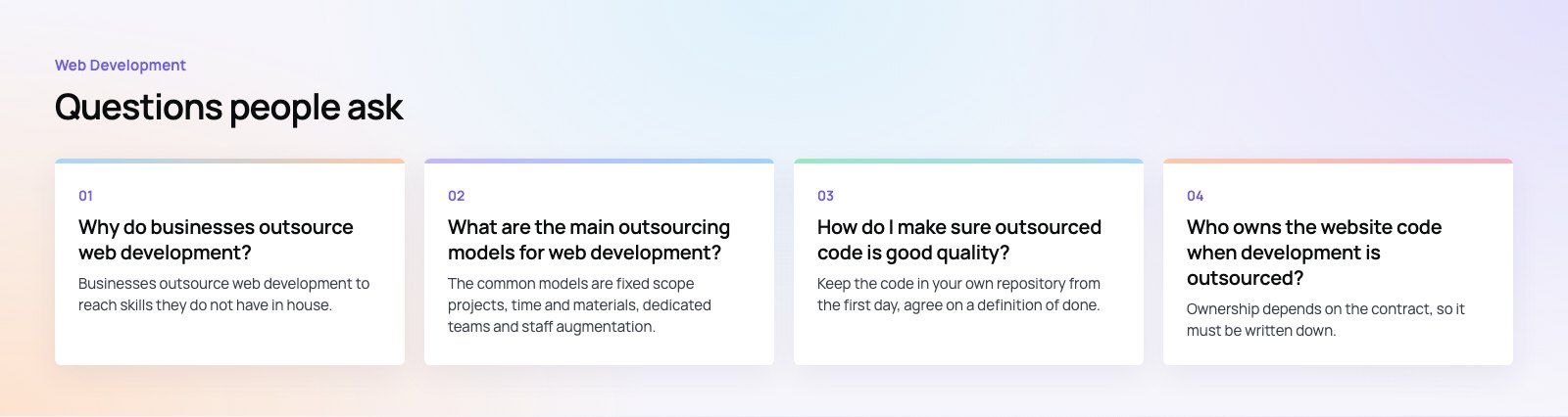
Businesses outsource web development to reach skills they do not have in house, to launch faster than hiring would allow and to match team size to the workload.
It also lets internal staff focus on sales, operations and product decisions. The benefit depends on a clear scope, a named owner on the client side and a vendor whose process you have checked before signing.
Web DevelopmentWordPress vs Drupal: Which CMS Is Right for Your Business?WordPress vs Drupal compared on ease of use, content modeling, security, performance, ecommerce and cost drivers, with five questions to help you choose. Web DevelopmentCustom Website Development vs Website Builders: Pros and ConsAn honest comparison of custom website development and website builders: control, cost over time, SEO, integrations, and how to decide which fits your business.
 Web DevelopmentWeb Development Consultant: What They Do and When to Hire OneWhat a web development consultant does, how the role differs from a developer or agency, when hiring one pays off and how to choose the right one.
Tell us what the business needs. We will tell you what to build first.
Schedule a free consultation and get a written recommendation, with costs, before you commit to anything.
Get in touchPROVEN RESULTS
4.7 / 5verified reviews on Google