 Software DevelopmentAPI Integration for Saudi Business Websites: ERP, CRM and Payment GatewaysHow Saudi websites connect to ERP, CRM, payment gateways like mada and Tabby, ZATCA e-invoicing, logistics and WhatsApp through APIs.
CodeeoInsightsSoftware Development
White Label Software Development: How It Works, Pros and Cons
What white label software development is, how the reseller model works, where it is used, its benefits and risks, and how it compares to custom software.
White label software development is when one company builds a software product and another company sells it under its own brand. The reseller adds its name, logo and colors, often adjusts features or settings, and presents the product to its customers as its own, while the original developer stays in the background. It lets a business offer software quickly without building it from scratch, in exchange for less control over the core product.
This guide explains how white label software works, where it is used, the real benefits and risks, how it compares to custom development, and what to check before signing an agreement.
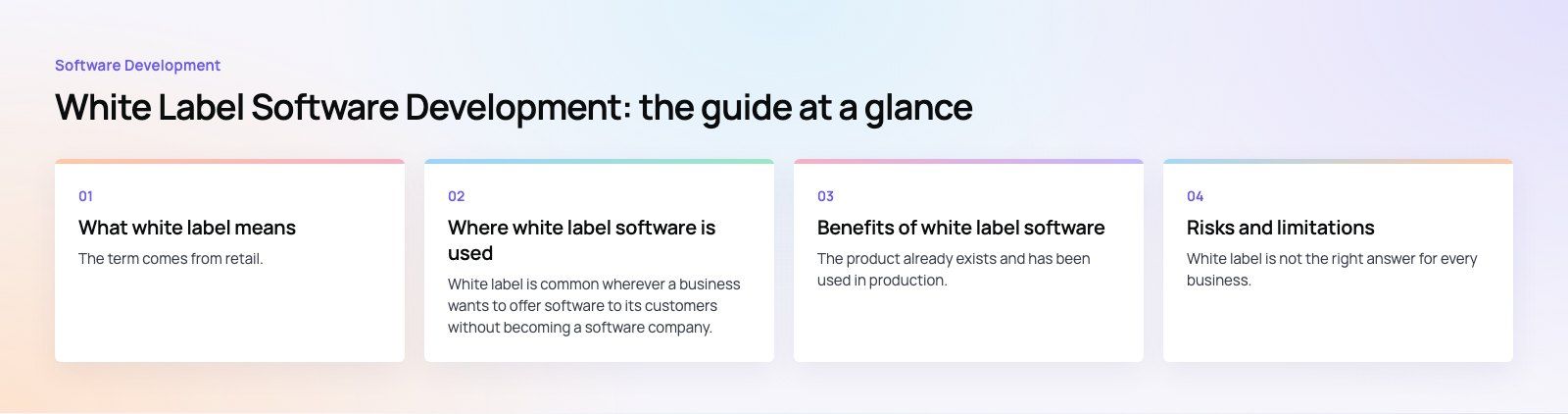
What white label means
The term comes from retail. A manufacturer produces a product, and a supermarket sells it under its own label. The shopper sees the store brand, not the factory.
Software works the same way. A developer builds a platform, such as an email marketing tool, a booking system or a mobile app framework, and licenses it to other companies. Each reseller rebrands it and sells it to its own clients. Customers deal with the reseller for sales, onboarding and usually first line support.
It is worth separating two related ideas:
- White label products. A ready made platform licensed to many resellers, each with its own branding. Common with SaaS tools.
- White label development services. An agency or software company builds custom projects for another agency, which delivers them to its clients under its own name. The end client never sees the builder.
Both rely on the same principle: the brand that sells is not the team that builds.
How the white label model works
- The developer builds and maintains the product. It owns the codebase, hosting setup and roadmap.
- The reseller licenses it. Usually on a subscription or per client basis, with rights to rebrand and resell.
- The reseller customizes it. Branding, domain, email templates, and sometimes features or integrations.
- The reseller sells and supports. It sets its own pricing to customers and handles the relationship.
- The developer handles the core. Updates, security fixes, infrastructure and second line support.
Where white label software is used
White label is common wherever a business wants to offer software to its customers without becoming a software company.
- Marketing agencies resell rebranded SEO reporting, social media scheduling, email marketing and website builder tools.
- Financial services use white label payment gateways, digital wallets and investment platforms.
- Telecoms and internet providers bundle rebranded security, backup and communication tools.
- Healthcare and wellness businesses offer branded booking, telehealth and patient apps.
- Ecommerce and delivery companies launch branded marketplace, ordering and delivery apps on existing platforms.
- Training and education providers run learning platforms under their own name.
- Internal tools such as rebranded intranets, chat and collaboration software that match the company's identity.
Benefits of white label software
Faster time to market
The product already exists and has been used in production. A reseller can launch in weeks rather than months, which matters when a competitor is moving first or a client needs a solution now.
Lower upfront investment
There is no need to fund a full development team, design work and testing before earning anything. Costs are spread over the license, and the reseller sets its own margin.
Proven, tested software
A mature white label product has been used by many customers, so common bugs are usually found and fixed already. That reduces the risk compared with launching something new.
Focus on your strengths
An agency can stay focused on marketing, sales or consulting, and a service business can stay focused on its customers, while the software experts maintain the product.
Wider service range
Adding a branded product can increase revenue per client and keep clients from looking elsewhere for the same service.
Brand consistency
Customers see one brand from first contact to daily use, which builds trust and recognition.
Risks and limitations
White label is not the right answer for every business. These are the trade offs to weigh honestly.
- Limited control. The developer owns the roadmap. If you need a feature it does not plan to build, you may wait or go without.
- Little differentiation. Competitors can license the same product. Your edge has to come from service, pricing or packaging.
- Vendor dependence. If the developer raises prices, changes terms, gets acquired or shuts down, your product is affected.
- Support layers. Your customers contact you, but you may depend on the developer to fix the problem. Slow responses reflect on your brand.
- Data and compliance. You remain responsible to your customers for how their data is handled, even though someone else hosts it.
- Exit costs. Moving customers off a white label platform later can be difficult if data export is limited.
White label vs custom software development
| Factor | White label software | Custom software |
|---|---|---|
| Time to launch | Fast, product already exists | Slower, built from scratch |
| Upfront cost | Lower, paid through licensing | Higher, paid for development |
| Control of features | Limited to what the vendor offers | Full control over the roadmap |
| Ownership of code | Stays with the developer | Usually transferred to you |
| Differentiation | Low, others can sell the same product | High, built around your process |
| Best for | Standard needs, fast entry, testing a market | Core products, unique workflows, long term value |
Many businesses start with white label to test demand, then move to custom software development once the product becomes central to the business and the limits start to hurt.
How to choose a white label software partner
Check the product, not the pitch
Ask for a full demo account, not a sales presentation. Use it as your customers would. Check performance, mobile behavior and how complete the branding options are.
Read the license terms carefully
Look at what you can rebrand, whether you can set your own pricing, any limits on clients or users, and what happens if either side ends the agreement.
Ask about data ownership and export
Your customers' data should be exportable in a usable format. Ask where it is hosted, who can access it and how backups work.
Understand support and updates
Agree response times for issues you escalate, how updates are announced, and whether updates can break your customizations.
Check security and compliance
Ask how the vendor handles security testing, access control and incident response, and whether it meets the data protection rules that apply to your customers. A recognized framework such as ISO/IEC 27001 gives you a common checklist for those questions, even if the vendor is not formally certified.
Plan for integrations
Most white label products need to connect to a CRM, payment system or accounting software. Confirm there is a documented API.
When white label development services make sense
For agencies, the service version of white label is often more useful than a licensed product. An agency that sells websites, apps or integrations can work with a development team that builds under the agency's name, scaling delivery without hiring a full team for every skill. The keys are clear briefs, agreed standards for code and documentation, and a shared way of tracking work so the agency can answer client questions confidently.
If you run an agency and want to add delivery capacity this way, our partnership page explains how to work with us, and our dedicated developers and team options cover longer engagements. For a first conversation about a white label or custom build, you can contact our team. Codeeo has delivered 200+ projects across the UAE and the US with a team of 80+ across Dubai, Riyadh and Karachi.
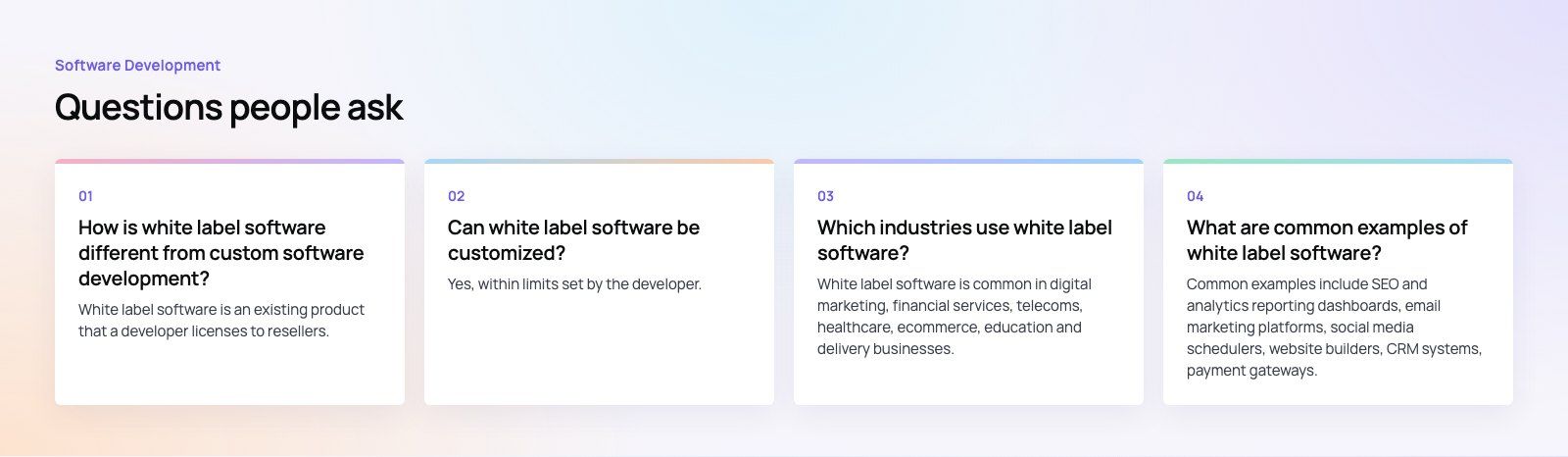
Frequently asked questions
White label software is an existing product that a developer licenses to resellers, who rebrand it and sell it as their own.
Custom software is built from scratch for one organization's needs, and the code is usually owned by that client. White label is faster and cheaper to start, while custom development offers full control, ownership and a product competitors cannot simply license too.
Software DevelopmentAPI Integration for Saudi Business Websites: ERP, CRM and Payment GatewaysHow Saudi websites connect to ERP, CRM, payment gateways like mada and Tabby, ZATCA e-invoicing, logistics and WhatsApp through APIs. Software DevelopmentAI Workflow Automation for Case Management: Where AI Saves Case Teams Real TimeHow AI workflow automation fits into case management: practical uses, human review, data security and when to build a custom AI workflow.
 Software DevelopmentLaw Firm Client Portal, Legal CRM and Intake Software: Turning Inquiries into Signed ClientsTurn more legal inquiries into signed clients with intake software, a legal CRM and a secure client portal built around your firm.
Tell us what the business needs. We will tell you what to build first.
Schedule a free consultation and get a written recommendation, with costs, before you commit to anything.
Get in touchPROVEN RESULTS
4.7 / 5verified reviews on Google