 SEOSEO Rank Tracking Tools for Saudi Arabia: What to Track and HowHow to track Google rankings in Saudi Arabia: by city, Arabic and English keywords, mobile, local pack, AI Overviews and Search Console.
AI SEO Strategies for Saudi Brands: Practical Workflows
Practical AI SEO workflows for Saudi brands: Arabic and English keyword research, content planning, technical SEO and AI search visibility.

AI SEO for Saudi brands works best as a set of practical workflows: using AI tools to speed up Arabic and English keyword research, content planning and technical checks, while making sure your pages are clear and structured enough to be cited in AI Overviews and answer engines. The tools save time on research and drafts. People still own strategy, Arabic quality, facts and final judgement.
Search in the Kingdom is changing quickly. Customers in Riyadh, Jeddah and Dammam still search on Google, but they also ask chat assistants for recommendations and read AI generated summaries at the top of results. That does not make traditional SEO obsolete. It raises the bar on clarity, structure and trust. This guide sets out workflows marketing teams can actually run, and the mistakes to avoid.
What AI SEO really means in practice
The phrase covers two different ideas, and it helps to separate them.
- Using AI to do SEO. Language models and AI features inside SEO tools help with keyword clustering, outlines, metadata, schema drafts, log analysis and content audits.
- Optimising for AI search. Making your content easy for AI Overviews, chat assistants and answer engines to understand, trust and cite. This is often called answer engine optimisation (AEO) or generative engine optimisation (GEO).
Both matter. The first makes your team faster. The second decides whether your brand appears when someone asks an assistant which clinic, developer or supplier to choose. Neither replaces the fundamentals of SEO Saudi Arabia businesses have always needed: a fast, crawlable site, useful content and a credible brand.
Workflow one: AI assisted keyword research in Arabic and English
Arabic SEO is where AI tools help most and also where they fail most visibly. Saudi users search in Modern Standard Arabic, in Saudi dialect, in English, and in transliterated Arabic written in Latin letters. A single service can have a dozen ways of being searched.
A workflow that holds up
- Start with seed terms from your sales team, call logs, WhatsApp enquiries and site search, not from the AI tool.
- Ask an AI model to expand each seed into Arabic variants: formal, dialect, plural forms, common misspellings and transliterations.
- Validate every suggestion against real search volume and live results in a keyword tool and on Google itself.
- Use AI to cluster the validated list by intent: informational, commercial, local and transactional.
- Have a native Arabic speaker review the clusters and remove terms that are technically correct but nobody uses.
The validation step is not optional. Models will confidently suggest phrases with no search demand or slightly unnatural Arabic. For a deeper method, see our Arabic SEO keyword research guide.
Where AI saves time
| Task | AI is useful for | Humans must check |
|---|---|---|
| Keyword expansion | Generating variants, dialect forms and transliterations | Whether people actually search them |
| Intent clustering | Grouping hundreds of terms quickly | Whether clusters match how your buyers think |
| Content briefs | Draft outlines and question lists | Accuracy, angle and local relevance |
| Metadata | First drafts of titles and descriptions in two languages | Tone, length and natural Arabic |
| Schema | Drafting structured data from page content | Validity and match with visible content |
| Audits | Summarising crawl exports and spotting patterns | Priority and business impact |
Workflow two: content planning that answers real questions
AI search systems tend to pull from pages that answer a question directly, define terms clearly and show evidence of real expertise. That favours the same content good SEO has always rewarded, but it punishes vague, padded pages more harshly.
Build topic clusters around buyer questions
Group content around a core service page and supporting articles that each answer one important question. A Riyadh clinic, for example, might have a service page for a treatment, with supporting pages on preparation, recovery, suitability and what to ask at a consultation. Each page links to the others, and the service page links back.
Write for extraction
- Open each section with a direct answer in two or three sentences, then expand.
- Use clear headings phrased the way people ask questions.
- Use lists and tables for steps, comparisons and specifications.
- Define technical terms on first use.
- Keep one main idea per paragraph.
This structure helps human readers scanning on a phone, helps traditional search snippets, and makes it easier for generative engine optimisation efforts to succeed because the answer is easy to lift and attribute.
Use AI drafts as a starting point only
AI can produce a reasonable first draft of a supporting article. It cannot add your experience, your local knowledge or your proof. Before anything is published, a subject expert should add specifics: how your team actually handles a process, what questions customers really ask, what is different in the Saudi market. Google's guidance on helpful content, available in its Search documentation, focuses on whether content is made for people and shows experience, regardless of how it was produced.
Workflow three: technical SEO with AI help
Technical foundations decide whether search engines and AI crawlers can reach and understand your content at all. AI tools are good assistants here, provided someone who understands the site makes the decisions.
Useful AI assisted technical tasks
- Summarising large crawl exports into a ranked list of issues.
- Explaining server log patterns, such as which sections crawlers visit least.
- Drafting redirect maps during a migration, for a developer to verify.
- Writing regular expressions for analytics filters or crawl rules.
- Checking hreflang patterns between Arabic and English pages for consistency.
Fundamentals that still matter most
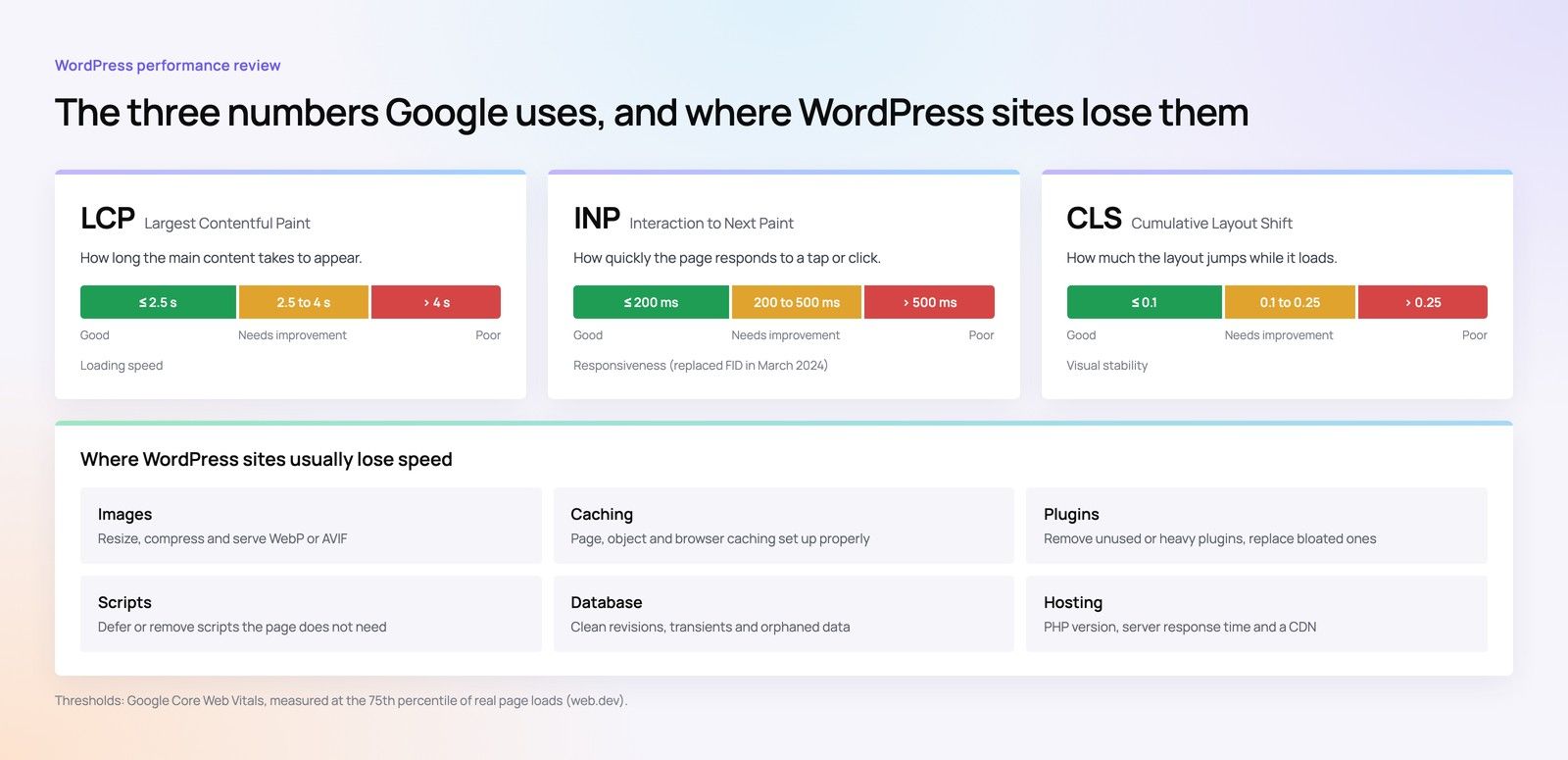
Fast pages, especially on mobile, remain essential. Arabic sites often lose speed through heavy web fonts, large hero images and too many third party scripts. Our Core Web Vitals service focuses on exactly these problems. Bilingual sites also need correct hreflang, separate URLs for each language, and RTL layouts that render properly; our guide to Arabic and English website governance covers how to keep both versions aligned. A technical SEO review is a sensible way to find the gaps before investing in more content.
It is also worth checking your robots rules. Some sites block AI crawlers by default through hosting or security settings without the marketing team knowing. Whether to allow them is a business decision, but it should be a deliberate one.
Workflow four: optimising for AI Overviews and answer engines
AI search optimisation is less about tricks and more about being the clearest, most credible source on a topic. A few practical steps help.
Strengthen entity signals
AI systems need to understand who you are. Keep your business name, address, phone number and service descriptions consistent across your website, Google Business Profile, social profiles and directories. An About page that clearly states what the company does, where it operates and who leads it helps. For businesses with physical locations, local SEO work on profiles and reviews supports this directly.
Use structured data carefully
Schema markup helps search engines read your content. Organisation, LocalBusiness, Service, Product, Article, BreadcrumbList and FAQ types are common starting points. AI tools can draft JSON LD quickly, but every property must reflect what is visible on the page, and the markup must validate. Schema that describes content not on the page can do more harm than good.
Earn mentions, not just links
Answer engines appear to draw on a wide range of sources. Being mentioned in credible Saudi publications, industry associations, event listings and partner sites helps establish your brand as an entity worth citing. This is slow, steady work and cannot be automated well.
Track what you can
Measurement for AI search is still immature. Watch branded search trends, referrals from AI assistants in analytics where they appear, and manual checks of how assistants describe your brand for key questions. Record these checks over time rather than reacting to single results.
Where humans stay essential
AI tools change the speed of SEO work, not the need for judgement. In a Saudi context, several areas need experienced people.
- Arabic quality. Natural, culturally appropriate Arabic still needs native writers and editors.
- Strategy. Deciding which markets, services and cities to prioritise is a business decision.
- Facts and claims. Regulatory points, prices and service details must be checked by someone accountable.
- Brand voice. Consistent tone across Arabic and English needs editorial ownership.
- Relationships. Earning mentions and partnerships depends on people.
Common AI SEO mistakes
- Publishing large volumes of lightly edited AI articles that add nothing new.
- Machine translating English pages into Arabic without native review.
- Targeting keyword variants the AI suggested without checking real demand.
- Adding schema that does not match the visible page.
- Ignoring site speed and mobile experience while focusing on content volume.
- Blocking or allowing AI crawlers by accident rather than by decision.
- Treating one chat assistant answer as proof of ranking or of failure.
A starter checklist for Saudi marketing teams
- Collect seed keywords from sales, support and WhatsApp conversations.
- Expand them in Arabic and English with AI, then validate with real data.
- Cluster by intent and map each cluster to one page.
- Rewrite key pages so each section opens with a direct answer.
- Have native editors review every Arabic page.
- Fix speed, hreflang and RTL rendering issues.
- Add and validate structured data that matches visible content.
- Align business details across every profile and directory.
- Decide your policy on AI crawlers and check robots rules match it.
- Review results monthly and adjust.
How Codeeo helps Saudi businesses with AI SEO
Codeeo is a web, app, software, AI and marketing company. Our team of 80+ people across Dubai, Riyadh and Karachi has delivered 200+ projects across the UAE and the US, and we are rated 4.7 from 23 Google reviews. Riyadh clients can meet us at our office there; clients elsewhere in the Kingdom work with us over video calls.
We combine technical SEO, bilingual content and development in one team, which matters when ranking problems sit in the code rather than the copy. We use AI tools where they speed up research and audits, and keep people in charge of strategy, Arabic quality and facts. Read more in our guide to SEO services in Saudi Arabia, or see how SEO fits into wider digital marketing.
To discuss a practical search plan for your brand, get in touch with Codeeo.
Frequently asked questions
Google's published guidance focuses on whether content is helpful, original and made for people, not on how it was produced.
Problems arise when AI is used to publish large volumes of thin, generic pages. Using AI for research, outlines and first drafts is reasonable if experts then add real experience, check facts and edit the result before publishing.
SEOSEO Rank Tracking Tools for Saudi Arabia: What to Track and HowHow to track Google rankings in Saudi Arabia: by city, Arabic and English keywords, mobile, local pack, AI Overviews and Search Console. SEOAI SEO Tools for Saudi Businesses: What Each Type Is Good ForThe main types of AI SEO tools, what each is good for, why Arabic support matters for Saudi businesses, and where human review is still needed.
 SEOHow to Add AEO and GEO to Your Existing SEO StrategyAnswer engine and generative engine optimisation explained: question led content, structured data, entities, citations and AI visibility.
Tell us what the business needs. We will tell you what to build first.
Schedule a free consultation and get a written recommendation, with costs, before you commit to anything.
Get in touchPROVEN RESULTS
4.7 / 5verified reviews on Google