 InsightsCybersecurity Best Practices for Engineering Teams: A Defense-in-Depth ApproachDefense-in-depth security architecture for engineering teams: zero-trust design, MFA, encryption, incident response, and compliance. Built on OWASP top 10 and industry benchmarks.
How to Become a Technology Services Reseller in Saudi Arabia
What a Saudi company needs to resell web, app and software services: registration, 15% VAT, Fatoora e-invoicing, Etimad tenders and how to apply to Codeeo.
To become a technology services reseller in Saudi Arabia, you need a company that can legally sell and invoice IT services in the Kingdom, a VAT registration with compliant e-invoicing, and a delivery partner who will scope, build and support the work while you hold the client and the contract. If you already sell into Riyadh, Jeddah or the Eastern Province and keep turning away web, app or software requests, you can apply to Codeeo's reseller programme and start carrying those lines under one agreement.
What reselling technology services means in Saudi Arabia
Reselling software licences is familiar in the Saudi market. Distributors and value added resellers have sold Microsoft, Oracle, SAP and security products for years. Reselling services is different. You are not passing on a product with a fixed specification. You are selling a website, a mobile app, an ERP rollout or a marketing retainer that someone has to scope, design, build, test, host and support.
So the services reseller model rests on two questions: who holds the contract, and who does the engineering. You sign with the client, invoice the client and own the renewal conversation. Your delivery partner contracts with you and does the technical work behind your name.
Saudi procurement teams want a local counterparty with a verifiable commercial registration and an Arabic invoice. A reseller gives them that, while the engineering bench sits with the partner.
Who typically resells services in the Kingdom
- System integrators running infrastructure and security programmes who are asked for a customer portal or internal app on the same contract.
- IT distributors and value added resellers with deep account lists who want a services line beyond licences and hardware.
- Microsoft and ERP partners implementing Dynamics 365 or Odoo who keep being asked for the website, store or app on top.
- Marketing agencies in Riyadh and Jeddah whose clients want the website rebuilt before the campaign starts.
What they share is a sales team and a client base, but not an engineering bench for every request that comes in.
The legal groundwork: commercial registration and the MISA route
Before you can sign and invoice a Saudi client, your company needs a legal presence that allows it to trade. The route depends on who owns the company.
Saudi owned companies
A Saudi owned company selling IT services registers with the Ministry of Commerce and obtains a commercial registration, the record that buyers and government portals check. The Commercial Register Law approved in 2024 changed several things that matter to a reseller. According to the Ministry of Commerce summary of the new law, a single commercial registration now covers all activities across the Kingdom, subsidiary and city based registrations fall away, and the expiry date has been replaced by an annual confirmation of the registration data. A registration that stays suspended for one year is cancelled.
Foreign owned companies
A foreign owned company goes through the Ministry of Investment first. Under the updated Investment Law, MISA replaced the old licensing procedure with registration. The Updated Investment Law page on the MISA site sets out that a foreign investor registers with the Ministry before engaging in any investment, and once MISA confirms the registration, the investor can obtain a commercial registration and the other licences the business needs. The same law states that local and foreign investors are treated equally in similar circumstances.
Requirements depend on the activity code you choose, so confirm them with MISA or a licensed adviser before you commit.
VAT and ZATCA e-invoicing for resellers
Tax is where a services reseller has to be most careful, because you sit between two invoices: the one you issue to your client and the one you receive from your delivery partner.
The VAT rate
The standard VAT rate in the Kingdom is 15%, administered by the Zakat, Tax and Customs Authority (ZATCA). The rate rose from 5% with effect from 1 July 2020. ZATCA's guideline on tax invoicing and records describes how persons subject to VAT add 15% to taxable supplies, account for it separately from revenue and remit it to ZATCA, while recovering VAT on their own purchases as input tax.
Quote your client clearly as exclusive or inclusive of VAT, and work out your margin on net figures. How VAT applies to the invoice you receive from your partner depends on which entity issues it and from where, so settle that with your tax adviser when the agreement is drafted.
Arabic on every tax invoice
The same guideline quotes the VAT Implementing Regulations: records must be kept in Arabic and all invoices must be issued in Arabic, in addition to any other language. Every field of the tax invoice must be completed in Arabic, and where the Arabic and another language differ, the Arabic is the approved version. A bilingual Arabic and English invoice is normal for B2B work. An English only invoice will not do.
Fatoora: the two e-invoicing phases
ZATCA's e-invoicing programme, known as Fatoora, replaces paper invoices with structured electronic documents. The ZATCA e-invoicing introduction sets out two phases:
- Phase one, the generation phase, took effect on 4 December 2021. Resident taxpayers must issue invoices, credit notes and debit notes through a compliant electronic solution, with the additional fields the rules require.
- Phase two, the integration phase, began on 1 January 2023 and is rolled out in waves of taxpayers. The invoicing solution must integrate with ZATCA's systems and produce e-invoices in the required format. ZATCA notifies taxpayers of their wave in advance.
Your accounting system must produce compliant e-invoices before you sign your first services deal.
Selling to government and semi government buyers
Government entities and the large semi government companies around Vision 2030 programmes are among the most valuable accounts in the Kingdom. They also buy differently from private enterprises.
Etimad and the tender process
Government procurement is governed by the Government Tenders and Procurement Law issued by Royal Decree M/128 in 2019. The law defines a single electronic portal for government procurement under the Ministry of Finance's supervision, and in practice that is the Etimad platform. The Etimad user guide for browsing competitions explains that suppliers subscribe to the competitions service, then view available competitions, receive invitations, buy tender documents and submit bids electronically.
The practical sequence for a reseller is a valid commercial registration, an Etimad business account, the annual subscription, then the habit of watching for competitions in your categories. Your delivery partner can help with the technical proposal, but the bid goes in under your company.
Local content and SME preference
Article 9 of the Government Tenders and Procurement Law gives priority to local small and medium sized enterprises, to local content and to companies listed on the Capital Market, with the method set by regulation. In 2026 the Ministry of Finance announced Cabinet approval of a new tenders law that, in the ministry's words, strengthens industrial localisation and knowledge transfer, so read the current text and each competition's documents rather than an old summary.
Arabic in government contracts
Article 55 of the same law requires government contracts, their annexes and related documents to be drafted in Arabic. Another language may be used alongside it, but Arabic governs interpretation, execution, specifications and correspondence. Private buyers are more flexible, yet most enterprises in the Kingdom still expect an Arabic version of the proposal and contract. Budget time for translation and legal review in every bid.
Who buys and how they buy
Buying behaviour in the Kingdom shifts between regions and types of buyer.
Riyadh enterprises and semi government entities
Riyadh concentrates head offices, ministries, regulators and the companies attached to national programmes. Buying is formal: vendor registration, prequalification, a written technical proposal, then a commercial round. Relationships open the door rather than close the deal. Expect several stakeholders and a procurement function that checks your registration.
Jeddah and the Western Region
Jeddah has a deep base of family groups, retail, hospitality and logistics companies. Decisions often sit close to the owner. A strong reference and a working demo carry more weight than a long document, and Arabic first design for consumer work is expected.
The Eastern Province
Dammam, Khobar and Jubail are shaped by energy, petrochemicals and industrial services. Buyers think about contractor management, documentation and integration with existing systems. Portals, field apps and ERP extensions are common requests, often through integrators already on site.
Fast growing SMEs
Saudi SMEs in retail, food, health and education want bilingual websites, ecommerce with local payment options and booking apps, delivered in weeks. They buy on trust and speed, and often prefer one local supplier for website, app and marketing together.
How the Codeeo reseller model works
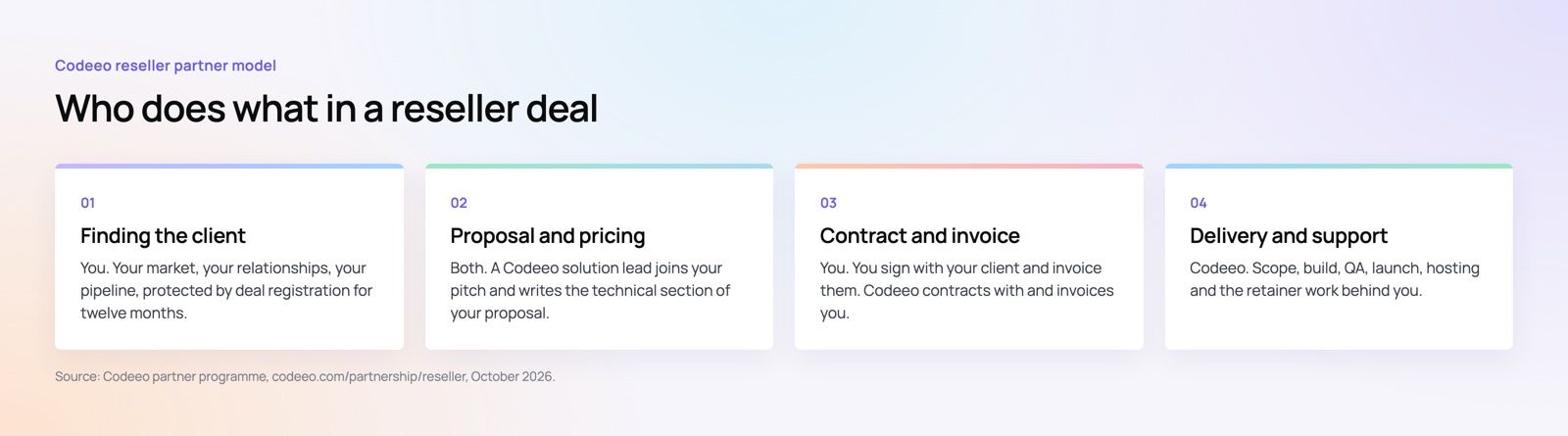
Codeeo runs four partner models: reseller, white label delivery, referral and product partner, all compared on the partnership overview. In the reseller model you take Codeeo's services into your market under a reseller agreement. You own the client and the contract. Codeeo prices, scopes and delivers behind you.
One agreement covers the full catalogue: websites, apps, custom software, Dynamics 365, Odoo, design, developers and marketing. For a Saudi integrator or ERP partner, the portal, the app and the ERP extension can sit in one commercial relationship instead of three subcontracts.
What you keep
- The client relationship and the renewal conversation.
- The contract and the invoice to your client.
- Your own price on top of the agreed margin.
- The pitch, with Codeeo's solution lead beside you.
What Codeeo does
- Scope and estimate within two business days.
- Architecture, build, QA and launch.
- Hosting, support and retainer work behind you.
- Deal registration and a quarterly review.
Codeeo contracts with you, not your client, unless you ask Codeeo to contract directly. You invoice your client, and Codeeo invoices you in the currency and from the entity agreed in your contract.
Local delivery from Riyadh
Codeeo has a team of 80+ across Dubai, Riyadh and Karachi, has delivered 200+ projects across the UAE and the US, and is rated 4.7 from 23 Google reviews. For Saudi resellers, the Riyadh team means workshops and acceptance sessions can happen in person, in the client's working week. The Middle East territory is served by teams in Dubai and Riyadh for Gulf enterprises, with Dynamics 365, web and app builds as the core lines.
Presales support
Saudi enterprise bids are won or lost on the technical proposal. A Codeeo solution lead joins your pitch, sizes the work and writes the technical section of your proposal. Standard scopes come back within two business days. Anything needing architecture work gets a call with the solution lead first.
Deal registration
Register an opportunity and it is yours for twelve months, with no second Codeeo route into the same account. If two partners bring the same account, the first valid registration on a named opportunity holds for twelve months.
Margins and terms
Codeeo does not publish margins. Rates are set per territory and per service line in your agreement and improve as registered volume grows. There is no minimum volume, no quota and no certification gate, and nothing is withheld at the start. Your territory sets your default terms but does not fence you in: register an out of territory deal and Codeeo will look at it.
Reseller, white label or referral: which fits a Saudi company
The right model depends on two things: do you want to hold the contract, and how much client contact do you want to carry?
| Question | Reseller | White label delivery | Referral |
|---|---|---|---|
| Who signs with the client | You | You | Codeeo |
| Who invoices the client | You, with Arabic tax invoices under your VAT registration | You | Codeeo |
| Whose brand the client sees | Yours, with Codeeo's solution lead in the pitch | Yours only | Codeeo's |
| Who owns renewals | You | You | Codeeo |
| Best suited to | Integrators, distributors and ERP partners with a sales team | Agencies that want to deliver under their own name | Advisers who want to introduce, not sell |
If you want Codeeo to stay invisible and deliver purely under your name, read about white label delivery. If you would rather introduce clients and step back, the referral programme is the lighter option.
What Saudi clients will ask you
Can you deliver right to left, Arabic first work?
Arabic layouts are not a translation layer added at the end. Navigation, forms, typography and content structure all change. Codeeo's Diyafah case study shows a bilingual school website on Strapi built right to left from the start, with 399+ conversions recorded since launch.
Can you handle listed company content?
Listed companies, and the semi government entities around them, treat their website as a disclosure channel. The Modon Holding case study explains why a listed company website is a disclosure surface rather than a brochure, with governance documents, board changes and financial reporting all needing to publish reliably.
Applying to Codeeo's reseller programme
The process has four steps.
- Apply. Tell Codeeo your market, your client base and the lines you want to carry. Applications are reviewed within two business days.
- Align. A call with your partner manager. Territory, service lines, margin and deal registration go in writing.
- Enable. You receive a sales kit, pricing guidance, demo environments and a named solution lead.
- Grow. Register deals, review quarterly and move up the terms as volume builds.
Reselling fits companies that already sell technology services or software into a defined market, want to hold the contract and client relationship, have a sales team but not the engineering bench, and are asked for capabilities they currently turn away. If that describes your business in Riyadh, Jeddah or the Eastern Province, apply as a Codeeo reseller using the form at the bottom of the page, and browse the full list of Codeeo services to see what you would carry.
Frequently asked questions
To sign and invoice Saudi clients in your own name, you need a legal presence with a commercial registration from the Ministry of Commerce.
Saudi owned companies register directly. Foreign owned companies first register with the Ministry of Investment under the updated Investment Law, then obtain a commercial registration. You also need VAT registration and an e-invoicing solution that meets ZATCA's rules before you issue your first tax invoice.
InsightsCybersecurity Best Practices for Engineering Teams: A Defense-in-Depth ApproachDefense-in-depth security architecture for engineering teams: zero-trust design, MFA, encryption, incident response, and compliance. Built on OWASP top 10 and industry benchmarks. InsightsPostgreSQL JSON and JSONB: Complete Guide to Data Types and PerformanceMaster PostgreSQL JSON and JSONB data types: use cases, performance, indexing, real-world patterns, and when to use each.
 InsightsRedis Caching Patterns: Cache-Aside, Write-Through, and Operational StrategiesMaster Redis caching patterns: cache-aside, write-through, invalidation strategies, and operational best practices for production systems.
Tell us what the business needs. We will tell you what to build first.
Schedule a free consultation and get a written recommendation, with costs, before you commit to anything.
Get in touchPROVEN RESULTS
4.7 / 5verified reviews on Google