 App DevelopmentBest Apps for Finance Professionals, by CategoryThe most useful apps for finance professionals by category, from budgeting and accounting to market news and security, and when to build your own.
Apps Like Amazon Flex: Delivery Driver Apps Compared
Compare apps like Amazon Flex, including DoorDash, Uber Eats, Instacart, Spark Driver and Roadie, plus what a business needs to build its own driver app.
The main apps like Amazon Flex for delivery drivers in the US are DoorDash, Uber Eats, Grubhub, Instacart, Spark Driver, Gopuff and Roadie. Like Flex, they let you sign up as an independent contractor, use your own vehicle and choose when you work. They differ in what you deliver (packages, restaurant food, groceries or large items), how work is offered (scheduled blocks or on demand requests) and how pay is calculated, so the best choice depends on your area, your vehicle and the hours you have free.
This guide explains how Amazon Flex works, compares the leading alternatives, and covers what to check before signing up. At the end, we look at the same model from the other side: what a business needs to build its own delivery driver app.
How Amazon Flex works
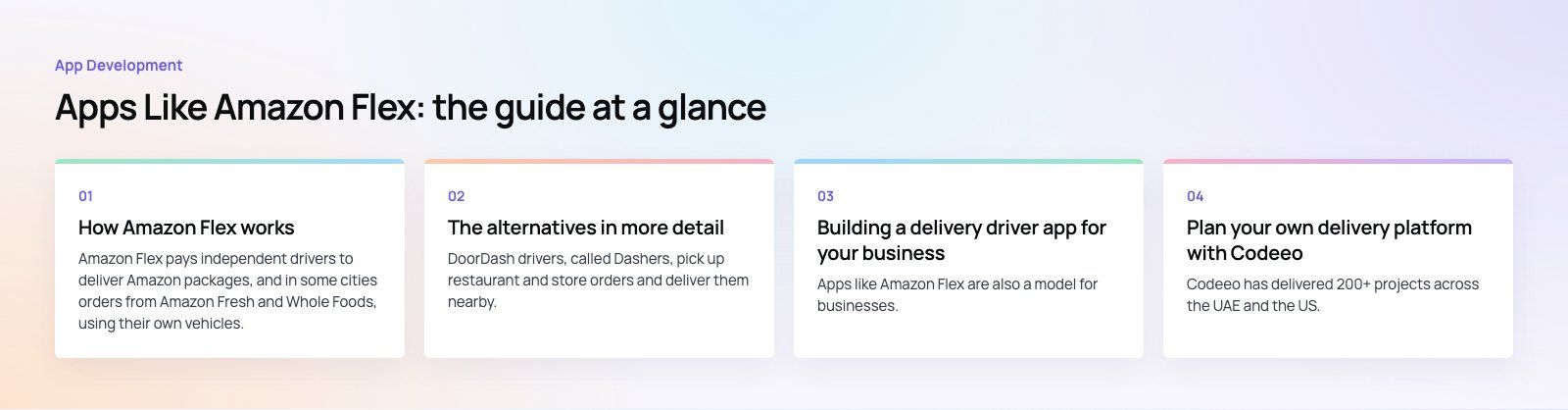
Amazon Flex pays independent drivers to deliver Amazon packages, and in some cities orders from Amazon Fresh and Whole Foods, using their own vehicles. Drivers reserve delivery blocks in the Amazon Flex app, collect packages from a delivery station or store, and follow the app's route to each stop.
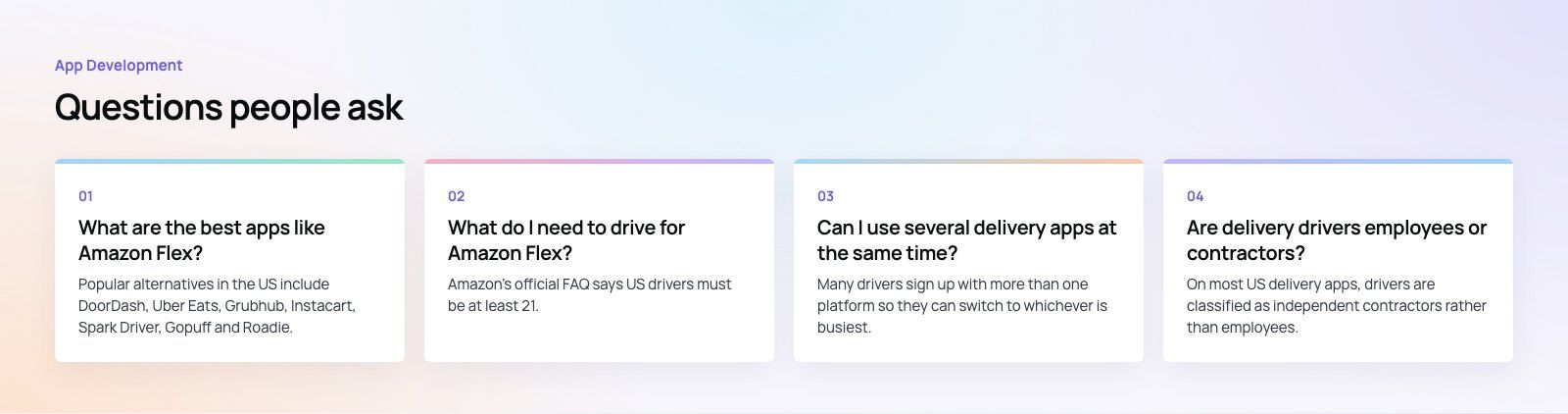
According to the official Amazon Flex FAQ, US drivers must be 21 or older, hold a valid driver's license and have a suitable vehicle such as a four door midsize sedan or larger. Requirements and availability vary by city, so check the app for your area.
The appeal is structure: you know in advance when a block starts and roughly how long it lasts. The downside is that blocks can be competitive in busy areas, and package routes do not usually include tips the way food delivery does.
Apps like Amazon Flex compared
| App | What you deliver | How work is offered | Good fit for |
|---|---|---|---|
| Amazon Flex | Amazon packages, some grocery orders | Scheduled blocks | Drivers who want planned shifts |
| DoorDash | Restaurant food, convenience and retail orders | On demand, with optional scheduled time | Evenings and weekends in busy areas |
| Uber Eats | Restaurant food, grocery and retail orders | On demand | Drivers who also want rideshare work |
| Grubhub | Restaurant food | Scheduled blocks and on demand | Drivers who like booking time ahead |
| Instacart | Groceries, shopped and delivered | On demand batches | People happy to shop as well as drive |
| Spark Driver | Walmart orders and returns | Offers sent through the app | Areas near Walmart stores |
| Gopuff | Convenience items from local hubs | Scheduled shifts | Short, local trips from one pickup point |
| Roadie | Packages and larger items, often same day | Gigs accepted through the app | Drivers with larger vehicles or flexible routes |
The alternatives in more detail
DoorDash
DoorDash drivers, called Dashers, pick up restaurant and store orders and deliver them nearby. You can go online when you like, and in many markets you can also schedule time in advance. Earnings depend heavily on local demand, distance and tips, and waiting at busy restaurants can eat into your time.
Uber Eats
Uber Eats works through the Uber driver app, so people who already drive for Uber can switch between rides and deliveries. In many cities you can deliver by car, bike or scooter. Like DoorDash, it is on demand, so income follows meal times and local demand.
Grubhub
Grubhub focuses on restaurant delivery and lets drivers schedule blocks ahead of time, which feels closer to Flex than purely on demand apps. Coverage varies by metro area, so check availability before you sign up.
Instacart
Instacart shoppers pick groceries in store and deliver them to customers. The role involves more than driving: you choose replacements, message customers and handle heavier orders. Larger orders can pay more, but take longer to complete.
Spark Driver
Spark Driver is the delivery platform for Walmart orders. Drivers receive offers for curbside pickup, delivery and sometimes returns. Availability depends on how close you are to participating Walmart locations.
Gopuff
Gopuff delivers snacks, drinks and household items from its own local hubs. Because every trip starts from the same place, routes are short and predictable. It operates only in areas with a Gopuff facility.
Roadie
Roadie, owned by UPS, connects drivers with deliveries ranging from small parcels to bulky items, including same day local deliveries for retailers. Drivers with SUVs, vans or pickups can take on larger gigs that car only apps cannot offer.
What to check before you sign up
- Local availability. Not every app operates in every city, and some open sign ups only when they need drivers.
- Vehicle and license rules. Age limits, vehicle types and documents differ by platform and state.
- Insurance. Your personal auto policy may not cover commercial delivery. Read each platform's insurance terms and speak to your insurer.
- Real costs. Fuel, maintenance, depreciation and phone data all come out of your earnings. Track mileage from day one.
- Taxes. As an independent contractor you are usually responsible for your own taxes. The IRS explains the basics on its Gig Economy Tax Center.
- How pay is calculated. Some apps show a set amount per offer, while others combine base pay, promotions and tips. Read the current pay terms in each app before accepting work.
Tips for earning more from delivery apps
- Run more than one app so you can switch to whichever is busiest, where each platform's terms allow it.
- Learn your area's peaks, such as lunch, dinner, weekends and bad weather.
- Decline poor offers that pay too little for the distance once costs are counted.
- Stay close to busy pickup zones rather than driving around without an order.
- Keep good records of mileage and expenses for tax time.
Building a delivery driver app for your business
Apps like Amazon Flex are also a model for businesses. Retailers, restaurants, pharmacies, laundries and logistics firms increasingly run their own delivery networks instead of relying entirely on third party platforms. That usually means three connected products:
- A customer app or website for ordering, payment and live tracking.
- A driver app for onboarding, document upload, shift or offer acceptance, navigation, proof of delivery and earnings.
- An admin and dispatch panel for assigning jobs, managing drivers, handling disputes and reporting.
Features that make or break a driver app
- Clear offers that show pickup, drop off, distance and pay before acceptance.
- Reliable GPS tracking that does not drain the battery.
- Proof of delivery through photos, signatures or one time codes.
- In app chat or masked calling with customers.
- Transparent earnings history and payouts.
- Offline handling for poor signal areas.
Plan your own delivery platform with Codeeo
Codeeo has delivered 200+ projects across the UAE and the US. Our work includes Teachers Lunch, a food ordering platform with a customer app, a rider app, restaurant menus, payments and an admin, and JobIQ, where the platform handles chat, dispatch and payment for booked technicians. If you are planning a delivery or gig platform, see our mobile app development service or explore our work for marketplaces and on demand businesses.
Frequently asked questions
Popular alternatives in the US include DoorDash, Uber Eats, Grubhub, Instacart, Spark Driver, Gopuff and Roadie.
Grubhub and Gopuff are closest to Flex because they offer scheduled time. DoorDash and Uber Eats are mostly on demand. Instacart adds grocery shopping to the job, and Roadie suits drivers with larger vehicles who can take bulky or same day deliveries.
App DevelopmentBest Apps for Finance Professionals, by CategoryThe most useful apps for finance professionals by category, from budgeting and accounting to market news and security, and when to build your own. App DevelopmentApps Like Cash App: Money Transfer Alternatives ComparedVenmo, PayPal, Zelle, Apple Cash, Revolut, Wise and more compared as Cash App alternatives, plus what it takes to build a payments app of your own.
 App DevelopmentApps Like Dave: Cash Advance and Earned Wage Access OptionsEarnIn, Brigit, MoneyLion, Chime, Branch and other apps like Dave compared by how they charge, plus what it takes to build a wage access app.
Tell us what the business needs. We will tell you what to build first.
Schedule a free consultation and get a written recommendation, with costs, before you commit to anything.
Get in touchPROVEN RESULTS
4.7 / 5verified reviews on Google