 App DevelopmentBest Apps for Finance Professionals, by CategoryThe most useful apps for finance professionals by category, from budgeting and accounting to market news and security, and when to build your own.
Apps Like Instacart: Grocery Delivery Alternatives Compared
Apps like Instacart compared, from Shipt and DoorDash to Gopuff and FreshDirect, plus how grocers decide between marketplaces, off the shelf and custom apps.
The main apps like Instacart in the US are Shipt, DoorDash, Uber Eats, Gopuff, Walmart, Amazon and FreshDirect, plus Rappi in Latin America. They differ in where the groceries come from: some send personal shoppers into local stores, some run their own warehouses, and some are marketplaces that added groceries to restaurant delivery. For a grocer or retailer, the bigger question is whether to sell through these platforms, run your own app, or do both.
This guide compares the alternatives, explains the operating models behind them, and walks through the off the shelf versus custom decision for businesses that want their own grocery ordering app.
How Instacart works
Instacart is a marketplace. Customers choose a store, add items, and a shopper picks and delivers the order, usually the same day. Retailers also use Instacart's technology to power their own branded storefronts. That mix of marketplace and white label platform is why so many alternatives compare themselves to it.
Apps like Instacart compared
Grocery delivery changes fast, with services entering and leaving cities every year. The apps below are established names still operating; check each one's coverage for your area before relying on it.
Shipt
Shipt is owned by Target and works on a similar shopper model to Instacart. Customers order from Target and a range of partner retailers, and a shopper picks and delivers the order. It suits households that already shop at its partner stores and want same day delivery.
DoorDash
DoorDash started with restaurant delivery and now carries grocery and convenience stores in many markets. Its strength is coverage and speed for smaller baskets. Customers who already use it for meals often add groceries without installing anything new.
Uber Eats
Uber Eats has followed the same path, adding supermarkets, convenience stores and specialty grocers to its restaurant marketplace. In 2025 it announced a partnership with FreshDirect to offer FreshDirect groceries for on demand delivery in New York City.
Gopuff
Gopuff runs its own network of micro fulfillment centers rather than sending shoppers into stores. That gives it control over stock and speed for snacks, essentials and everyday groceries, though the range is narrower than a full supermarket.
Walmart and Amazon
Both large retailers offer grocery delivery and pickup directly through their own apps and memberships. Because they own the inventory and the stores or warehouses, pricing and availability are consistent, and delivery often bundles with general merchandise.
FreshDirect
FreshDirect is an online grocer serving the New York area from its own facilities, known for fresh produce, meat and prepared meals. Customers book delivery slots in advance, which suits planned weekly shops more than last minute orders.
Rappi
Rappi is a multi service app across Latin America that includes grocery delivery alongside restaurants, pharmacy and other errands. It is not a US option, but it shows how grocery fits inside a wider super app.
Operating models side by side
The real difference between these apps is the operating model behind them. The table summarizes the trade offs.
| Model | Examples | Strengths | Limits |
|---|---|---|---|
| Shopper marketplace | Instacart, Shipt | Wide store choice, no warehouses to run | Substitutions and stock accuracy depend on the store |
| Restaurant marketplace with grocery | DoorDash, Uber Eats | Large existing customer base, fast small baskets | Grocery is one category among many |
| Own fulfillment centers | Gopuff, FreshDirect | Control over stock, quality and timing | Narrower range, limited to served areas |
| Retailer owned app | Walmart, Amazon | Own inventory, consistent pricing, loyalty data | Only that retailer's products |
Should a grocer build its own app?
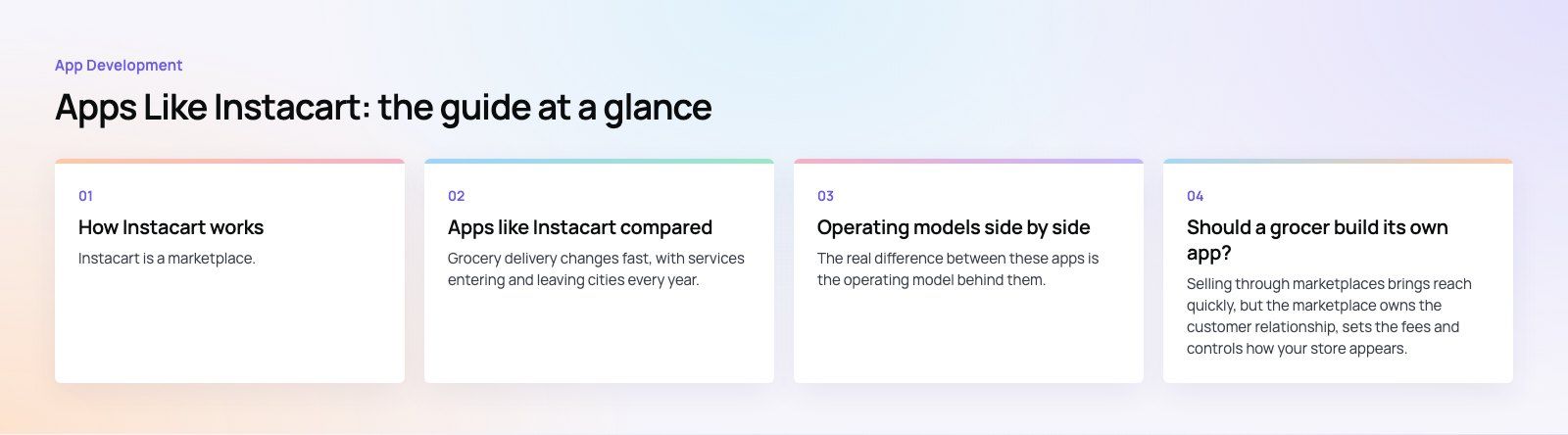
Selling through marketplaces brings reach quickly, but the marketplace owns the customer relationship, sets the fees and controls how your store appears. A direct app gives you the customer data, loyalty and margin, but you have to drive downloads and run delivery yourself or through a courier partner. Many grocers end up doing both: marketplaces for reach, their own app for repeat customers.
Off the shelf platforms
Off the shelf grocery ordering platforms are prebuilt products you subscribe to and brand.
- Faster launch. You can go live in weeks rather than months.
- Lower upfront spend. The vendor has already built and tested the core features.
- Vendor maintenance. Updates, security patches and app store changes are handled for you.
- Limited control. Features, checkout flow and integrations are what the vendor offers, and switching later can be painful.
- Generic experience. Your app looks and behaves like every other store on the same platform.
Custom apps
A custom app is designed and built around your catalog, operations and customers.
- Fits your operations. Picking, substitutions, delivery slots and loyalty rules work the way your stores already work.
- Integrations you choose. Point of sale, inventory, ERP, CRM and payment providers connect directly.
- Distinct experience. Features such as recipe baskets, reorder lists or subscriptions can set you apart.
- Higher initial investment and longer timeline. Discovery, design, build and testing take months.
- Ongoing ownership. You need a team or partner to maintain the app and keep up with iOS and Android changes.
| Factor | Off the shelf | Custom |
|---|---|---|
| Time to launch | Weeks | Months |
| Upfront investment | Lower | Higher |
| Fit with operations | Adapt to the platform | Platform adapts to you |
| Integrations | Vendor supported list | Whatever your systems need |
| Customer experience | Standard | Branded and distinctive |
| Maintenance | Vendor | Your team or partner |
Features a grocery app needs
Whichever route you take, these features decide whether customers come back.
- Accurate stock. Live or near live inventory from your stores, so customers do not order items that are not there.
- Search and categories that match how people shop. Fast search, filters for dietary needs, and quick reorder of past baskets.
- Substitution rules. Let customers approve or reject replacements, and remember their preferences.
- Delivery slots and pickup. Clear windows, cutoff times and capacity limits by area.
- Payments and promotions. Saved cards, wallets, coupons and loyalty points that work at checkout. Our payment integration work covers this layer.
- Driver and picker tools. A separate app or screen for staff to pick, pack and deliver orders.
- Admin and reporting. Order management, refunds, stock sync and sales reporting for the operations team.
Teachers Lunch, a Codeeo project, shows how these parts fit together in food ordering: a customer app, a rider app, restaurant menus, payments and an admin that sees the whole day. JobIQ applies the same dispatch thinking to booking technicians, with chat, dispatch and payment handled by the platform.
Mistakes to avoid
- Launching before stock data is reliable. Out of stock items and constant substitutions lose customers faster than slow delivery.
- Ignoring the picker experience. If picking is slow or confusing in store, every order runs late.
- Too many delivery promises. Offer slots you can fulfill. Missed windows damage trust.
- No reason to download. If your app offers nothing a marketplace does not, customers stay on the marketplace. Give them loyalty, exclusive ranges or faster reorder.
Picking your route
Customers have plenty of apps like Instacart to choose from, and each suits a different shopping habit. For retailers, marketplaces are a good way to reach new customers, while a direct app builds the repeat relationship. If you are weighing a grocery or delivery app, Codeeo's mobile app development team can help you decide what to build, what to buy and how to connect it to your stores. See our work for retail and ecommerce businesses or book a product scoping session.
Frequently asked questions
It depends on where you shop and what you need.
Shipt is the closest match for shopper based delivery from partner stores, DoorDash and Uber Eats are convenient for smaller, faster baskets, and Walmart or Amazon suit people who want one retailer's consistent pricing. In the New York area, FreshDirect is a strong option for planned weekly shops with fresh produce.
App DevelopmentBest Apps for Finance Professionals, by CategoryThe most useful apps for finance professionals by category, from budgeting and accounting to market news and security, and when to build your own. App DevelopmentApps Like Cash App: Money Transfer Alternatives ComparedVenmo, PayPal, Zelle, Apple Cash, Revolut, Wise and more compared as Cash App alternatives, plus what it takes to build a payments app of your own.
 App DevelopmentApps Like Dave: Cash Advance and Earned Wage Access OptionsEarnIn, Brigit, MoneyLion, Chime, Branch and other apps like Dave compared by how they charge, plus what it takes to build a wage access app.
Tell us what the business needs. We will tell you what to build first.
Schedule a free consultation and get a written recommendation, with costs, before you commit to anything.
Get in touchPROVEN RESULTS
4.7 / 5verified reviews on Google