 Software DevelopmentProperty Management Software vs a Custom Website: How to ChooseProperty management software runs leases and rent; your website wins owners. Compare US platforms and learn how to plan a site that connects to them.
CodeeoInsightsSoftware Development
What Is the Epic EHR System? Modules, MyChart and Costs
What the Epic EHR system is, its main modules, MyChart, Chronicles and Clarity, what drives its cost, and how developers connect apps to it.
Epic is an electronic health record (EHR) system made by Epic Systems, a private software company based in Verona, Wisconsin. It gives hospitals and health systems one shared patient record across clinics, wards, labs, pharmacy and billing, plus the MyChart patient portal. It is used mainly by large and mid sized US health systems, and it is a major undertaking to buy, implement and run.
This guide explains what Epic does, its main modules, what it means for patients and staff, what drives its cost, and what developers need to know when building apps that connect to it.
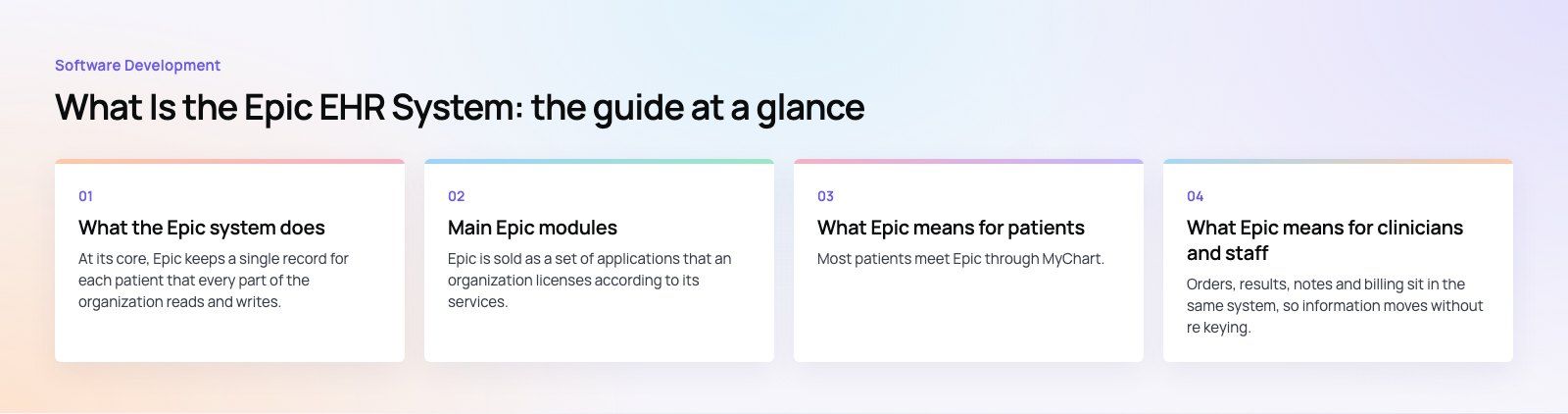
What the Epic system does
At its core, Epic keeps a single record for each patient that every part of the organization reads and writes. A nurse on a ward, a doctor in an outpatient clinic, a pharmacist and a billing clerk all work from the same chart. That shared record is the main reason organizations choose an integrated system rather than separate tools from different vendors.
EHR or EMR?
The terms are often used interchangeably. An electronic medical record (EMR) usually means the digital chart inside one practice, while an electronic health record (EHR) is designed to follow the patient across providers and settings. Epic covers both: the chart within an organization and the exchange of records with other organizations.
Who uses it
Epic is built for hospitals, academic medical centers and multi specialty groups. Smaller practices often reach it through a program called Community Connect, where a larger health system extends its Epic instance to affiliated clinics. Independent small practices more often choose lighter systems built for their size.
Main Epic modules
Epic is sold as a set of applications that an organization licenses according to its services. Common ones include:
| Area | What it covers |
|---|---|
| Ambulatory and inpatient charting | Clinical notes, orders, problem lists, medication lists and templates for clinic and hospital care |
| Scheduling and registration | Appointments, referrals, patient demographics and insurance details |
| Billing and revenue cycle | Charges, claims, payments and follow up with insurers |
| Pharmacy and e prescribing | Medication orders, dispensing and electronic prescriptions |
| Laboratory and imaging | Test orders, results and integration with lab and radiology systems |
| Emergency and surgery | Department specific workflows for the emergency room and operating theaters |
| Managed care | Tapestry, for health plans: eligibility, claims, authorizations and member billing |
| Reporting and analytics | Operational reports, dashboards and data warehouse tools |
| Patient engagement | MyChart portal and app for patients |
Under the hood: Chronicles, Clarity and Caboodle
Epic's live system runs on a database called Chronicles, which stores data in a hierarchical, non tabular structure tuned for fast clinical use. Data is copied regularly into Clarity, a relational database used for reporting, and into Caboodle, a data warehouse for analytics. Analysts usually work with Clarity and Caboodle rather than the live database.
What Epic means for patients
Most patients meet Epic through MyChart. Depending on how their provider sets it up, patients can view test results, read visit notes, message their care team, book or change appointments, pay bills, renew prescriptions and join video visits. Proxy access lets parents and caregivers manage a family member's account.
For admitted patients, Epic offers a bedside version that lets them see their care team, schedule and educational material from the hospital bed.
Because many providers use Epic, a feature called Care Everywhere lets organizations exchange records, so a patient's history can follow them between unrelated hospitals.
What Epic means for clinicians and staff
Integrated workflows
Orders, results, notes and billing sit in the same system, so information moves without re keying. Organizations can tailor templates, order sets and screens to each specialty.
Pre charting and templates
Clinicians can prepare parts of a note before a visit, such as reviewing history and queuing orders, which shortens the visit itself. Specialty templates and smart phrases speed up documentation.
The downsides staff report
No large EHR is free of complaints. Documentation load, many clicks for common tasks and alert fatigue are frequent concerns with any big system, including Epic. How well an organization configures and trains on the system makes a large difference to the daily experience.
Training
Epic provides structured training and certification for staff at customer organizations, and customers access materials through Epic's UserWeb portal. Training is usually run in house by the organization's own Epic team.
What drives the cost of Epic
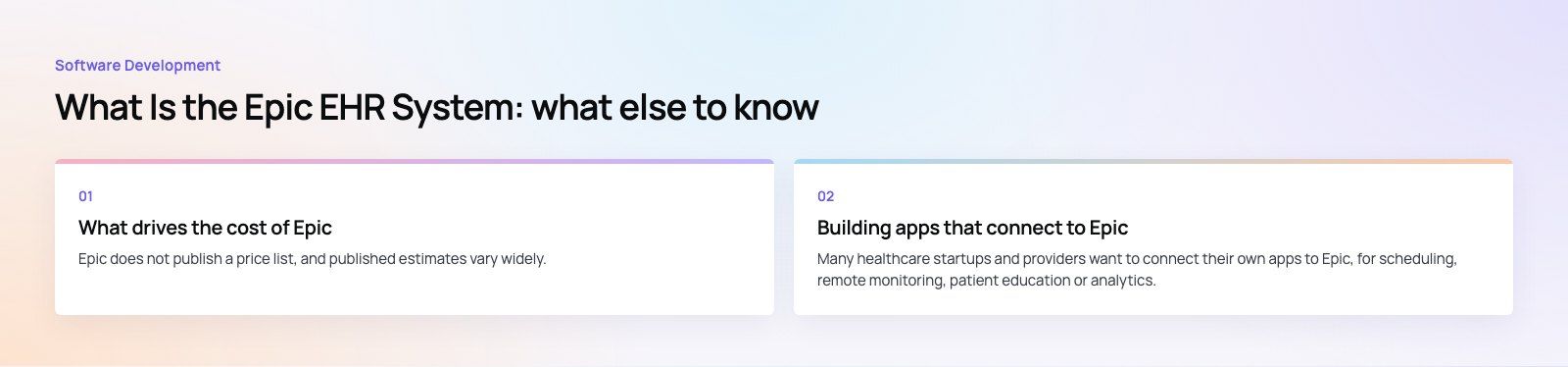
Epic does not publish a price list, and published estimates vary widely. Instead of relying on old figures, look at the factors that move the total cost:
- Size and scope: number of users, sites, beds and the modules licensed.
- Hosting: running it in your own data center versus a hosted arrangement.
- Implementation: internal project staff, consultants, data migration and testing.
- Training and backfill: time staff spend in training instead of seeing patients.
- Integrations: connecting devices, labs, imaging and third party systems.
- Ongoing support: maintenance, upgrades and a permanent internal Epic team.
The most expensive system is not automatically the right one. Smaller organizations should compare Epic, Community Connect access through a partner health system, and alternatives sized for their needs.
Building apps that connect to Epic
Many healthcare startups and providers want to connect their own apps to Epic, for scheduling, remote monitoring, patient education or analytics. Epic supports this through its developer resources at open.epic.com, which list its available APIs, including standards based FHIR APIs, along with documentation and developer playbooks.
What to plan for
- Define the use case. Decide exactly which data you need to read or write, and for whom.
- Use standards first. FHIR and SMART on FHIR make your app easier to connect to Epic and to other EHRs.
- Work with the customer. Each health system controls its own Epic instance and must approve and configure access.
- Design for privacy. Health data falls under HIPAA in the US. Plan access control, audit logging and encryption from the first sprint.
- Test with realistic data. Use sandbox environments and synthetic patients before touching live records.
Our custom software and integration teams build this kind of connected product. A product scoping session is a good way to pin down data flows and approvals before development starts.
Lessons from Epic for other healthcare software
Even if you never use Epic, its design offers useful lessons for anyone building healthcare or business software:
- A single shared record avoids errors from copying data between systems.
- Patient facing tools such as portals and apps drive engagement and reduce phone calls.
- Configuration per department matters as much as features.
- Reporting databases should be separate from the live clinical system.
Our healthcare workforce platform case study shows the same principle on a smaller scale: shifts, bookings, incident reports and reviews in one platform, with a design system shared by the web app and the admin.
Epic is a deep, integrated EHR that suits organizations big enough to fund and staff it, and it shapes how much of US healthcare software connects together. If you are building a product for healthcare providers, our healthcare software team can help you plan integrations, privacy and the patient experience.
Frequently asked questions
Epic is both.
It works as an electronic medical record inside a hospital or practice, holding charts, orders and notes, and as an electronic health record that shares patient information with other organizations through features such as Care Everywhere. In everyday use, people call it an EHR, and the two terms are often used to mean the same thing.
Software DevelopmentProperty Management Software vs a Custom Website: How to ChooseProperty management software runs leases and rent; your website wins owners. Compare US platforms and learn how to plan a site that connects to them. Software DevelopmentBest CRM for Real Estate: Top Picks and When to Go CustomFollow Up Boss, Wise Agent, Realvolve, Top Producer and Market Leader compared, the features that matter, and when a custom real estate CRM is worth it.
 Software DevelopmentCapitalizing Software Development Costs: Rules and Best PracticesWhen US GAAP lets you capitalize software development costs, what changed with ASU 2025-06, which costs qualify and how to track them for a clean audit.
Tell us what the business needs. We will tell you what to build first.
Schedule a free consultation and get a written recommendation, with costs, before you commit to anything.
Get in touchPROVEN RESULTS
4.7 / 5verified reviews on Google