 AIPredictive HR Analytics: How to Forecast Workforce TrendsHow predictive HR analytics forecasts hiring, turnover and skills needs, how to start with your own data, and when to build a custom tool or buy one.
AI Digital Transformation: Where It Pays Off and How to Start
What AI digital transformation really involves, where it delivers value in a business, the challenges that stall projects, and a practical way to start.
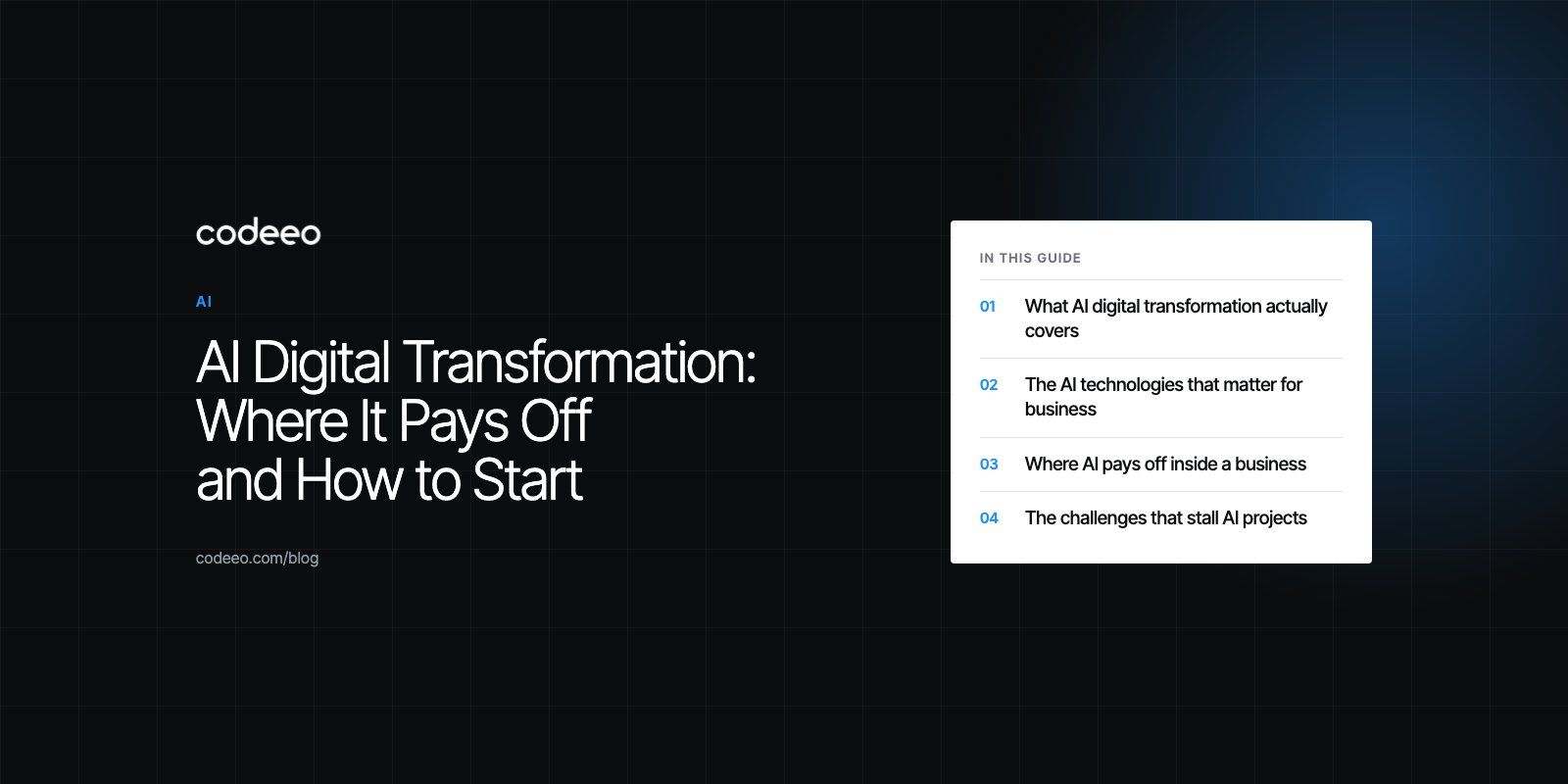
AI digital transformation means using artificial intelligence to change how a business actually runs: automating repetitive work, helping people make better decisions with data, and personalizing what customers see. It works when it is tied to a specific process with a measurable outcome. It fails when it starts as a technology purchase looking for a problem.
This guide explains the main types of AI in plain terms, where they pay off inside a business, what gets in the way, and a practical order of steps for getting started without wasting a year on pilots that never reach production.
What AI digital transformation actually covers
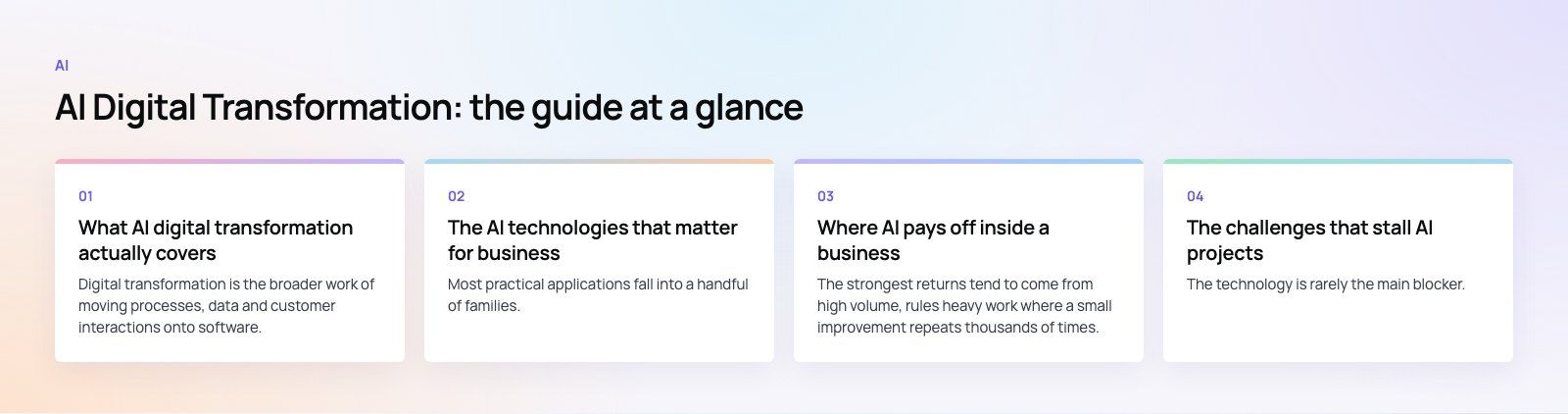
Digital transformation is the broader work of moving processes, data and customer interactions onto software. AI is one layer on top of that. It only adds value once the underlying process is already digital, because a model needs clean, accessible data and a system it can act inside.
That is why many AI projects quietly turn into data and integration projects. A sales forecasting model is useless if half the deals live in spreadsheets. A support chatbot cannot answer order questions if it has no access to the order system. The AI part is often the smaller part of the work.
Narrow AI, general AI and the hype in between
Almost everything a business can buy or build today is narrow AI: systems trained to do a defined task, such as classifying documents, predicting churn, transcribing calls or drafting text. General AI, meaning a system that can reason across any intellectual task the way a person can, remains a research goal rather than a product. Superintelligence, a system beyond human ability in every area, is a hypothetical idea.
Keeping this distinction clear helps with planning. You are not buying a digital employee. You are buying or building tools that do specific jobs well and need people around them to check, correct and decide.
The AI technologies that matter for business
Most practical applications fall into a handful of families. The table below maps each one to the kind of work it suits.
| Technology | What it does | Typical business uses |
|---|---|---|
| Machine learning | Finds patterns in historical data to predict or classify | Demand forecasting, fraud detection, churn prediction, lead scoring |
| Natural language processing | Understands and generates human language | Support assistants, email triage, contract review, sentiment analysis |
| Generative AI and large language models | Produces text, code, summaries and images from prompts | Drafting content, internal knowledge search, summarizing meetings and tickets |
| Computer vision | Interprets images and video | Quality inspection, document capture, stock counting, identity checks |
| Deep learning | Layered neural networks behind most of the above | Speech recognition, image recognition, complex pattern detection |
Where AI pays off inside a business
The strongest returns tend to come from high volume, rules heavy work where a small improvement repeats thousands of times. Here are the areas we see most often.
Automating repetitive operations
Invoice capture, data entry between systems, ticket routing and document classification are good first targets. The process is already well understood, mistakes are easy to spot, and staff time saved is easy to measure. AI works best here as an assistant inside an existing workflow, for example reading a supplier invoice and proposing the ledger coding for a person to approve.
Better decisions from existing data
Predictive models can forecast demand, flag accounts likely to churn, or highlight orders that look fraudulent. The value is not the prediction itself but the action it triggers: a reorder, a retention call, a manual review. When data sits in an ERP or CRM, connecting it to reporting tools such as Power BI dashboards is often the step that makes predictions visible to the people who act on them.
Personalized customer experiences
Recommendation engines suggest products based on browsing and purchase history. Support assistants answer common questions at any hour and hand complex cases to a person with the context attached. Marketing teams use AI to segment audiences and test messaging faster. Each of these depends on customer data being connected and permissioned properly.
Faster knowledge work
Generative AI is now useful for summarizing long documents, drafting first versions of proposals and answering internal questions from company policies or manuals. The biggest gains come when the model is grounded in your own documents rather than answering from general knowledge, and when output is reviewed before it reaches a customer.
The challenges that stall AI projects
The technology is rarely the main blocker. These are the issues that usually decide whether a project ships.
- Data quality and access. Models trained or grounded on incomplete, duplicated or outdated data produce confident wrong answers. Fixing data pipelines is unglamorous and essential.
- Integration. An AI feature that lives in a separate tool nobody opens will not change anything. It has to sit inside the CRM, ERP, helpdesk or app people already use.
- Skills. Teams need people who can evaluate models, design prompts, monitor output and understand the business process. Training existing staff is often more effective than hiring for AI alone.
- Bias and fairness. Models learn from historical data, including its biases. Any use that affects hiring, lending, pricing or access to services needs testing for unfair outcomes.
- Privacy and regulation. Customer data used for AI must follow local privacy law and your own contracts. Some jurisdictions now regulate AI directly, such as the European Union's AI Act.
- Unclear ownership. Someone has to own the outcome, the model's behavior and the budget after launch. Projects without an owner drift.
The US National Institute of Standards and Technology publishes a free AI Risk Management Framework that is a useful checklist for governance, even outside the US.
How to start an AI digital transformation
A sensible sequence keeps risk low and proves value early.
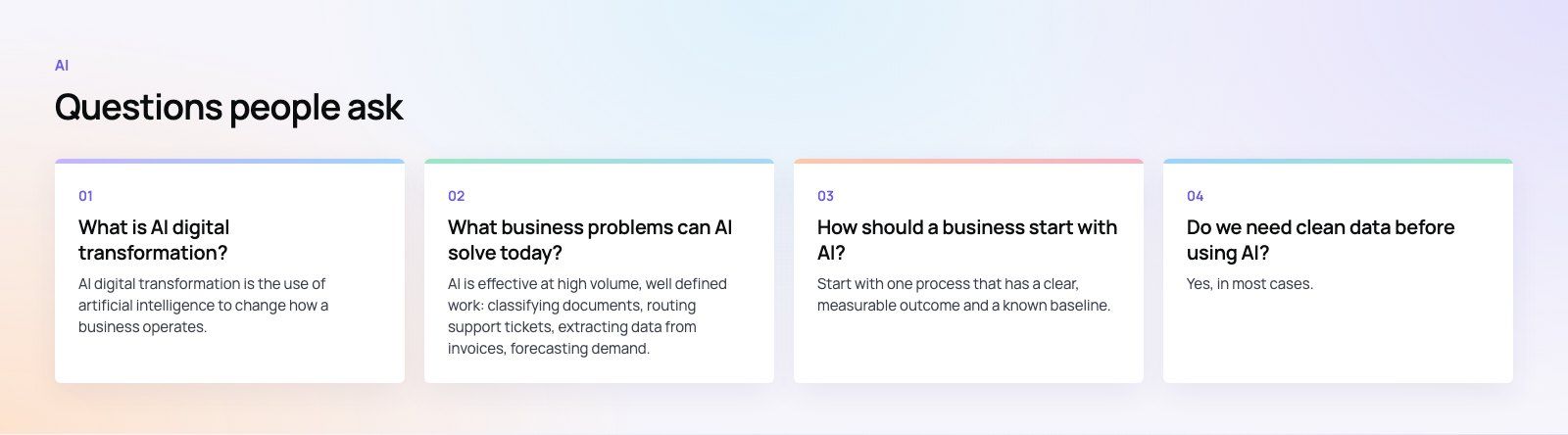
- Pick one process with a clear metric. Time to resolve a ticket, invoices processed per day, forecast accuracy. If you cannot measure today's baseline, you cannot prove improvement.
- Audit the data behind it. Where does it live, who owns it, how clean is it, and can a system reach it through an API?
- Decide build, buy or extend. Many CRMs, ERPs and helpdesks now include AI features. Turning those on is often faster than building. Custom work makes sense when the process is specific to you or a core advantage.
- Run a short pilot with real users. Keep a person in the loop, log every output, and compare against the baseline.
- Integrate, then scale. Move the feature into the daily tools, add monitoring for accuracy drift, and only then repeat the approach on the next process.
If you want help shaping that first step, a short product scoping session is a practical way to define the process, data and success measure before any build starts.
Common mistakes to avoid
- Starting with a model or vendor instead of a business problem.
- Running many pilots at once, none with enough attention to reach production.
- Letting generative AI send customer facing output without review.
- Ignoring the cost of running models at scale, which grows with usage.
- Treating launch as the finish line. Models need monitoring, retraining and updated prompts as data and products change.
Where AI and digital transformation are heading
The clear direction is AI moving inside everyday business systems rather than living as separate tools. ERP platforms are adding forecasting and anomaly detection, CRMs are adding drafting and lead scoring, and sales automation is increasingly driven by models that suggest the next action. Agent style systems that can carry out multi step tasks across tools are maturing, but they raise the stakes on permissions, auditing and human oversight.
For most businesses the winning approach is steady rather than dramatic: connect your data, automate one process well, measure it honestly and repeat. Companies that do this consistently build an advantage that is hard to copy, because it lives in their processes rather than in a product anyone can buy.
Codeeo has delivered 200+ projects across the UAE and the US, with a team of 80+ across Dubai, Riyadh and Karachi. If you are planning AI features inside a product or internal system, our custom software development team can help you scope, build and integrate them, or you can contact us to talk through your first use case.
Frequently asked questions
AI digital transformation is the use of artificial intelligence to change how a business operates, for example by automating repetitive tasks, predicting demand or risk from data, and personalizing customer interactions.
It builds on broader digital transformation, because AI needs processes and data that already live in software. The aim is a measurable improvement in a specific process, not adopting AI for its own sake.
AIPredictive HR Analytics: How to Forecast Workforce TrendsHow predictive HR analytics forecasts hiring, turnover and skills needs, how to start with your own data, and when to build a custom tool or buy one. AIHow Dubai Police Uses AI to Improve Public ServicesHow Dubai Police uses AI for minor accident reports, vehicle history checks and the Amna virtual officer, and what UAE businesses can learn from it.
 AIHow to Add a Chatbot to Your Website in 5 StepsAdd a chatbot to your website in five steps: choose its job, set KPIs, map users and flows, build and install the script, then target and improve it.
Tell us what the business needs. We will tell you what to build first.
Schedule a free consultation and get a written recommendation, with costs, before you commit to anything.
Get in touchPROVEN RESULTS
4.7 / 5verified reviews on Google