 AIHow Dubai Police Uses AI to Improve Public ServicesHow Dubai Police uses AI for minor accident reports, vehicle history checks and the Amna virtual officer, and what UAE businesses can learn from it.
Predictive HR Analytics: How to Forecast Workforce Trends
How predictive HR analytics forecasts hiring, turnover and skills needs, how to start with your own data, and when to build a custom tool or buy one.
Predictive HR analytics uses historical workforce data and statistical models to forecast what is likely to happen next, such as which roles will be hard to fill, which teams face rising turnover, and how many people the business will need next year. It turns HR from reporting on the past into planning ahead. Done well, it helps leaders act earlier on hiring, retention and skills gaps.
This guide explains how predictive HR analytics works, where it helps most, how to get started with the data you already have, and how to choose between a custom analytics tool and an off the shelf product.
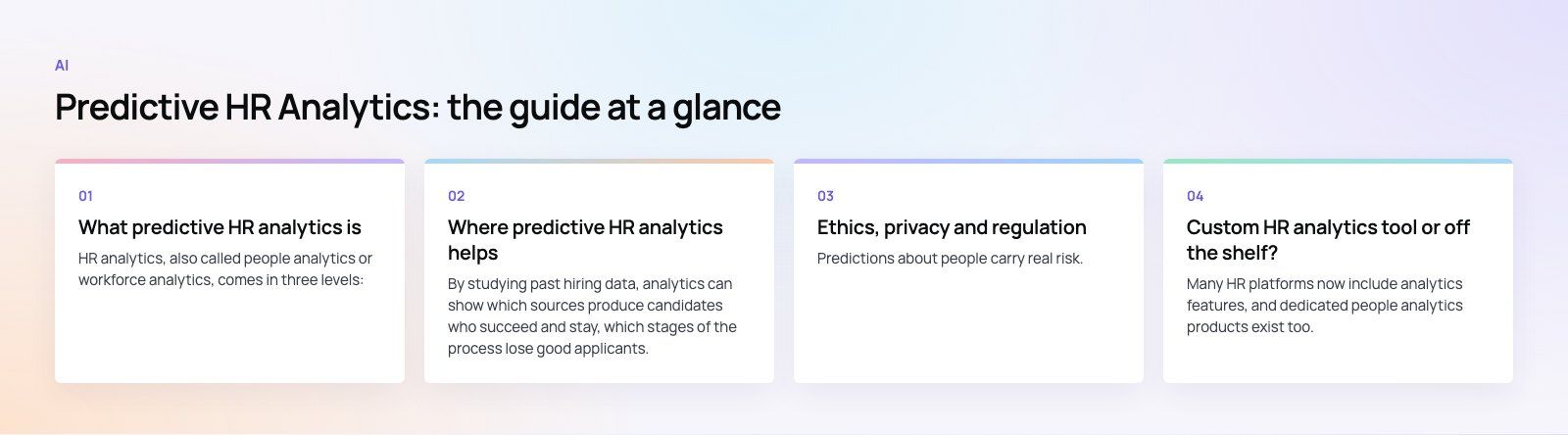
What predictive HR analytics is
HR analytics, also called people analytics or workforce analytics, comes in three levels:
- Descriptive: what happened. Headcount, turnover, absence and hiring time for last quarter.
- Predictive: what is likely to happen. Which employees or teams show patterns that previously came before resignations, or how hiring needs will change as the business grows.
- Prescriptive: what to do about it. Suggested actions, such as which retention steps have worked for similar cases.
Predictive analytics builds on the first level. Models look for patterns in historical data, test whether those patterns hold on data they have not seen, then apply them to current data to estimate future outcomes. The results are probabilities, not certainties, and they are only as good as the data behind them.
Where predictive HR analytics helps
Talent acquisition
By studying past hiring data, analytics can show which sources produce candidates who succeed and stay, which stages of the process lose good applicants, and how long different roles usually take to fill. Recruiters can then focus effort on the channels that work and start hiring earlier for roles that are slow to fill.
Employee retention
Turnover models look for patterns that tended to come before past resignations, such as long periods without a pay review or promotion, changes of manager, rising overtime or falling engagement scores. Flagging teams at higher risk lets HR and managers step in early with conversations, development or workload changes. Used carelessly, this can feel intrusive, so focus on team level patterns and supportive action rather than labeling individuals.
Performance management
Analytics can show which factors are associated with strong performance in a role, such as particular training, experience or team structures. That helps HR design better development plans and identify where training will make the most difference.
Workforce planning
By combining historical headcount, turnover and productivity data with business forecasts, workforce planning models estimate how many people, and which skills, the business will need. This makes it possible to address skills shortages and succession gaps before they become urgent.
Employee engagement
Survey results, comment themes and participation rates can be analyzed alongside absence and turnover to show which drivers of engagement matter most in your organization. That helps HR target the changes most likely to improve the employee experience.
HR operations
Analytics can also improve scheduling, overtime planning and resource allocation by spotting inefficiencies and predicting demand, for example forecasting peak periods in a contact center or a retail chain so rosters match expected workload.
Benefits for the wider business
- Decisions based on evidence. Leaders can test assumptions about hiring, pay and retention against real data.
- Earlier action. Forecasts give time to respond before a skills gap or turnover spike affects customers.
- Better use of budgets. Recruitment and training spend can be directed where it has the most effect.
- Stronger compliance. Regular analysis of pay, hiring and promotion data can reveal inconsistencies that need attention.
- HR alongside finance and operations. When people data sits next to business data, workforce decisions become part of business planning.
How to get started
- Pick one question. For example: which teams are likely to see the most resignations next year? A narrow question is easier to answer well.
- Audit your data. Check where HR, payroll, attendance, performance and survey data live, how complete it is and how far back it goes. Fix duplicates and inconsistent job titles before modeling.
- Start with descriptive reporting. A reliable dashboard of headcount, turnover and absence is the foundation for any prediction.
- Build a simple model. Begin with transparent methods that HR can explain, and test them on past data before trusting them.
- Act and measure. Use the forecast to guide a specific action, then check whether the outcome changed.
- Set governance. Decide who can see predictions, how they may be used and how bias is checked.
Ethics, privacy and regulation
Predictions about people carry real risk. Historical data can contain bias, for example in past promotion or hiring decisions, and a model trained on it can repeat that bias. Keep humans responsible for decisions, explain to employees what data is used and why, limit access to sensitive outputs and test models regularly for unfair outcomes across groups.
Regulation is tightening. The EU's Artificial Intelligence Act (Regulation 2024/1689) treats AI systems used for recruitment and decisions about workers as high risk, with obligations on providers and users. Outside Europe, the NIST AI Risk Management Framework offers a practical structure for managing these risks. Check the data protection rules in every country where you employ people before you start.
Custom HR analytics tool or off the shelf?
Many HR platforms now include analytics features, and dedicated people analytics products exist too. The alternative is a custom solution built on your own data platform and business intelligence tools. The table summarizes the trade offs.
| Factor | Custom analytics tool | Off the shelf tool |
|---|---|---|
| Fit to your needs | Built around your questions, data and structure | Standard metrics that may not match how you work |
| Speed to start | Longer design and build | Quick setup and deployment |
| Integration | Connects HR data with finance and operations data | Usually limited to connected HR systems |
| Upfront effort | Higher, needs in house or partner expertise | Lower, features ready to use |
| Ongoing cost and maintenance | Your team or partner maintains it | Vendor handles updates within a subscription |
| Control and ownership | You own the models, data and roadmap | Vendor controls features and updates |
| Risk | Scope creep and delays if poorly managed | Vendor lock in and limited customization |
A common middle path is to keep HR data in your existing platform and build reporting and forecasting on a business intelligence tool such as Power BI, with data stored in a platform like Dataverse or Azure. That gives custom models without replacing the HR system itself.
Turning forecasts into decisions
Predictive HR analytics pays off when it answers a clear question with clean data and leads to an action someone owns. Start small, prove value, then extend. If you need help connecting HR, payroll and business data or building forecasting dashboards, Codeeo's custom software and Power BI teams can scope it with you; get in touch to start.
Frequently asked questions
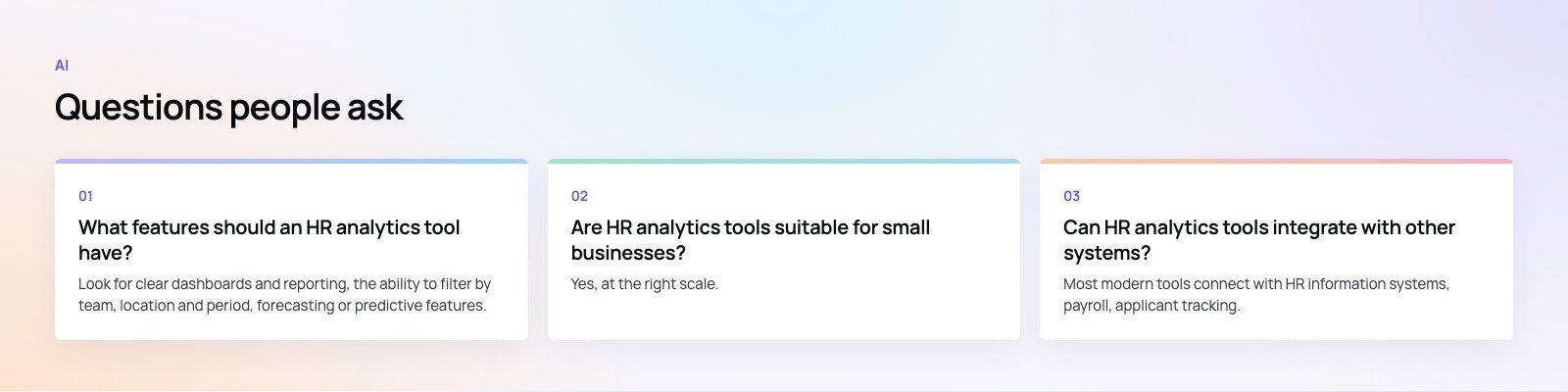
Look for clear dashboards and reporting, the ability to filter by team, location and period, forecasting or predictive features, and integration with your HR, payroll and business systems.
Security matters as much as features, so check role based access, audit logs and data protection controls. Finally, make sure HR staff can use it without needing a data scientist for every question.
AIHow Dubai Police Uses AI to Improve Public ServicesHow Dubai Police uses AI for minor accident reports, vehicle history checks and the Amna virtual officer, and what UAE businesses can learn from it. AIHow to Add a Chatbot to Your Website in 5 StepsAdd a chatbot to your website in five steps: choose its job, set KPIs, map users and flows, build and install the script, then target and improve it.
 AIGPT-4 Turbo Explained: What It Did and What Replaced ItWhat GPT-4 Turbo offered, the myths that grew around it, its scheduled shutdown and a step by step plan for moving applications to a current model.
Tell us what the business needs. We will tell you what to build first.
Schedule a free consultation and get a written recommendation, with costs, before you commit to anything.
Get in touchPROVEN RESULTS
4.7 / 5verified reviews on Google