 AIPredictive HR Analytics: How to Forecast Workforce TrendsHow predictive HR analytics forecasts hiring, turnover and skills needs, how to start with your own data, and when to build a custom tool or buy one.
GPT-4 Turbo Explained: What It Did and What Replaced It
What GPT-4 Turbo offered, the myths that grew around it, its scheduled shutdown and a step by step plan for moving applications to a current model.
GPT-4 Turbo was OpenAI's faster, larger context version of GPT-4, introduced in late 2023 and widely used by developers through 2024. It is now a legacy model: OpenAI's own documentation recommends newer models, and its deprecations page lists GPT-4 Turbo for shutdown on October 23, 2026. If you still run anything on it, the practical question is no longer what GPT-4 Turbo can do, but how to migrate safely.
This guide explains what GPT-4 Turbo offered, which of its ideas still shape AI products today, what claims about it were never true, and how to move an application to a current model.
What GPT-4 Turbo was
GPT-4 Turbo was released as an improvement on the original GPT-4 for developers using OpenAI's API. Its main selling points were a much longer context window, fresher training data, image input and lower cost per token than GPT-4. According to OpenAI's GPT-4 Turbo model page, the final version supports:
- A context window of 128,000 tokens
- Up to 4,096 output tokens per response
- Text and image input, with text output
- A knowledge cutoff of December 1, 2023
The same page now describes it as an older model and recommends using a newer one. Earlier preview versions had an older knowledge cutoff, and OpenAI has already retired some of those preview snapshots.
Why it mattered at the time
Long context changed what applications could do
Before GPT-4 Turbo, most developers worked with short context windows and had to cut documents into small pieces. A 128,000 token window let an application pass a long contract, a large set of support tickets or a sizeable chunk of code in one request. That made document question answering, summarization and analysis tools far simpler to build.
Long context did not remove the need for good retrieval, though. Models can miss details buried in the middle of very long prompts, and every extra token adds cost and latency. Well built applications still select the most relevant passages rather than sending everything.
Lower cost opened up more use cases
GPT-4 Turbo was priced well below the original GPT-4 per token, which made it practical for higher volume tasks such as customer support assistants and content workflows. That trend has continued: each generation since has generally offered more capability per unit of cost, which is one reason to migrate rather than stay on a legacy model.
It arrived alongside a wider platform push
GPT-4 Turbo was announced together with other developer features, including custom GPTs that anyone could configure with instructions and files, text to speech in the API, and Copyright Shield, under which OpenAI said it would defend eligible enterprise and API customers facing certain copyright claims. Several of those ideas, especially configurable assistants and voice output, are now standard features across AI platforms.
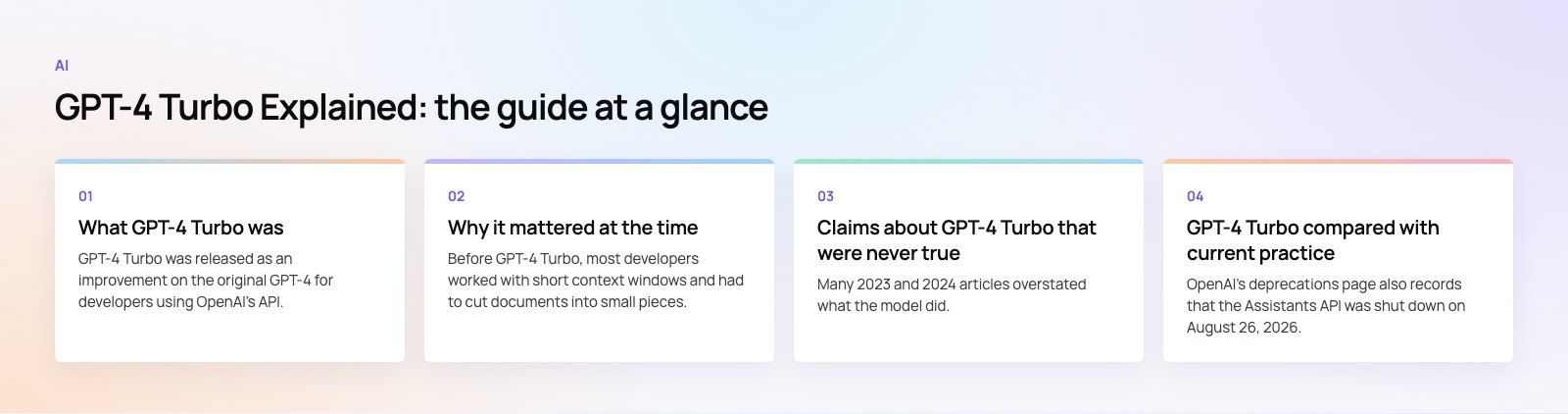
Claims about GPT-4 Turbo that were never true
Many 2023 and 2024 articles overstated what the model did. Three claims are worth correcting because they still circulate:
- "It knows the latest information." No language model knows events after its training cutoff unless the application gives it fresh data, for example through search or retrieval. GPT-4 Turbo had a fixed cutoff like every other model.
- "It automatically optimizes content for SEO." It did not. It could draft text that included keywords if asked, but it had no special knowledge of ranking systems and no access to search data. Google's guidance rewards helpful, accurate content, however it is produced.
- "It suggests trustworthy backlinks." Language models can invent URLs and sources. Any link or citation produced by a model must be checked by a person before publishing.
GPT-4 Turbo compared with current practice
| Area | GPT-4 Turbo era | What to expect from current models |
|---|---|---|
| Status | Legacy, scheduled for shutdown | Actively supported and updated |
| Context | 128,000 tokens | Check the model page; many current models accept longer inputs |
| Inputs | Text and images | Text, images and often audio, depending on the model |
| Reasoning | General purpose chat model | Dedicated reasoning models alongside faster general models |
| Tooling | Chat Completions and the now retired Assistants API | Responses API and newer tool calling features |
OpenAI's deprecations page also records that the Assistants API was shut down on August 26, 2026, with the Responses API and Conversations API as the recommended replacements. Applications built on both GPT-4 Turbo and the Assistants API need two changes, not one.
How to migrate an application off GPT-4 Turbo
- Find every call. Search your code, environment variables and third party tools for model names such as gpt-4-turbo and older preview identifiers. Low code automations and plugins are easy to miss.
- Pick a replacement per task. Use the recommendation on OpenAI's deprecations page as a starting point, then choose a faster, cheaper model for simple tasks such as classification, and a stronger reasoning model for complex analysis.
- Build a small test set. Collect real prompts and the answers you consider correct. Run them against the old and new models and compare quality, format and length.
- Adjust prompts. Newer models often follow instructions more literally. Remove workarounds written for older models and tighten output format rules, especially for JSON.
- Check cost and latency. Measure token use and response times under realistic load before switching production traffic.
- Roll out gradually. Send a share of traffic to the new model, monitor errors and user feedback, then complete the switch.
Lessons that still apply
The GPT-4 Turbo period taught several lessons that hold for any model you choose today:
- Design for model changes. Keep the model name in configuration, not scattered through code, so switching is a small change.
- Keep humans in the loop for published content. Models still make confident mistakes, especially with facts, numbers and citations.
- Ground answers in your own data. For customer facing assistants, retrieval from your documentation is more reliable than relying on what the model learned in training.
- Protect user data. Decide what information may be sent to an external API, and check the provider's data handling terms.
Getting help with AI features
Adding AI to a product is mostly ordinary engineering: clean data, careful testing, sensible fallbacks and monitoring. Codeeo's team of 80+ across Dubai, Riyadh and Karachi builds web, app and software products, and can help you plan or migrate AI features. See our custom software development and mobile app development services, ask for a codebase review to find legacy model calls, or contact us to talk through your use case.
Frequently asked questions
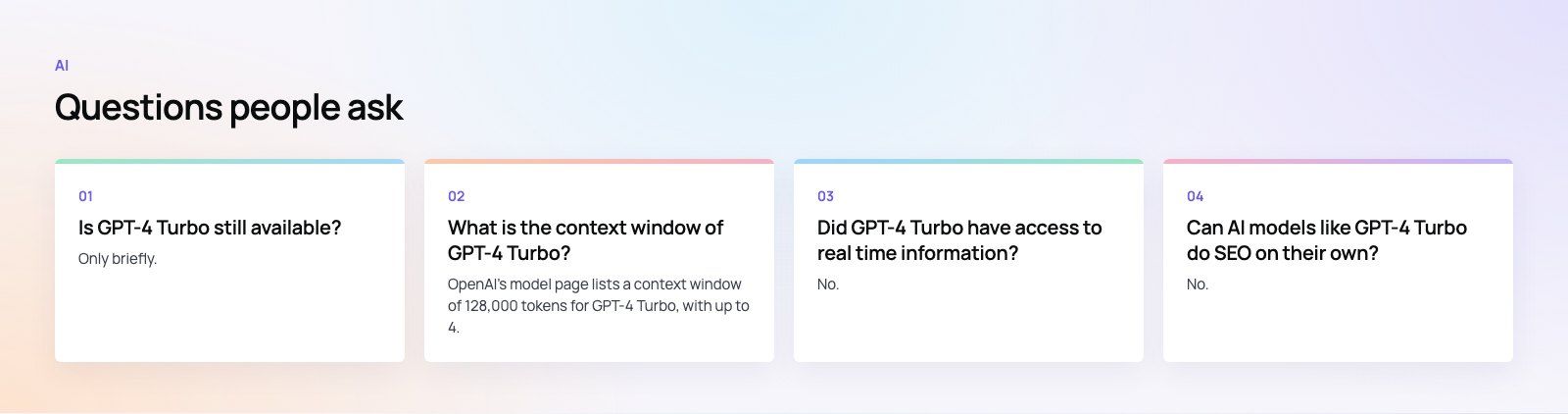
Only briefly.
OpenAI's deprecations page lists gpt-4-turbo, including its April 2024 snapshot, for shutdown on October 23, 2026, and some earlier preview versions were already shut down in March 2026. After shutdown, API calls to those model names will fail, so any application still using them should be migrated to a current model now.
AIPredictive HR Analytics: How to Forecast Workforce TrendsHow predictive HR analytics forecasts hiring, turnover and skills needs, how to start with your own data, and when to build a custom tool or buy one. AIHow Dubai Police Uses AI to Improve Public ServicesHow Dubai Police uses AI for minor accident reports, vehicle history checks and the Amna virtual officer, and what UAE businesses can learn from it.
 AIHow to Add a Chatbot to Your Website in 5 StepsAdd a chatbot to your website in five steps: choose its job, set KPIs, map users and flows, build and install the script, then target and improve it.
Tell us what the business needs. We will tell you what to build first.
Schedule a free consultation and get a written recommendation, with costs, before you commit to anything.
Get in touchPROVEN RESULTS
4.7 / 5verified reviews on Google