 AIPredictive HR Analytics: How to Forecast Workforce TrendsHow predictive HR analytics forecasts hiring, turnover and skills needs, how to start with your own data, and when to build a custom tool or buy one.
AI in Manufacturing: Use Cases, Benefits and How to Start
How AI is used in manufacturing: quality inspection, predictive maintenance, forecasting and scheduling, the data you need first, and how to run a pilot.
AI in manufacturing means using machine learning and related techniques on factory and supply chain data to spot defects, predict machine failures, forecast demand and plan production. The most proven uses today are visual quality inspection, predictive maintenance and demand forecasting. Results depend far more on clean data, connected systems and clear goals than on the AI model itself.
This guide covers the main use cases, the benefits and limits, the data you need, and a practical way to start.
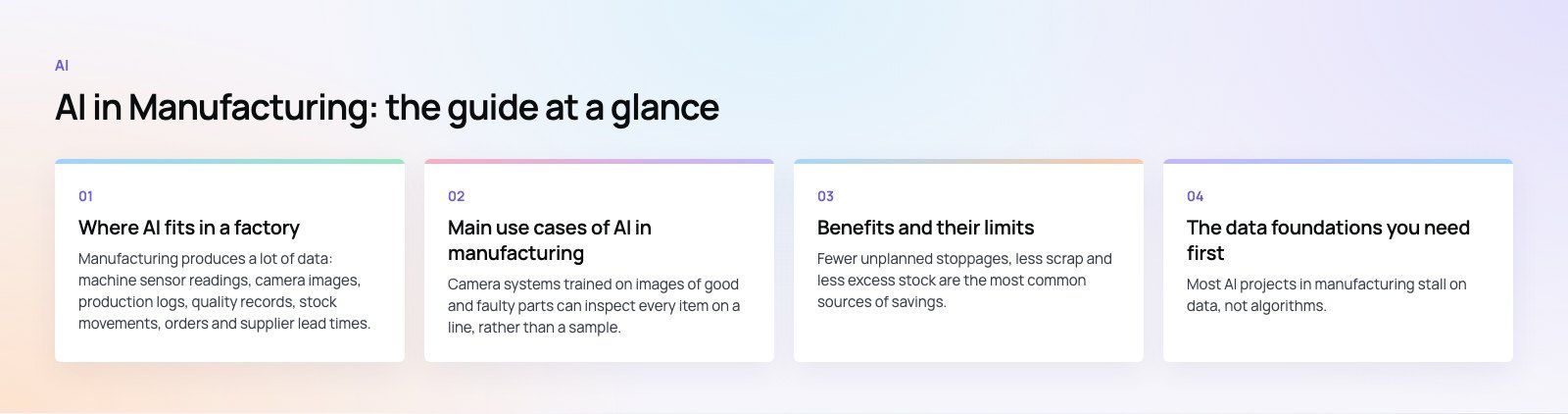
Where AI fits in a factory
Manufacturing produces a lot of data: machine sensor readings, camera images, production logs, quality records, stock movements, orders and supplier lead times. Most of it is collected and never used. AI is useful because it can find patterns across large volumes of this data faster than people can, and then turn those patterns into alerts, forecasts or decisions.
It helps to separate three kinds of AI you will hear about:
- Predictive models learn from history to forecast something: a failure, a demand level, a delivery delay.
- Computer vision analyzes images or video to find defects, count items or check safety.
- Generative AI works with text and documents: summarizing maintenance logs, answering questions about procedures, or drafting reports.
Main use cases of AI in manufacturing
| Use case | Data it needs | Typical benefit |
|---|---|---|
| Visual quality inspection | Labeled images of good and defective parts | Defects caught earlier and more consistently |
| Predictive maintenance | Sensor data and maintenance history | Fewer unplanned stoppages |
| Demand forecasting | Sales history, orders, seasonality, promotions | Better production and purchasing plans |
| Inventory optimization | Stock levels, lead times, consumption | Less excess stock and fewer shortages |
| Production scheduling | Orders, machine capacity, changeover times | Higher throughput from the same equipment |
| Logistics and routing | Shipments, routes, delivery times | Shorter transit times and lower fuel use |
| Worker safety | Camera feeds, incident records | Hazards flagged before incidents |
Quality control
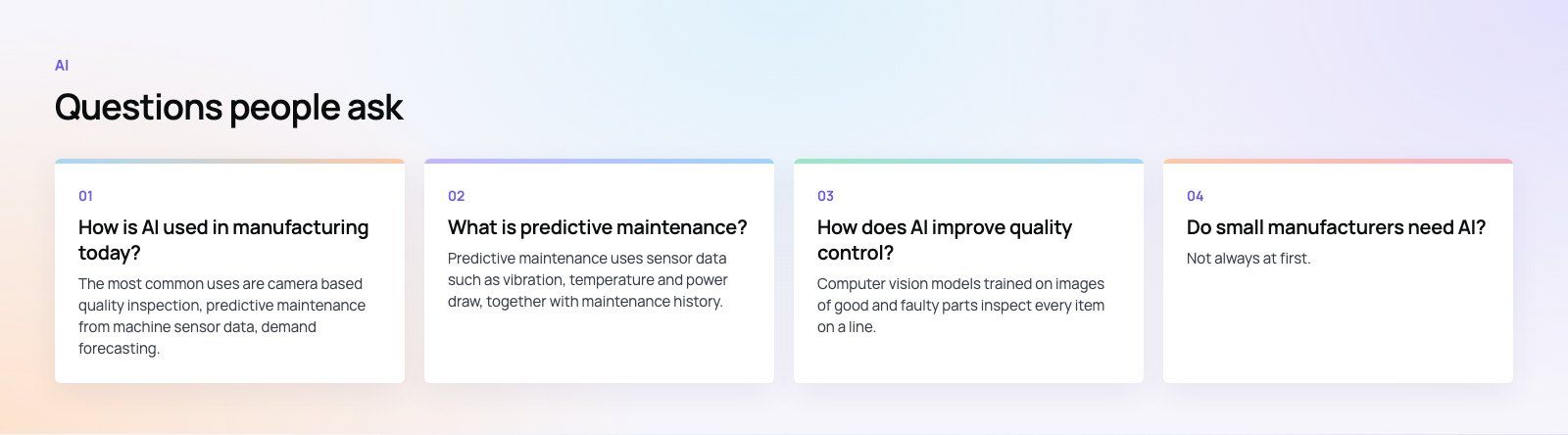
Camera systems trained on images of good and faulty parts can inspect every item on a line, rather than a sample. They flag scratches, misalignments, missing components or color variations, and the images build a record that helps engineers trace the cause. Vision systems need a steady supply of labeled examples, especially of rare defects, and they need retraining when products or lighting change.
Predictive maintenance
Traditional maintenance follows a fixed schedule or waits for a breakdown. Predictive maintenance uses sensor data such as vibration, temperature, pressure and power draw to spot the small changes that come before a failure. Engineers can then plan repairs during a planned stop instead of losing a shift. It works best on critical machines with good sensor coverage and a history of failures to learn from.
Demand forecasting and inventory
Forecasting models combine order history with seasonality, promotions and outside signals to predict demand by product and location. Better forecasts feed purchasing and stock decisions: reorder points can adjust automatically, and planners can see shortages coming. This only works when the ERP holds accurate stock records, which is why inventory accuracy is usually the first project.
Production planning and scheduling
Scheduling a factory means balancing orders, due dates, machine capacity, changeovers, materials and staff. Optimization and machine learning tools can test many more schedule options than a planner with a spreadsheet, and re plan quickly when a machine stops or a rush order arrives.
Logistics
For inbound materials and outbound goods, AI can suggest routes, estimate arrival times from past patterns and flag shipments likely to be late. That helps planners act before a delay reaches the production line or the customer.
Robots and automation
Robots for picking, assembly and moving materials increasingly use vision and learning to handle variation, such as parts in different positions. These projects involve hardware, safety engineering and integration, so they need longer planning than software only uses.
Benefits and their limits
Lower cost from less downtime and waste
Fewer unplanned stoppages, less scrap and less excess stock are the most common sources of savings. The size of the saving varies widely by plant, product and starting point, so set your own baseline before the project and measure against it.
More consistent quality
Automated inspection does not tire at the end of a shift. It applies the same standard to every item, and its records support root cause analysis.
Better planning
Forecasts and schedules that update with new data let teams react faster to changes in demand or supply.
The limits
- Data quality. Incomplete or inconsistent records produce unreliable models.
- Integration. Insights that do not reach the ERP, maintenance system or shop floor screens change nothing.
- Skills. Plants need people who understand both the process and the data.
- Upfront investment. Sensors, cameras, data platforms and integration work all come before the benefits.
- Trust. Operators need to understand why a model raises an alert, or they will ignore it.
The data foundations you need first
Most AI projects in manufacturing stall on data, not algorithms. Before you choose a model, check these foundations:
- Accurate master data. Items, bills of materials, routings and locations defined consistently in your ERP.
- Reliable transactions. Stock movements, production orders and quality results recorded when they happen.
- Connected machines. Sensor and machine data collected with timestamps and linked to assets.
- A shared data store. Data from ERP, maintenance, quality and machines brought together for analysis.
- Reporting people use. Dashboards that show current performance, so improvements can be measured.
Business systems such as Business Central, Dynamics 365 or Odoo hold much of this data, and tools such as Power BI make it visible before any AI is added.
How to start an AI project in manufacturing
- Pick one painful problem. A machine that fails often, a defect that reaches customers, or stock that is always short. Define how you will measure improvement.
- Check the data. Confirm you have enough history, of good enough quality, for that problem.
- Run a focused pilot. One line, one machine type or one product family, for a fixed period.
- Put results where people work. Alerts in the maintenance system, forecasts in the ERP, inspection results on the line screen.
- Measure and decide. Compare with the baseline. Scale what works and stop what does not.
- Govern the models. Monitor accuracy over time, retrain when processes change, and manage risk. The NIST AI Risk Management Framework is a useful reference for this.
A product scoping session can turn a use case into a clear pilot plan with data sources, integrations and success measures.
Common mistakes
- Starting with the technology instead of a business problem.
- Running pilots that never connect to production systems.
- Underestimating the work of labeling images and cleaning data.
- Leaving operators and maintenance teams out of the design.
- Treating a model as finished once it is deployed.
AI can make factories more reliable and better planned, but only on top of accurate data and connected systems. If you are preparing for it, our custom software team builds the integrations, dashboards and AI features that turn plant data into decisions. Manufacturers in the vehicle and parts sector can also see our automotive industry page.
Frequently asked questions
The most common uses are camera based quality inspection, predictive maintenance from machine sensor data, demand forecasting, inventory optimization and production scheduling.
Generative AI is also used to search manuals and summarize maintenance records. Most successful projects target one specific problem, use data the plant already collects, and feed results into existing systems such as the ERP or maintenance software.
AIPredictive HR Analytics: How to Forecast Workforce TrendsHow predictive HR analytics forecasts hiring, turnover and skills needs, how to start with your own data, and when to build a custom tool or buy one. AIHow Dubai Police Uses AI to Improve Public ServicesHow Dubai Police uses AI for minor accident reports, vehicle history checks and the Amna virtual officer, and what UAE businesses can learn from it.
 AIHow to Add a Chatbot to Your Website in 5 StepsAdd a chatbot to your website in five steps: choose its job, set KPIs, map users and flows, build and install the script, then target and improve it.
Tell us what the business needs. We will tell you what to build first.
Schedule a free consultation and get a written recommendation, with costs, before you commit to anything.
Get in touchPROVEN RESULTS
4.7 / 5verified reviews on Google