 AIPredictive HR Analytics: How to Forecast Workforce TrendsHow predictive HR analytics forecasts hiring, turnover and skills needs, how to start with your own data, and when to build a custom tool or buy one.
AI vs Machine Learning: What Is the Difference?
AI is the broad field; machine learning is the part that learns from data. A plain guide to the difference, deep learning, generative AI and business uses.
Artificial intelligence (AI) is the broad field of building systems that perform tasks we associate with human intelligence, such as understanding language, recognizing images and making decisions. Machine learning (ML) is a subset of AI in which systems learn patterns from data instead of following rules written by hand. Put simply, all machine learning is AI, but not all AI is machine learning.
The two terms are often used as if they mean the same thing. This guide explains the difference in plain language, where deep learning and generative AI fit, how the main types of ML work, and how a business can tell which approach a problem actually needs.
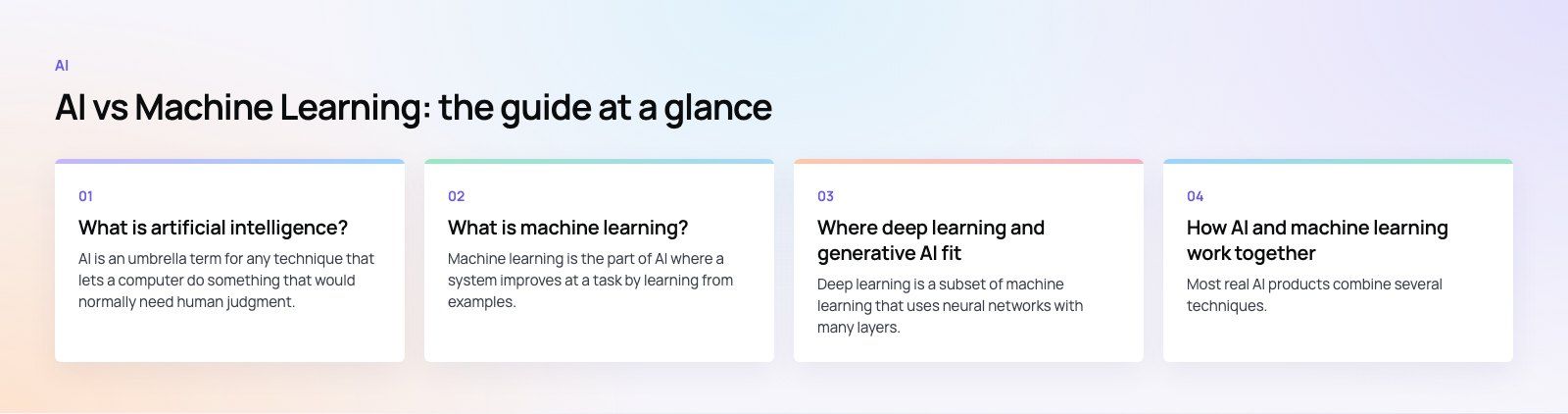
What is artificial intelligence?
AI is an umbrella term for any technique that lets a computer do something that would normally need human judgment. That includes approaches that do not learn at all. A rules based system that approves expense claims under certain conditions, or a chess program that searches through possible moves, can both be called AI.
AI is often described in three levels:
- Narrow AI: systems built for specific tasks, such as translation, fraud detection, speech recognition or product recommendations. Every AI system in commercial use today is narrow AI, including large language models, even though they handle a wide range of language tasks.
- General AI (AGI): a hypothetical system that could learn and perform any intellectual task a person can. It does not exist yet, and researchers disagree on when or whether it will.
- Superintelligence: a further hypothetical stage where AI would surpass human ability across every domain.
What is machine learning?
Machine learning is the part of AI where a system improves at a task by learning from examples. Instead of a developer writing "if the email contains these words, mark it as spam", an ML model is shown thousands of emails labeled spam or not spam and learns the patterns itself. When new emails arrive, it applies what it learned.
The quality of an ML system therefore depends heavily on the quality, quantity and relevance of its data. Google's Machine Learning Crash Course is a good free primer if you want to go deeper into how models are trained and evaluated.
The three main types of machine learning
- Supervised learning: the model learns from labeled examples, where both the input and the correct answer are known. Used for spam filters, credit risk scoring, demand forecasting and image classification.
- Unsupervised learning: the model looks for structure in data without labels. Used for customer segmentation, grouping similar products and spotting unusual activity.
- Reinforcement learning: the model learns by trial and error, receiving rewards or penalties for its actions. Used in robotics, game playing, some recommendation systems and in fine tuning language models.
Common machine learning algorithms
- Linear and logistic regression: simple, explainable models for predicting a number or a yes or no outcome.
- Decision trees and tree ensembles: models such as random forests and gradient boosting that split data by questions; strong on business data in tables.
- Clustering algorithms: such as k-means, for grouping similar records.
- Neural networks: layers of connected units, loosely inspired by the brain, that can learn very complex patterns in images, audio and text.
Where deep learning and generative AI fit
Deep learning is a subset of machine learning that uses neural networks with many layers. It powers modern speech recognition, image recognition and translation, and it needs large amounts of data and computing power.
Generative AI is a use of deep learning in which models create new content: text, images, code, audio or video. Large language models behind chat assistants are generative AI. So the nesting looks like this: AI contains machine learning, machine learning contains deep learning, and generative AI is built on deep learning.
AI vs machine learning: the key differences
| Aspect | Artificial intelligence | Machine learning |
|---|---|---|
| Scope | The whole field of making machines act intelligently | One approach within AI |
| How it works | Rules, search, logic, learning or a mix | Learns patterns from data |
| Goal | Perform tasks that need human like judgment | Make accurate predictions or decisions from data |
| Data needs | Varies; rules based AI may need little data | Needs relevant, good quality data to train |
| Behavior over time | Fixed unless rules are changed | Can improve as it is retrained on new data |
| Examples | Chess engines, expert systems, chat assistants | Spam filters, fraud scoring, demand forecasts |
How AI and machine learning work together
Most real AI products combine several techniques. A self driving system, for example, uses ML models to recognize pedestrians, signs and other vehicles, then combines those predictions with rules and planning logic to decide when to brake or steer. A customer service assistant may use a language model to understand a question, a search system to find the right policy, and fixed rules to decide when to hand over to a person.
In other words, ML usually supplies the perception and prediction, and the wider AI system decides what to do with those predictions.
Applications across industries
- Finance and payments: fraud detection, credit risk scoring, transaction categorization and anti money laundering monitoring.
- Retail and e-commerce: product recommendations, search ranking, demand forecasting and dynamic merchandising.
- Healthcare: support for reading medical images, triage tools and administrative automation, always alongside clinicians.
- Manufacturing: predictive maintenance and visual quality inspection.
- Customer service: chat assistants, ticket routing and sentiment analysis.
- Transportation and logistics: route optimization, delivery time prediction and traffic management.
Does your business need AI, machine learning or neither?
A useful way to decide is to look at the problem, not the technology.
- Can the logic be written as clear rules? If yes, ordinary software or workflow automation is cheaper, faster and easier to explain. Many "AI" requests turn out to be automation problems.
- Is there a pattern hidden in historical data? Predicting churn, demand or fraud from past records is a classic machine learning problem, provided you have enough clean, relevant data.
- Is the task about language or content? Summarizing documents, drafting replies or searching a knowledge base often suits a generative AI model, usually combined with your own data and clear guardrails.
- What happens when it is wrong? High stakes decisions need human review, audit trails and explainable models.
- Who will maintain it? Models drift as data changes and need monitoring and retraining. Budget for that from the start.
One issue we often see is a business starting with the model rather than the data. If records are scattered across spreadsheets and disconnected systems, the first and most valuable step is usually integrating and cleaning that data, which also improves ordinary reporting.
Putting AI to work in your business
Codeeo's team of 80+ across Dubai, Riyadh and Karachi builds custom software and mobile apps, and connects business data through Azure integration and Power BI so it is ready for analytics and AI. If you are not sure whether your idea needs machine learning, rules or plain automation, a product scoping session will help you decide before you spend on a model.
Frequently asked questions
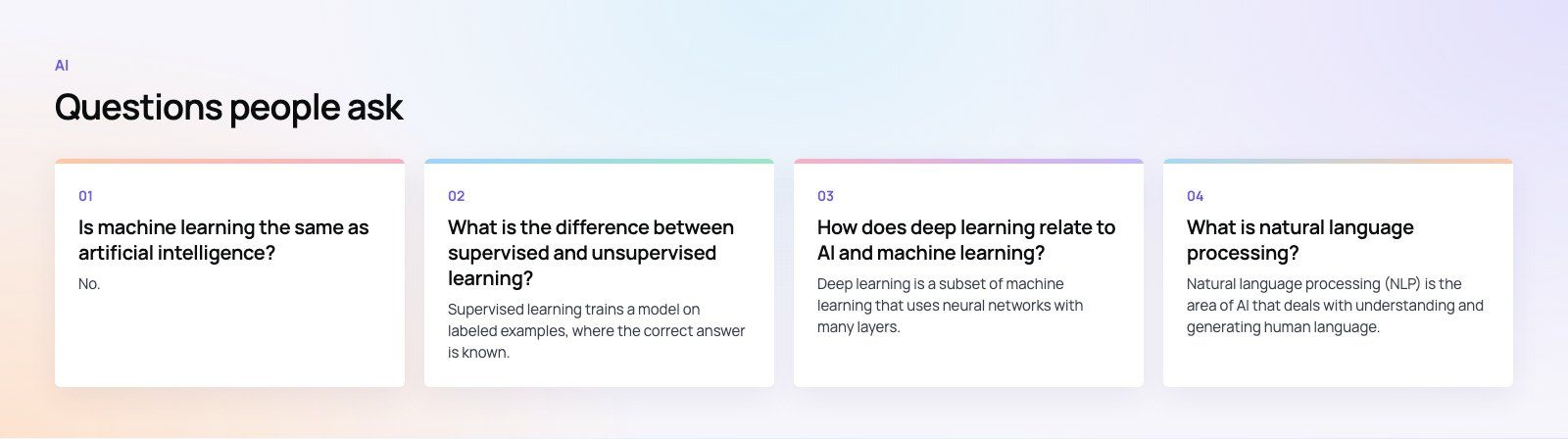
No.
Artificial intelligence is the broad field of making machines perform tasks that need human like judgment. Machine learning is one approach within AI, where systems learn patterns from data rather than following hand written rules. All machine learning counts as AI, but some AI, such as rules based expert systems or search algorithms, involves no learning at all.
AIPredictive HR Analytics: How to Forecast Workforce TrendsHow predictive HR analytics forecasts hiring, turnover and skills needs, how to start with your own data, and when to build a custom tool or buy one. AIHow Dubai Police Uses AI to Improve Public ServicesHow Dubai Police uses AI for minor accident reports, vehicle history checks and the Amna virtual officer, and what UAE businesses can learn from it.
 AIHow to Add a Chatbot to Your Website in 5 StepsAdd a chatbot to your website in five steps: choose its job, set KPIs, map users and flows, build and install the script, then target and improve it.
Tell us what the business needs. We will tell you what to build first.
Schedule a free consultation and get a written recommendation, with costs, before you commit to anything.
Get in touchPROVEN RESULTS
4.7 / 5verified reviews on Google