 App DevelopmentCross Platform App Development: How It Saves Time and MoneyHow shared code across iOS and Android cuts build and maintenance effort, which frameworks to consider in 2026, and when native development is still the better call.
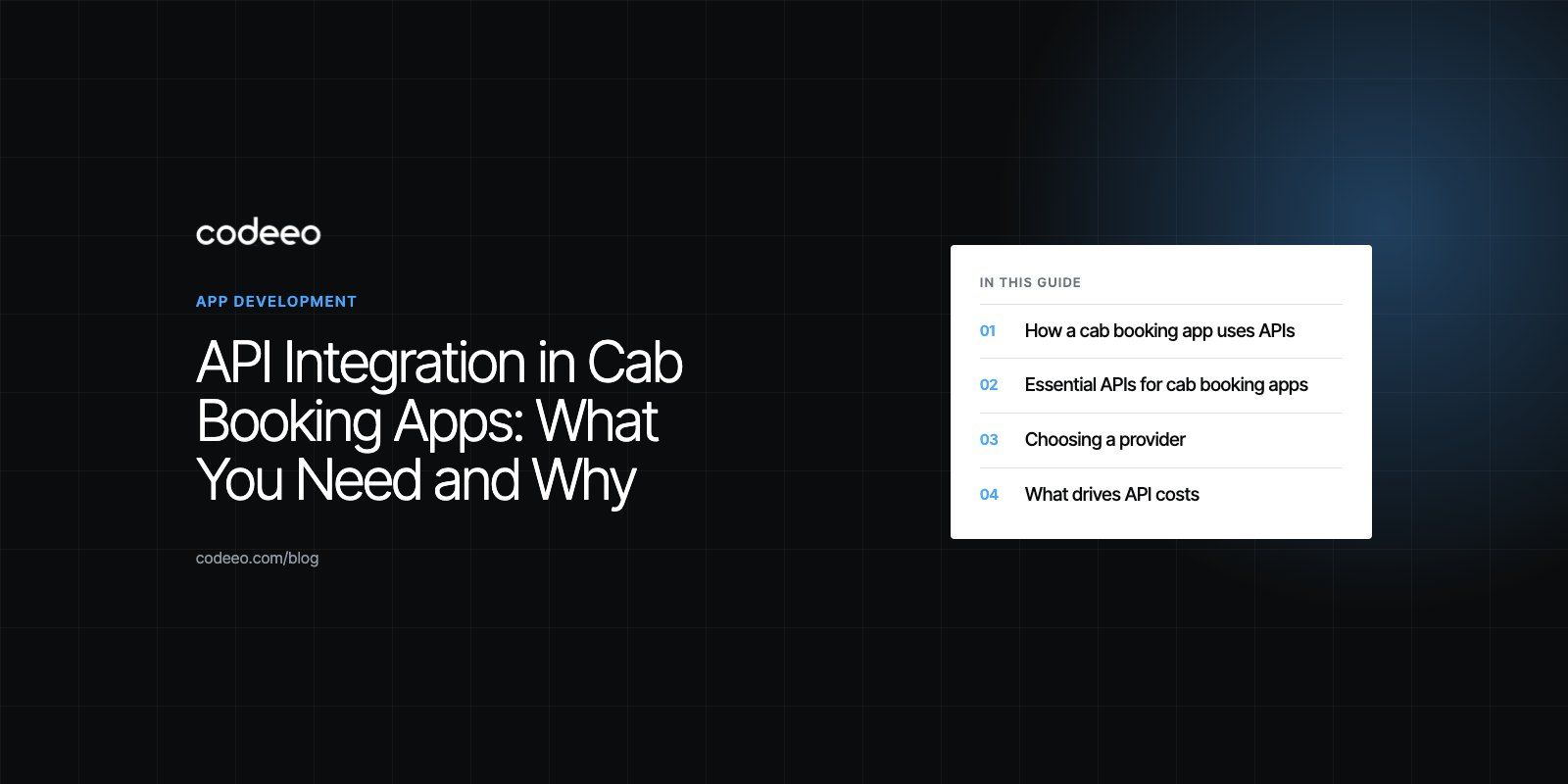
API Integration in Cab Booking Apps: What You Need and Why
The API integrations a cab booking app needs, from geocoding and routing to real time tracking and payments, plus provider choice, costs and common mistakes.
A cab booking app depends on a small set of API integrations: maps and geocoding to find riders and destinations, routing and distance calculations to estimate arrival times and fares, real time location to track drivers, and payments to settle the trip. Choosing current versions of these APIs and integrating them carefully decides whether the app feels instant and trustworthy or slow and unreliable.
This guide walks through each integration a ride hailing or taxi booking app needs, what it does, the common mistakes, and how to keep usage costs under control as trips grow.
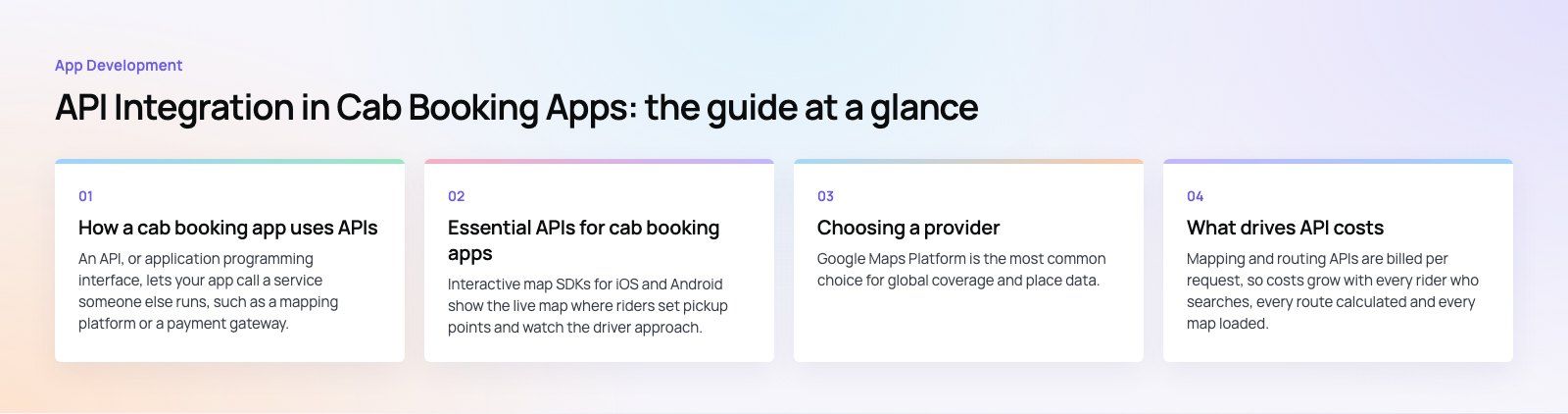
How a cab booking app uses APIs
An API, or application programming interface, lets your app call a service someone else runs, such as a mapping platform or a payment gateway, instead of building it yourself. A single ride touches many of them in sequence:
- The rider types a pickup and destination, and a places or geocoding API turns text into coordinates.
- A distance matrix call finds which nearby drivers can arrive fastest.
- A routing API calculates the trip path, duration and distance for the fare estimate.
- Real time location updates move the driver's car across the rider's map.
- Push notifications and SMS confirm the booking and announce arrival.
- A payment API charges the card or wallet when the trip ends, and issues refunds if needed.
Each step is a separate integration with its own limits, latency and billing, so the architecture matters as much as the choice of provider.
Essential APIs for cab booking apps
1. Maps and static maps
Interactive map SDKs for iOS and Android show the live map where riders set pickup points and watch the driver approach. Static map APIs return a simple image of a map with markers and a route line. Static maps are lighter and cheaper to render, which makes them a good fit for trip receipts, ride history and email confirmations where nobody needs to pan or zoom.
2. Geocoding and place search
Geocoding converts an address or place name into latitude and longitude, and reverse geocoding turns coordinates back into a readable address. Place autocomplete suggests locations as the rider types. Together they make sure "the mall on the main road" becomes an exact pickup point. Accurate geocoding reduces calls between riders and drivers trying to find each other.
3. Routing and directions
A routing API calculates the path between two or more points, with travel time that reflects traffic. Drivers use it for turn by turn navigation, and your backend uses it to estimate arrival times and trip length. If you build on Google Maps Platform, note that the older Directions API is now in legacy status, and Google points new projects to the Routes API. Starting a new app on a legacy service creates a migration job you do not need.
4. Distance matrix
A distance matrix calculates travel time and distance between many origins and many destinations in one request. Dispatch logic uses it to rank nearby drivers by real arrival time rather than straight line distance, which is often misleading in cities with one way streets and highways. On Google Maps Platform, the older Distance Matrix API is also legacy, and the Routes API's Compute Route Matrix method replaces it.
5. Real time location and messaging
Driver tracking needs a channel that pushes location updates from the driver app to your server and on to the rider several times a minute. This is usually built with WebSockets or a managed real time database rather than repeated HTTP polling. Throttle updates sensibly: too frequent drains phone batteries and inflates server costs, too infrequent makes the car jump across the map.
6. Payments
A payment API lets riders pay by card, digital wallet or other local methods, stores cards securely as tokens so your servers never handle raw card numbers, and supports refunds, tips and split fares. Ride apps typically authorize an estimated amount at booking and capture the final fare after the trip, which protects against unpaid rides. Payouts to drivers are a separate flow that needs its own reconciliation. Careful payment integration covers failed payments, retries and disputes, not just the happy path.
7. Notifications, SMS and identity
Push notification services for iOS and Android announce driver assignment and arrival. SMS APIs send one time passwords for sign in and fall back when push fails. Number masking APIs let riders and drivers call each other without revealing personal phone numbers, which is now an expected safety feature.
Choosing a provider
Google Maps Platform is the most common choice for global coverage and place data. Mapbox and HERE are established alternatives, and some apps mix providers, for example one for map display and another for routing. Compare them on these points:
| Factor | Why it matters for ride hailing |
|---|---|
| Map and address coverage in your cities | Poor local data means wrong pickups and longer waits |
| Traffic aware routing | Arrival times and fares depend on real traffic, not distance alone |
| Matrix limits per request | Dispatch needs many driver to rider comparisons at once |
| Pricing model and free tiers | Costs scale with every search, route and map load |
| Terms of use | Some providers restrict caching results or mixing their data with other maps |
| Product status | Avoid building on services marked legacy or deprecated |
What drives API costs
Mapping and routing APIs are billed per request, so costs grow with every rider who searches, every route calculated and every map loaded. The biggest drivers are autocomplete requests on every keystroke, repeated route calculations during a single trip, large distance matrix calls in dispatch, and dynamic map loads where a static image would do. Practical controls include session based autocomplete, debouncing input, caching geocoded addresses where the provider's terms allow it, limiting matrix calls to the nearest few drivers, and setting budget alerts in the provider console.
Common integration mistakes
- Calling APIs directly from the app with unrestricted keys. Keys can be extracted and abused. Restrict keys by app and API, and route sensitive calls through your backend.
- No fallback when a service fails. If routing times out, show a distance based estimate rather than a blank screen.
- Ignoring battery and data use. Aggressive GPS polling on the driver app causes complaints and uninstalls.
- Treating payments as a single call. Real payment flows include authorization, capture, refunds, chargebacks and payouts.
- Building on legacy APIs. Check each service's status page before you start, not after launch.
Planning the build
A cab booking product is really three apps: the rider app, the driver app and an admin panel for dispatch, pricing rules, support and reporting. Plan the API layer once and share it across all three. Start with a narrow launch area, measure arrival accuracy and API spend per trip, and tune dispatch before expanding to new cities.
Related products share much of this architecture. Our JobIQ case study covers a marketplace where customers book a technician and the platform handles chat, dispatch and payment, and Teachers Lunch covers a customer app, a rider app and an admin that sees the whole day. See more of our work for marketplaces and on demand services.
Codeeo has delivered 200+ projects across the UAE and the US with a team of 80+ across Dubai, Riyadh and Karachi. If you are planning a ride hailing or booking app, our mobile app development team can help you design the integrations and build the rider, driver and admin apps.
Frequently asked questions
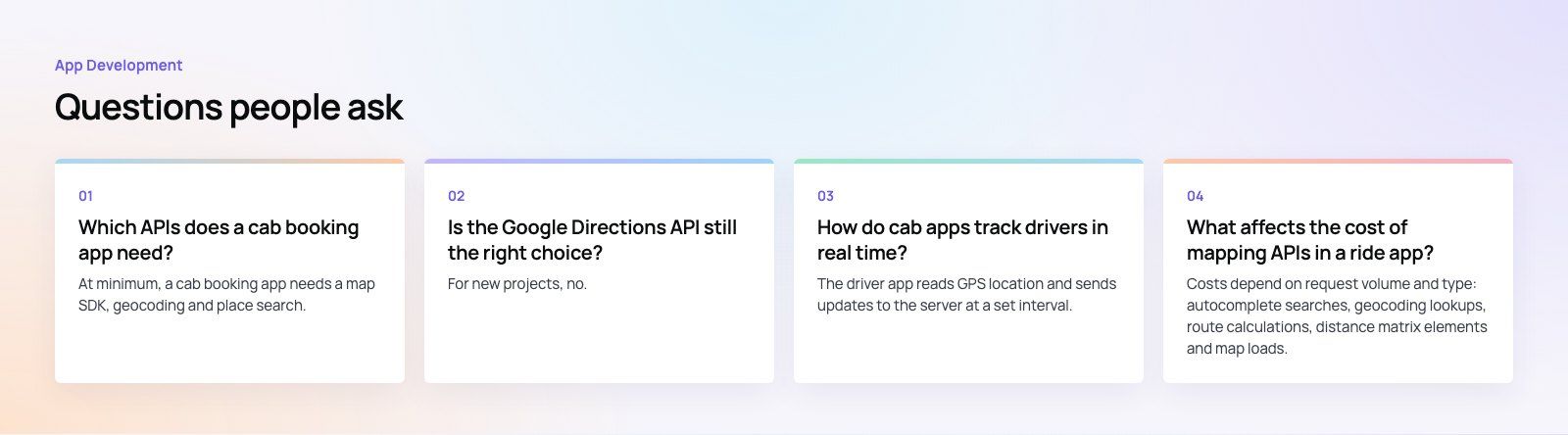
At minimum, a cab booking app needs a map SDK, geocoding and place search, a routing API for trip paths and arrival times, a distance matrix for dispatch, a real time location channel for driver tracking, a payment API, push notifications and SMS for one time passwords. Many apps also add number masking so riders and drivers can call each other privately.
App DevelopmentCross Platform App Development: How It Saves Time and MoneyHow shared code across iOS and Android cuts build and maintenance effort, which frameworks to consider in 2026, and when native development is still the better call. App DevelopmentHow to Plan an App Development Project From Start to FinishA step by step plan for an app project: define users and goals, scope an MVP, choose platforms, design, build the team, phase the timeline, test and launch.
 App DevelopmentMust Have Features of an HR Management AppThe features an HR management app needs, from onboarding and self service to payroll, performance and analytics, plus when to buy or build.
Tell us what the business needs. We will tell you what to build first.
Schedule a free consultation and get a written recommendation, with costs, before you commit to anything.
Get in touchPROVEN RESULTS
4.7 / 5verified reviews on Google